


French Neoclassical Table
A french neoclassical table brings architectural symmetry and refined proportion into a room, offering a distinct sense of classical restraint.
Identifying the French Neoclassical Table
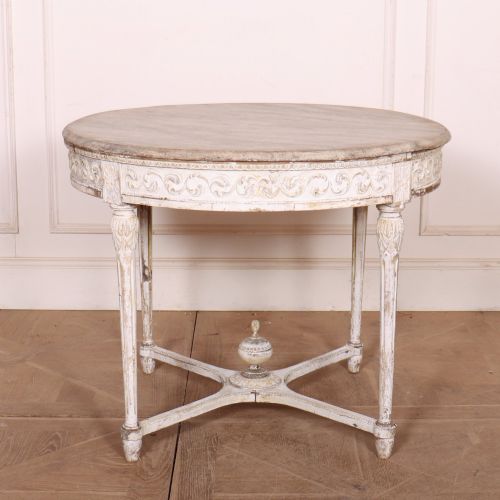
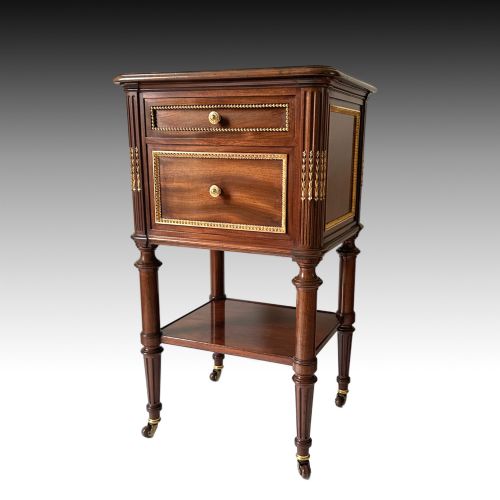
When you search for a french neoclassical table, you encounter formal forms designed to echo the classical antiquity of Greece and Rome. These pieces include console tables, display tables, side tables, centre tables, occasional tables, and gueridon tables.
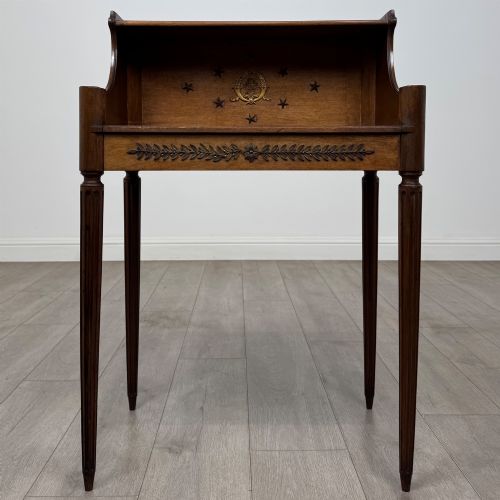
The most common versions met on this page belong to the nineteenth century, including pieces reflecting Louis XVI revival and French Empire styles, alongside mid-twentieth century interpretations.
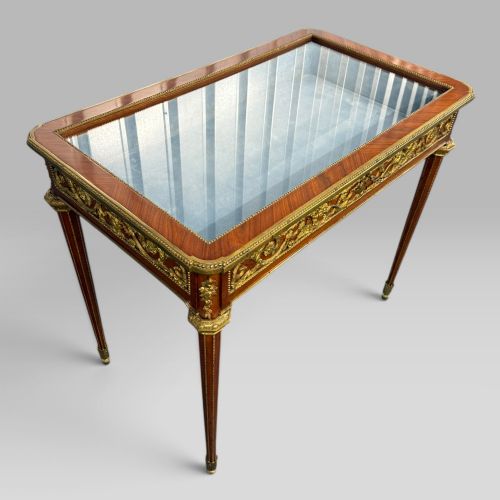
Makers and workshops of the period drew heavily on classical vocabularies, producing heavy architectural console tables with granite tops alongside lighter mahogany centre tables and glazed bijouterie display tables.
Materials and Construction
Cabinet makers utilised dense timbers such as mahogany and oak as the foundational structure for these tables, often shaping the timber by hand to achieve traditional forms.
Surfaces frequently feature heavy slabs of black marble or granite fitted neatly into the wooden framing, while decorative accents rely on cast and chased ormolu and brass mounts.
Retail Price Guide 2026
Typical UK retail prices for french neoclassical table, calculated from the Sellingantiques database of over a million retail prices indexed since 2003. This retail price guide relies exclusively on Sellingantiques data; no external sources or auction records are used, so the figures do not describe the wider market.
Listings span the nineteenth and twentieth centuries, incorporating mahogany, oak, marble, granite, glass, brass, and ormolu.
Judging Quality and Execution
Quality separates in the crispness of the hand-carved wooden details and the precision with which ormolu mounts are fitted to the timber carcass.
The choice of stone also dictates grade, where thick, deeply figured marble or polished granite tops demonstrate superior ambition compared to simpler timber surfaces.
François Linke·Henry Dasson
The French Neoclassical Table Glossary
- Gueridon
- A small round table supported by a central pillar or a number of legs. These originated in the seventeenth century and often feature marble tops.
- Bijouterie table
- A glass-topped display table specifically designed for showing small valuable objects or jewellery. They typically feature hinged glazed lids.
- Ormolu
- Gilded bronze applied to furniture as decorative mounts and feet. The process involves mercury gilding on bronze casting.
- Console table
- A table designed to be fixed against a wall, traditionally supported by two front legs with the rear secured to the masonry. They frequently carry heavy stone tops.
- Louis XVI Revival
- A nineteenth-century decorative style inspired by the furniture of the French court before the revolution. It emphasises straight lines, classical motifs, and restrained symmetry.
Frequently Asked Questions
What is a gueridon table?
A gueridon is a distinct round table typically supported by a central column or pillar.
They frequently incorporate stone surfaces such as black marble.
How were console tables used?
Console tables were traditionally placed flat against a wall in formal reception rooms.
Their heavy granite or marble tops provided sturdy surfaces for decorative objects.
What is a bijouterie table?
A bijouterie table is a specialised display piece featuring glass panels.
They were utilised for exhibiting small treasures and personal collections.
How to spot Empire style?
Empire pieces draw directly on Roman and Greek military and architectural motifs.
They often combine dark mahogany with bright ormolu mounts.