
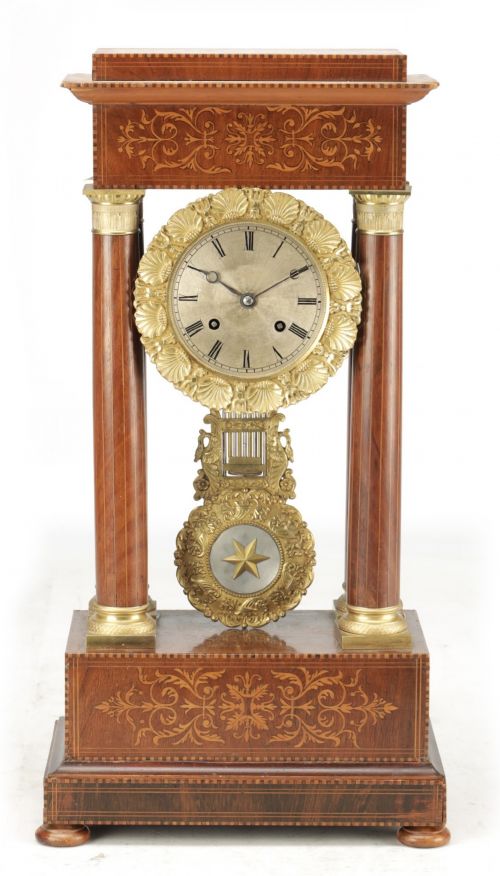
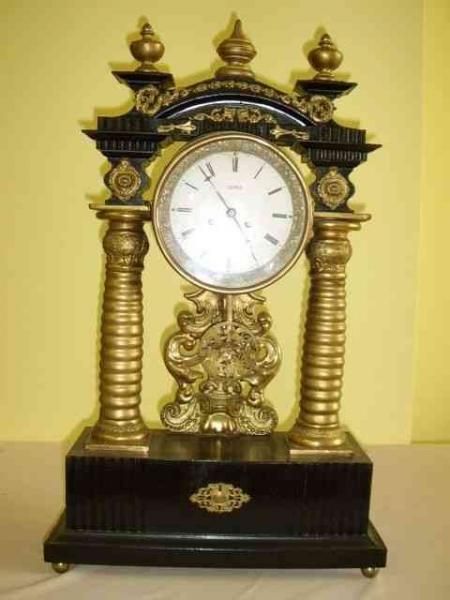
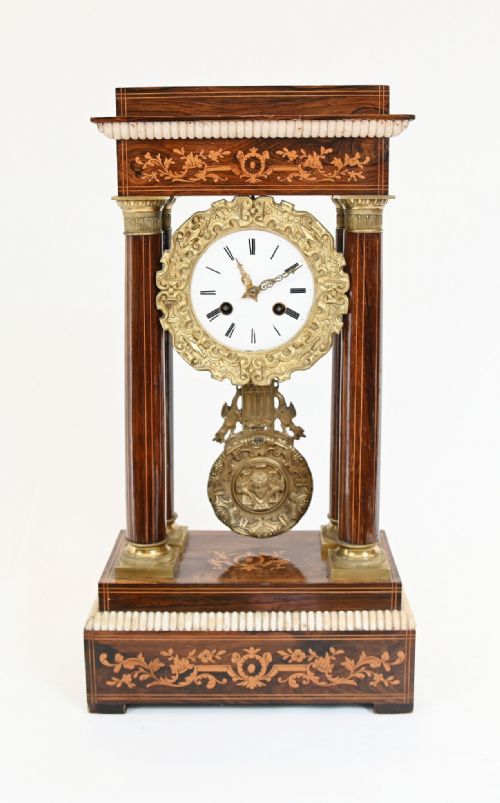
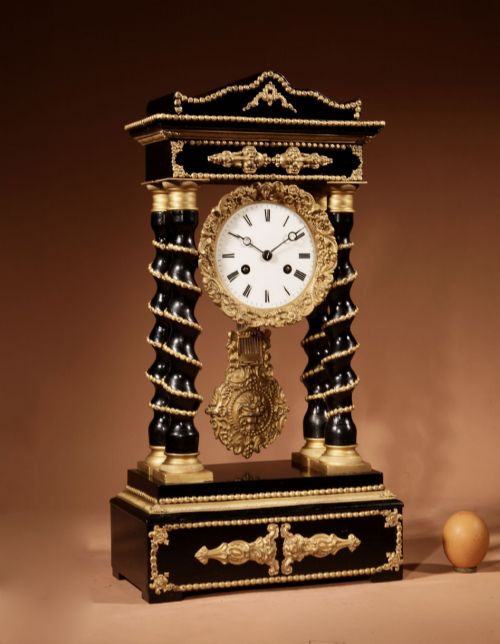


French Empire Portico Clock
A french empire portico clock brings architectural columns, gilt bronze, and precision movement into a room with striking classical presence.
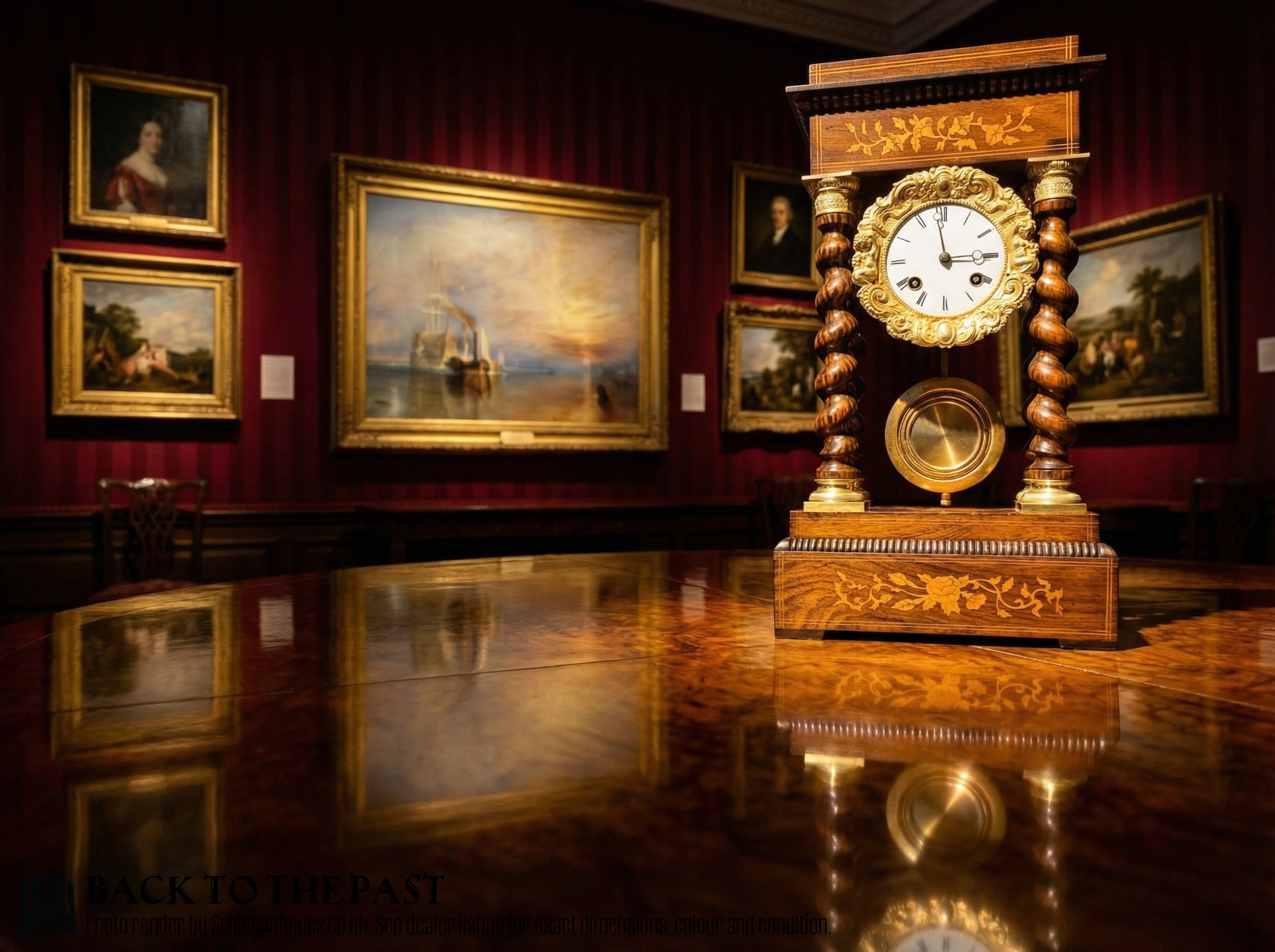
French Empire Portico Clock
The french empire portico clock stands as a distinguished architectural form of timekeeper defined by twin side columns supporting a classical entablature above the dial. Such pieces emerge across the nineteenth century, drawing upon French Empire, Charles X, and Victorian periods.
Buyers most frequently encounter examples featuring upright wooden frameworks in rosewood, mahogany, or ebonised finishes, often flanked by polished stone and metal mounts. These architectural clocks range from simple timepiece movements to complex musical or mystery arrangements housed under glass domes.
Materials and construction
Craftsmen built the structural columns and bases using dense cabinet timbers like rosewood, mahogany, and ebonised wood, frequently enhanced with contrasting satinwood inlay or marble plinths. This wooden framework supports the heavy movement suspended within the central arch.
Gilt bronze, ormolu, and brass provide the ornamental capitals, bezels, and pendulum bobs, while enamel and silvered metal form the legible dial faces. Cut crystal glass components and protective glass domes complete the traditional assembly of these architectural timepieces.
French Empire Portico Clock Retail Price Guide 2026
Typical asking prices for french empire portico clock among the pieces listed under this phrase on Sellingantiques today, from the lower quarter to the upper quarter. They describe what is for sale here now, not the wider market.
Some of these architectural timekeepers incorporate hidden musical boxes and mystery arrangements designed to bewilder guests who wonder how the hands move.
Factors of quality and execution
The precision and complexity of the movement separate standard examples from exceptional pieces, particularly when single fusee, musical, or table regulator mechanisms are employed. Superior work shows in the crispness of the knife edge suspension and the delicate engraving of the dial.
The depth and quality of the fire gilding upon the ormolu mounts dictate the visual richness of the facade. Furthermore, the selection of timber veneers and the exact alignment of the marble and cut crystal columns define the architectural integrity of the clock.
Breguet·Baltazart
The French Empire Portico Clock Glossary
- Portico clock
- An architectural clock design featuring vertical columns supporting a lintel and entablature that frame a central suspended pendulum. This classical layout derives from ancient Greek and Roman building styles.
- Ormolu
- Gilded bronze produced by applying a mixture of gold and mercury to a bronze base and firing it. This technique creates a durable, warm metallic lustre characteristic of luxury French metalwork.
- Charles X
- A French design period spanning the 1820s characterised by refined neoclassical restraint and lighter wood tones. Pieces from this era often balance rich gilt mounts with figured mahogany or rosewood.
- Fusee
- A conical pulley used in clock movements to equalise the driving force of the mainspring as it unwinds. This mechanism ensures consistent timekeeping accuracy throughout the running period.
- Clock garniture
- A matching set consisting of a central mantel clock accompanied by side ornaments such as urns or candelabra. These matched groupings create a balanced decorative display on a mantelpiece.
French Empire Portico Clock: Frequently Asked Questions
How do I wind a portico clock?
Wind the clock using the appropriate key inserted into the dial winding holes, turning gently until you feel resistance. Take care not to overwind the mainspring to preserve the historic mechanism.
Ensure you regulate the pendulum correctly after winding to maintain accurate timekeeping. Modern placement should remain on a stable, level surface away from vibrations.
Where should I place a portico clock?
Position the clock on a sturdy mantelpiece, console table, or desk where its architectural columns and glass domes can be safely admired. Avoid areas exposed to direct sunlight or fluctuating humidity to protect the wood and gilding.
Because many examples feature delicate glass domes or suspended movements, a low shelf away from heavy household traffic is ideal for daily enjoyment.
How do I identify a Charles X portico clock?
Look for lighter cabinet woods, cleaner neoclassical lines, and restrained ormolu mounts that distinguish Charles X pieces from earlier Empire designs. The dial layout and architectural proportions often reflect a transition toward simpler elegance during the 1820s.
Checking for original inlay work in satinwood or rosewood alongside traditional pendulum suspensions helps confirm the period execution of the piece.
Are these clocks kept in working order?
Many examples retain functional movements, often featuring anchor escapements or knife edge suspensions that drive the pendulum successfully. Working status depends on professional servicing and the preservation of the original internal components.
Buyers should verify movement descriptions carefully to determine whether a piece operates as a striking clock, a simple timepiece, or a table regulator.