


Rosewood Portico Clock
A rosewood portico clock is a architectural timepiece of striking symmetry, combining rich timber with polished metal to anchor a mantelpiece.
Understanding the rosewood portico clock
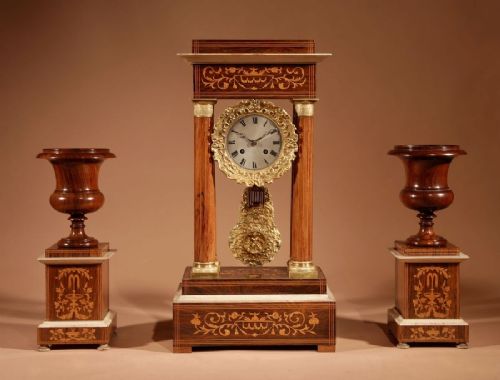
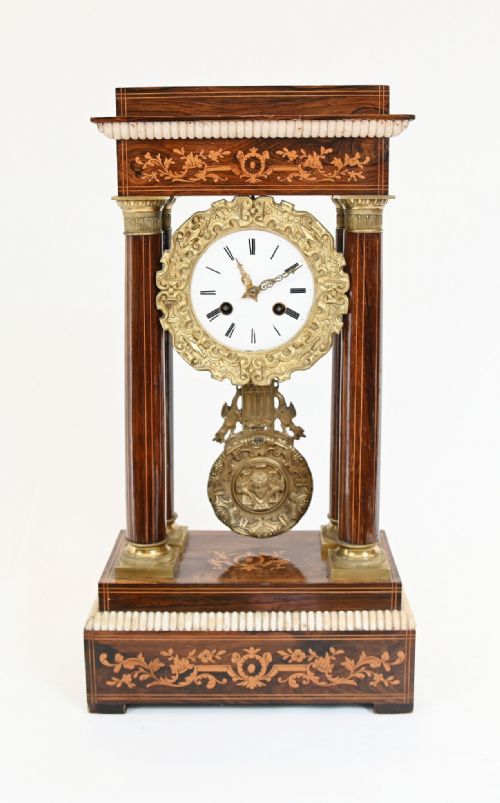
A rosewood portico clock presents an architectural columned case designed to frame a central pendulum bob. You will most frequently meet French examples dating through the nineteenth century, spanning periods from Charles X and Louis Philippe to Napoleon III.
The form relies on four upright pillars supporting an upper entablature above a base plinth. These mantel clocks bridge decorative cabinetry and mechanical horology, often appearing with matching garnitures.
Materials and construction
Timbers such as rosewood provide a dark, figured carcase that is frequently contrasted with lighter stringing of lemonwood, satinwood, or boxwood inlay. Ormolu, gilt bronze, and brass mounts accent the columns, bezels, and pendulum apertures.
Clockmakers housed movements behind enamel dials, protecting the escapement within balanced wooden frames. Cabinetmakers utilised precise jointing to maintain the structural alignment of the vertical pillars.
Retail Price Guide 2026
Typical UK retail prices for rosewood portico clock, calculated from the Sellingantiques database of over a million retail prices indexed since 2003. This retail price guide relies exclusively on Sellingantiques data; no external sources or auction records are used, so the figures do not describe the wider market.
Listings demonstrate rosewood portico clocks spanning the nineteenth century, incorporating lemonwood inlay, ormolu mounts, and enamel dials across French regional styles.
Assessing quality
Quality rests in the crispness of the timber inlay and the weight of the gilt bronze or ormolu mounts. Finer pieces demonstrate careful grain matching across the flat plinths and column shafts.
The sophistication of the dial design and the precision of the brass work distinguish standard production pieces from more ambitious cabinet work.
The Rosewood Portico Clock Glossary
- Portico clock
- A mantel clock styled with architectural columns supporting a top pediment. This design creates a central void for a visible swinging pendulum.
- Ormolu
- Gilt bronze mounted onto furniture and clock cases. The technique involves applying a mercury and gold amalgam to bronze.
- Garniture
- A set of matching decorative objects displayed alongside a clock. These usually comprise side vases or candelabra executed in matching materials.
- Escapement
- The internal mechanism that controls the release of gear trains to regulate timekeeping. It interacts directly with the pendulum.
Frequently Asked Questions
How do I wind my portico clock?
Most nineteenth-century mechanical movements require a key applied to winding squares on the enamel dial. Turn the key gently until resistance is felt, taking care not to overwind the spring.
Ensure you match the correct key size to avoid damaging the square arbor. Regular gentle winding maintains proper tension within the movement.
Where should I place a portico clock?
Position the clock on a stable mantelpiece or flat surface away from direct sunlight and draughts. A level foundation is essential for the pendulum to beat evenly.
Because rosewood is sensitive to extreme humidity changes, keep the clock away from active radiators or open fires.
How do I date a rosewood portico clock?
Examine the style of the wood inlay, column capitals, and dial numerals to indicate whether the piece originates from the Charles X, Louis Philippe, or Napoleon III eras. Construction methods inside the case also provide clues.
Archival comparison with nineteenth-century French models helps narrow down the decade of manufacture.
Why does the clock keep losing time?
Clocks often lose time when the pendulum suspension spring is displaced or the beat is out of adjustment. Slight movement of the case on its shelf can disrupt the tick.
Adjustment nuts on the pendulum rod allow you to regulate the speed by raising or lowering the bob.