



Empire Style Accent Chairs
Empire style accent chairs bring neoclassical severity and gilded grandeur to a room, offering commanding silhouettes that anchor a seating arrangement.
Empire Style Accent Chairs
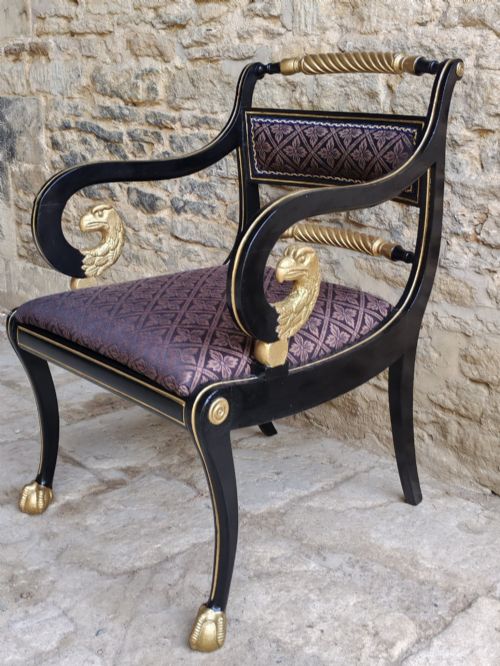
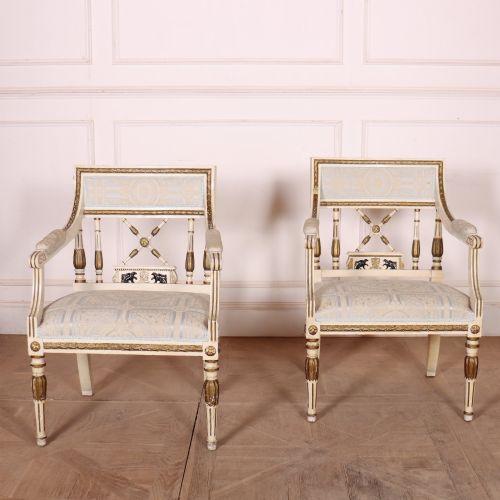
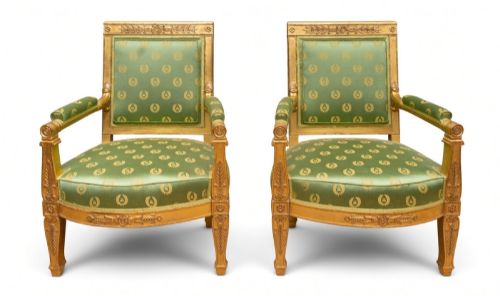
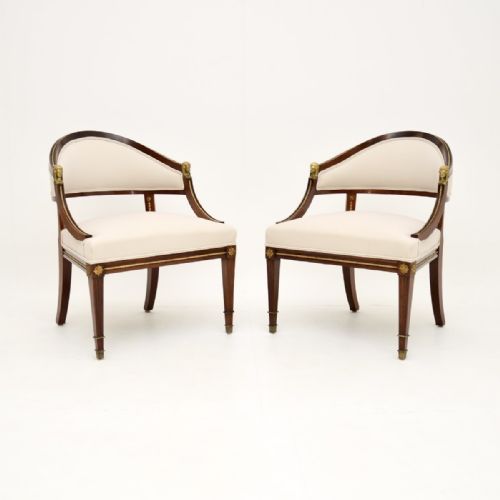
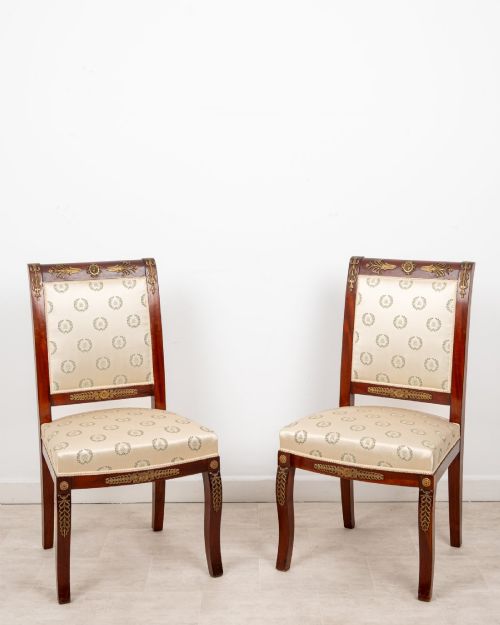
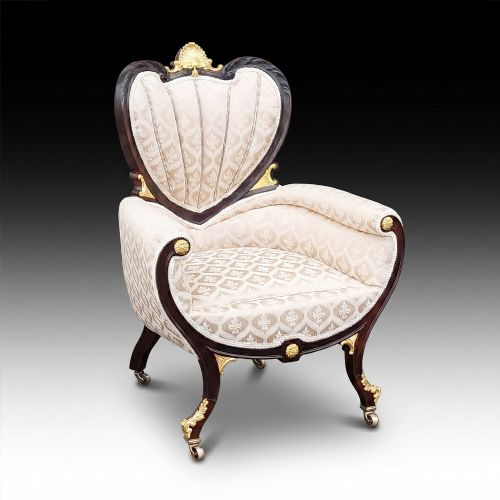
Empire style accent chairs draw on classical antiquity through formal lines and architectural restraint. When searching for empire style accent chairs, collectors encounter French, Swedish, and Italian interpretations spanning the nineteenth and early twentieth centuries. These seating forms range from open armchairs and library chairs to salon chairs and gilded stools.
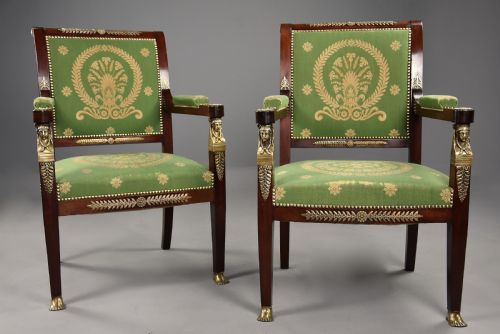
The versions most frequently met on this page include mahogany frames with ormolu mounts, alongside giltwood and painted pieces. Makers adopted Neoclassical, Regency, and Revival idioms across periods stretching from the early nineteenth century into the 1920s. These chairs function as focal points in period interiors and contemporary spaces alike.
Evaluating Quality and Execution
Quality reveals itself in the crispness of the wood carving and the precision of the cast ormolu mounts. Superior examples demonstrate harmonious proportions and balanced ornamentation, where gilded details complement the underlying mahogany or beech grain without cluttering the silhouette.
The integrity of the original construction and the subtlety of the applied surface finishes distinguish finer workshops from later revival pieces. Attention to structural detailing in the armrests and legs separates standard seating from exceptional cabinetmaking.
A solitary gilded curule stool brings imperial Roman theatre directly into the modern hallway.
Jacob Desmalter·Henry Thomas Peters
The Empire Style Accent Chairs Glossary
- Ormolu
- Gilded bronze used for decorative mounts on furniture. This technique involves applying a mercury and gold amalgam to cast bronze.
- Giltwood
- Wood that has been coated with gold leaf or gold paint. Artisans applied this finish to accentuate architectural carvings.
- Curule
- An ancient Roman stool shape characterised by curved legs crossing in an X-form. Nineteenth-century makers revived this design for formal seating.
Empire Style Accent Chairs: Frequently Asked Questions
How do I identify French Empire from Swedish Empire chairs?
French Empire pieces typically employ dark mahogany accented with heavy ormolu mounts and classical military motifs. They prioritise rich visual weight and dramatic gilding.
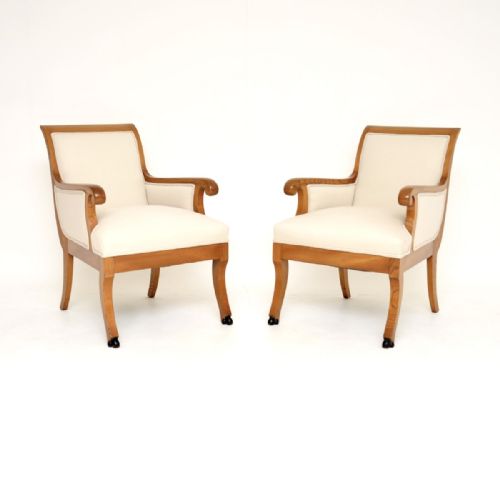
Swedish Empire and Neoclassical variants often utilise lighter woods such as birch and elm with restrained painted or gilded surfaces. They lean towards cooler palettes and more linear silhouettes.
What is the difference between a fauteuil and a salon chair?
A fauteuil is an open armchair featuring upholstered backrests and arm pads supported by exposed wooden framing. They were designed for formal sitting rooms.
Salon chairs encompass a broader category of seating used for entertaining, which may lack armrests or feature lighter frames designed for easy rearrangement.
Where should I place an empire style armchair?
These chairs excel as standalone accent pieces in hallways, studies, or drawing rooms where their architectural presence can be appreciated. Their upright posture makes them suited for conversational groupings rather than deep lounging.
Pairing them with neutral backgrounds allows the mahogany frames and metallic mounts to stand out as focal points in the interior.
How do I care for giltwood and ormolu mounts?
Giltwood requires dusting with a soft, dry cloth to protect the delicate gold leaf layer from abrasion. Moisture and chemical cleaners should be avoided on gilded surfaces.
Ormolu mounts benefit from gentle dusting without metal polishes, which can strip the historic gilt finish from the bronze substrate.