
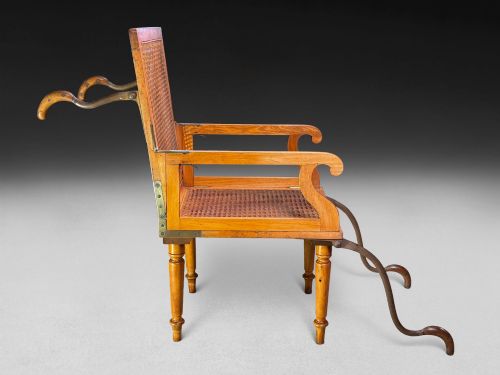
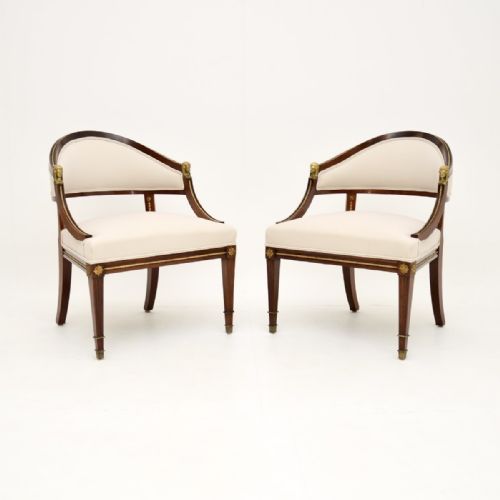
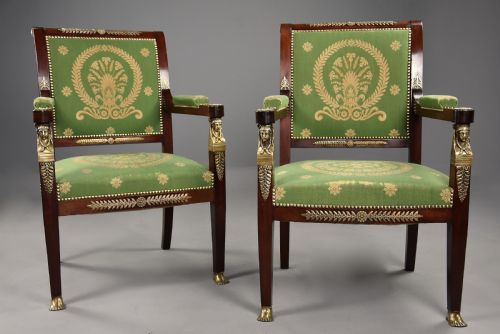
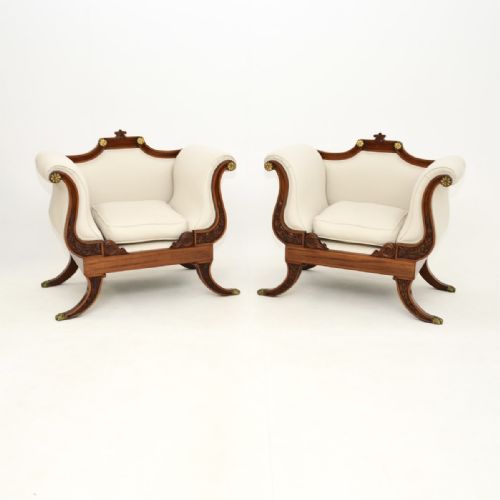


Brass Mounted Armchair
A brass mounted armchair brings robust structure and bright metal detail to any room, offering both sturdy support and distinct historical character.
Brass Mounted Armchair
A brass mounted armchair combines sturdy timber frames with polished metal mounts, corners, or inlays. When you search for this phrase, you encounter seating designed for libraries, campaign use, and formal drawing rooms.
The pieces on this page span the nineteenth century and the early twentieth century, taking forms such as campaign chairs, library armchairs, and French fauteuils. Mahogany and walnut provide the primary timber structures, often enriched with brass details.
You find regional variations ranging from Swedish neoclassical pairs to Chinese horseshoe chairs and Indian hardwood seating. British and continental styles dominate the selection, showing Regency, Empire, and Victorian influences.
How they were made
Cabinetmakers constructed the frames using solid hardwoods such as mahogany, walnut, and oak, joined with traditional framing techniques to ensure lasting strength. Timber selection dictated the weight and grain pattern of each seat.
Brass components were cast, hand-beaten, or inlaid directly into the wood to reinforce corners, protect edges, or create decorative motifs. Upholstery materials included leather, cane, and woven fabric secured over supportive webbing or stuffing.
Brass Mounted Armchair Retail Price Guide 2026
Typical asking prices for brass mounted armchair among the pieces listed under this phrase on Sellingantiques today, from the lower quarter to the upper quarter. They describe what is for sale here now, not the wider market.
Some nineteenth-century campaign chairs pack down neatly for travel, proving that officers insisted on proper arm support while conquering distant territories.
What varies in quality
Quality rests in the crispness of the brass casting and the tightness of the timber joints. Finer examples display hand-chiselled mounts and carefully selected mahogany or walnut veneers that show rich grain figures.
Proportion and comfort distinguish standard utility seating from high-status library or salon chairs. Well-balanced arm curves and harmonious metal placement elevate the visual weight of the piece.
The Brass Mounted Armchair Glossary
- Fauteuil
- An open-arm armchair originating in France, typically featuring an exposed wooden frame with upholstered seat and back pads. These chairs often reflect classical continental styling.
- Campaign chair
- Portable folding or dismantling furniture made for military officers on the move during the eighteenth and nineteenth centuries. They incorporate metal mounts and folding mechanisms for transport.
- Horseshoe shape
- A curved backrest design sweeping continuously from one arm rail around to the other. This form appears in traditional Chinese seating.
- Spindle
- A turned wooden rod supporting the backrest or arm of a chair. Spindles add structural rigidity while providing decorative rhythm.
- Neoclassical
- A style drawing inspiration from classical antiquity, marked by restrained ornamentation and symmetrical proportions. It appears frequently in Swedish and French designs.
Brass Mounted Armchair: Frequently Asked Questions
Where did these chairs originate?
The pieces span various workshops across Britain, continental Europe, and Asia. Makers adapted local timbers and regional aesthetic traditions to create seating featuring metal mounts.
European examples often follow French or Swedish design canons, while others reflect British campaign requirements or Eastern manufacturing traditions.
How are brass mounts attached?
Metal components are typically fixed using small brass pins or screws fitted flush into pre-drilled holes in the wood. Inlaid elements sit within carefully channeled grooves cut directly into the timber surface.
This method keeps the metal secure while allowing for minor timber movement as ambient humidity changes.
Can I use one at a desk?
Several variations in the inventory, specifically library and desk armchairs, were built for working environments. Their dimensions and arm heights accommodate standard writing tables.
Checking the seat height and clearance beneath the desk ensures comfortable daily use in a modern study.
How do I identify the period?
Dating relies on timber choice, turning styles, and the specific character of the brass hardware. Regency and Empire pieces display classical restraint and specific decorative motifs.
Later nineteenth-century iterations often combine revival styles with heavier framing and machine-finished metal components.