






Early Framed Tapestry Panel
An early framed tapestry panel brings centuries of tactile history indoors, offering rich woven textures that instantly ground a room.
Early Framed Tapestry Panel
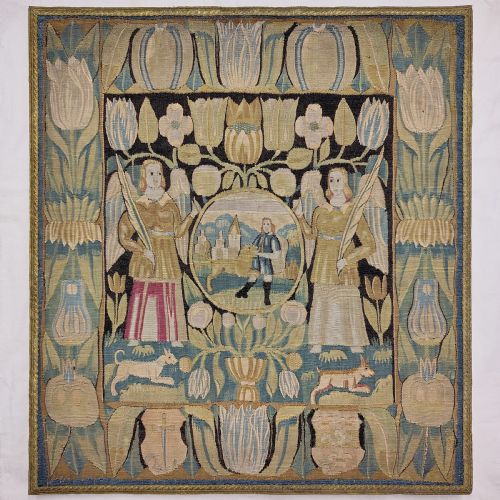
When you search for an early framed tapestry panel, you are looking at historic textile art preserved behind glass or mounted in timber frames. These pieces originate from periods spanning the seventeenth century through to the nineteenth century, encompassing styles such as Baroque, Jacobean, and Georgian.
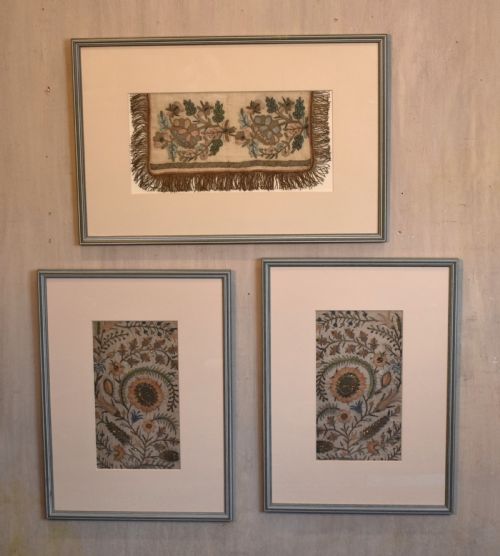
The selections available here most commonly feature seventeenth century tapestry cushion covers, eighteenth century needleworks, and nineteenth century crewel work embroidery or samplers. Italian embroidery from around seventeen hundred and French needlepoint panels also appear among the framed textile art.
Buyers encounter both wall art and smaller decorative pieces like needlework pictures and textile cushion covers adapted for display. Each object carries the distinct aesthetic of its era, whether that is the ornate flourish of French baroque or the disciplined hand of a Victorian sampler.
Materials and construction methods
The makers of these panels relied on natural fibres including wool, silk, and linen, working stitches by hand onto woven foundations. Crewel work, needlepoint, and traditional embroidery techniques formed the pictorial surfaces.
Frames utilise wood, walnut, gilt, and giltwood, often protected by glass to preserve fragile threads. Textile cushion covers from the seventeenth century and framed panels alike owe their survival to these sturdy mounting materials.
Jane Wettmore stitched her name into a sampler in 1847, inadvertently leaving a charming personal footnote in wool for modern collectors.
Judging quality in historic textiles
Quality rests primarily on the density of the stitching, the complexity of the pictorial design, and the survival of the original fibres. Finer wool and silk threads retain their coloration and structural integrity more effectively over the centuries.
The execution of the frame also dictates overall merit, as period giltwood and walnut surrounds complement the textile better than later replacements. The crispness of the needlework and the clarity of the composition separate ordinary samplers from exceptional pieces.
The Early Framed Tapestry Panel Glossary
- Crewel work
- Embroidery executed in wool onto a linen or cotton twill ground. This technique creates textured, pictorial designs popular in early needlework.
- Needlepoint
- A type of canvas work where yarn is stitched through a stiff open-weave mesh to cover the ground entirely. It produces durable panels suitable for upholstery and framed display.
- Sampler
- A piece of needlework produced to demonstrate skill in various stitches and alphabets. These dated examples provide useful reference points for textile historians.
- Giltwood
- Timber carved and coated with gold leaf or a gold-coloured finish. It provides a reflective, ornate border for formal framed panels.
Early Framed Tapestry Panel: Frequently Asked Questions
How should I hang an early textile panel?
Mount your framed textile on an interior wall away from direct sunlight to protect fragile wool and silk threads from fading. Keep panels clear of damp areas and strong heat sources.
Ensure the hanging wire and wall fixings match the weight of the timber frame and glass. Professional framing with UV-filtering glass offers the best protection for historic needlework.
Are these panels all from the seventeenth century?
The listings encompass several centuries, ranging from the seventeenth century through to the eighteenth and nineteenth centuries. Stylistic shifts reflect these changing periods.
Seventeenth century pieces often feature Baroque or Jacobean designs, while nineteenth century examples include samplers and crewel work embroidery from the Georgian and Victorian eras.
What is the difference between a sampler and a tapestry panel?
A sampler is an exercise in various stitches, alphabets, and motifs, usually worked by hand to demonstrate technical proficiency. They frequently include dates and maker names.
A tapestry panel or needlepoint picture focuses on a pictorial scene or decorative pattern rather than a collection of practice stitches. Both are typically mounted behind glass in wooden frames.
Can I use a tapestry cushion cover as wall art?
Many historical cushion covers are framed and displayed as flat textile art to preserve the fabric from daily wear. This allows the woven patterns to be enjoyed safely on a wall.
Mounting them behind glass protects the antique wool and silk from dust and handling while maintaining their original character.