
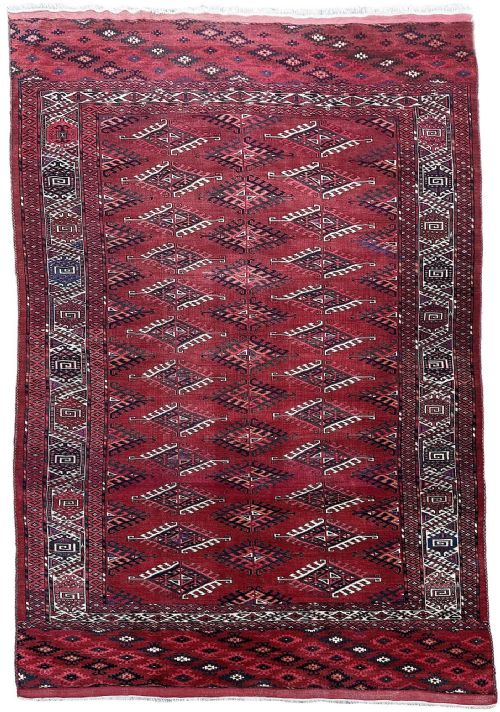


Dark Red Turkmen Rug
A dark red turkmen rug brings dense tribal patterning and rich madder tones into a room, offering durability and historical depth.
Dark Red Turkmen Rug
When you search for a dark red turkmen rug, you encounter hand-knotted nomadic and tribal textiles originating from Central Asia, often spanning the late nineteenth and early twentieth centuries. These pieces encompass various forms including main carpets, engsi door rugs, asmalyk tent trappings, and smaller torba or chuval bag faces. Most examples belong to specific tribal groups such as the Yomut, Tekke, Ersari, and Saryk.
The prevalent palette relies heavily on deep madder reds, complemented by secondary tones of ivory, dark blue, and brown. Designs frequently incorporate characteristic guls, which are repeating octagonal medallions identifying the specific tribe or clan. Buyers frequently find formats ranging from compact wall hangings and bag faces to larger floor carpets.
How they were made
Weavers constructed these textiles using hand-spun wool for the pile, foundations, and fringes, occasionally incorporating cotton or silk for specific highlights. Natural dyes provided the deep red hues and contrasting shades, fixed into the wool through traditional mordanting methods. Artisans knotted the pile densely onto warp and weft threads, finishing the edges with braided selvedges and woollen tassels.
Loom structures were portable, reflecting the nomadic lifestyle of the makers who worked outdoors or inside tents. The precision of the weave varied according to the specific tribal tradition and the intended function of the textile, whether meant for heavy floor use or decorative tent furnishings.
Listings feature pieces dated across the nineteenth and early twentieth centuries, utilising hand-spun wool, cotton, and natural dyes.
What varies in quality
The refinement of a piece depends heavily on knot density and the crispness of the geometric drawing within the guls and elem panels. Finer weaves allow for sharper definition of intricate motifs such as curled leaves, rams horns, or kedjebe designs.
The depth and saturation of the natural dyes also dictate overall standard, with vibrant, well-preserved red tones commanding attention. Furthermore, the presence of original elements like hanging loops, complete backs, and tassels elevates the integrity of surviving bag faces and tent trappings.
The Dark Red Turkmen Rug Glossary
- Gul
- A repeating octagonal medallion motif used by Central Asian weavers to denote specific tribal identity. These primary design elements anchor the field of most carpets and bag faces.
- Torba
- A small wall-hanging bag traditionally used for domestic storage inside a tent. They frequently display elaborate guls and elem panels along the lower border.
- Chuval
- A large storage bag produced by nomadic weavers for household possessions. Surviving examples are often collected as flat face panels complete with multiple guls.
- Engsi
- A specialised tribal rug used as a tent door hanging. They typically feature a quartered field design separating the textile into distinct panels.
- Asmalyk
- A pentagonal trapping hung on the flank of a camel during traditional wedding processions. These decorative textiles display full pile and often retain original tassels.
- Elem
- The heavily patterned lower border panel found on rugs and tent door hangings. This section often depicts stylized plant or tree motifs beneath the main field.
Dark Red Turkmen Rug: Frequently Asked Questions
What is a gul?
A gul is a repeating octagonal medallion placed across the field of a tribal textile. Each specific design correlates to the heritage of the weaving group.
These motifs act as ancestral emblems rather than mere decoration, helping historians and collectors identify the origin of individual carpets.
How were torbas used?
Torbas served as utility storage sacks inside nomadic tents, hung against the lattice walls to hold small possessions. Their decorated faces remained visible within the living space.
Over time, collectors separated these decorative faces from their plain wool backs to display them as small decorative wall hangings.
How do I identify tribal origins?
Tribal attribution relies on the specific structure of the guls, the secondary border ornaments, and the dominant shades of red. Yomut, Tekke, Saryk, and Ersari weavers each employed distinct structural nuances.
Examining the knotting style, wool texture, and side finishes provides further clues to separate regional workshops and nomadic groups.