
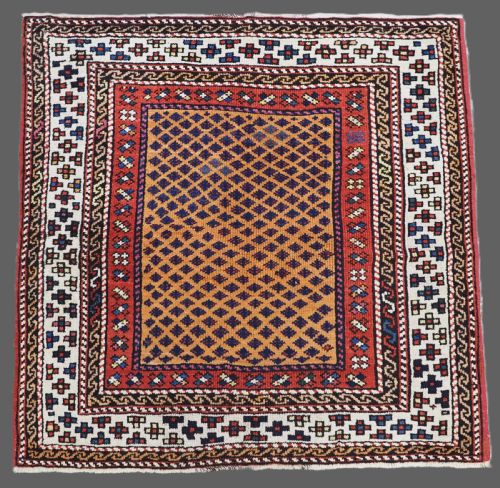
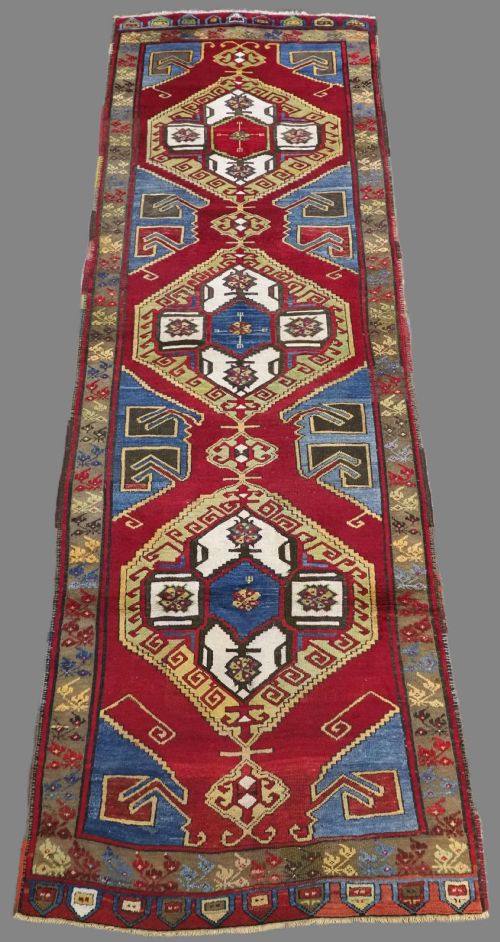


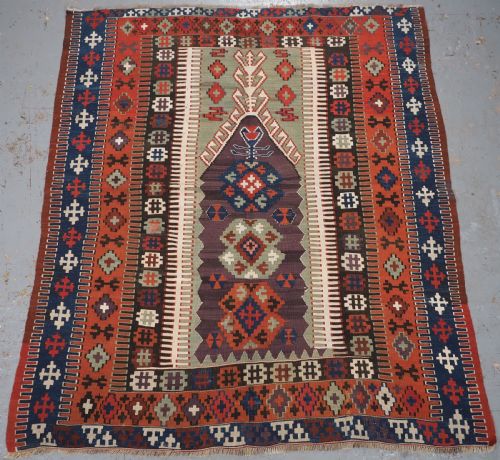


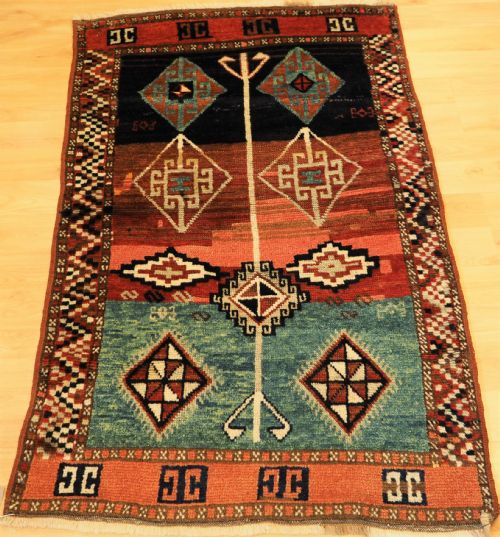
Circa 1900 Turkish Rug
These woven floor coverings bridge traditional village weaving and court design, offering rich wool texture and vegetable-dyed palettes suited to modern interiors.
Circa 1900 Turkish Rug
When searching for a circa 1900 turkish rug, buyers encounter diverse regional styles originating from Anatolian weaving centres like Oushak, Bergama, and Konya. These pieces span from rustic village long rugs and prayer formats to finely knotted city carpets.
Village workshops and nomadic groups produced distinct geometric and medallion compositions, utilising traditional motifs passed down through generations. Such pieces frequently display characteristic regional quirks in border arrangements and field layouts.
City manufactories around Kayseri and Sivas created more formal floral designs, occasionally incorporating silk alongside wool to achieve finer detail and smoother pile surfaces.
Materials and Construction
Weavers constructed these carpets predominantly using hand-spun wool for the pile, foundations, and fringes, though cotton warps and wefts appear frequently in urban productions. Selected city examples incorporate silk to execute intricate floral compositions and delicate medallion outlines.
Colour palettes derive from traditional vegetable dyes, yielding nuanced tones that develop depth over time. Natural mordants fixed these organic pigments within the wool fibres during processing.
Certain village weavers deliberately introduced slight geometric asymmetries to ward off evil spirits.
Evaluating the Weave
Knot density and structural regularity distinguish simpler village productions from master-woven city carpets. Finer foundations allow for sharper definition within medallion and lattice designs.
The integrity of the wool and the preservation of original side cordings determine the structural longevity of each piece. Purity of vegetable dye colouration and balanced saturation levels contribute significantly to visual appeal.
The Circa 1900 Turkish Rug Glossary
- Kilim
- A flat-woven carpet lacking pile, produced by tightly interlacing warp and weft threads.
- Mihrab
- The arched niche design characteristic of prayer rugs, traditionally oriented toward Mecca.
- Medallion
- A central ornamental motif dominating the field of the carpet.
- Warp
- The vertical threads stretched tightly on the loom that form the structural foundation.
- Weft
- The horizontal threads passed across the warps to secure the knots in place.
Circa 1900 Turkish Rug: Frequently Asked Questions
How do I identify a village rug?
Village pieces display bolder geometric motifs, heavier wool textures, and asymmetrical layout variations reflecting local weaving traditions.
These rugs often incorporate rustic charm and spontaneous colour shifts rather than strict symmetrical precision.
What is a prayer rug?
Prayer rugs feature a prominent architectural arch or mihrab design at one end of the field.
Weavers created these formats for personal devotion, guiding the user in positioning the carpet during daily prayers.
How should I clean my antique rug?
Regular gentle vacuuming without a rotating brush prevents dust accumulation within the wool pile.
Professional specialist cleaning is recommended for deep maintenance to protect natural vegetable dyes and delicate foundations.
What distinguishes Oushak carpets?
Oushak productions utilise larger scale floral patterns and softer, muted colour palettes compared to other Anatolian styles.
Their looser weave and lustrous wool give them a relaxed aesthetic that integrates easily into contemporary spaces.