


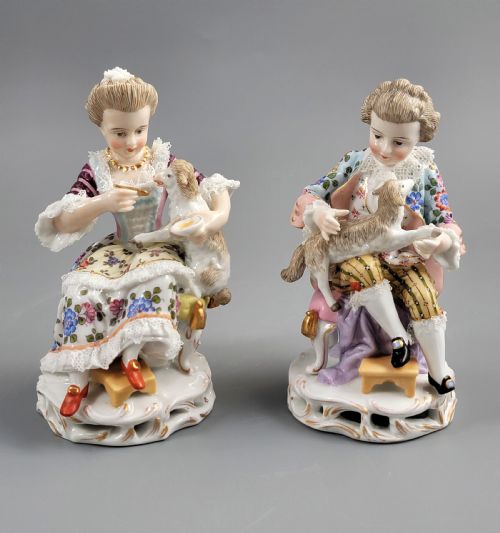

Antique Pastoral Figurines
These antique pastoral figurines depict shepherds, gardeners and rural folk in porcelain, bronze, earthenware and silver.
Antique Pastoral Figurines
Antique pastoral figurines capture idealised rural scenes of shepherds, shepherdesses, gardeners and farm folk at rest or labour. They are most commonly encountered here as 18th-century, Georgian, Victorian and 19th-century European porcelain, earthenware and bronze groups from factories in Britain, France and Germany.
The subjects draw upon historical models from Meissen, Derby, Chelsea and Samson, often depicting pairs of musicians, harvesters or children with lambs and baskets. They serve as decorative mantel and table objects, carrying stylistic influences ranging from Rococo Revival and Art Nouveau to folk art.
Buyers will find individual figures, pairs and figural candlesticks produced across various periods, from early soft-paste porcelain to later biscuit ware and cast metals.
How they were made
Makers shaped these pieces using porcelain, earthenware, pearlware, bisque, bronze and cast sterling silver, applying hand-painted enamel colours, glaze and gold leaf highlights. Many porcelain examples originated from moulds taken after earlier factory models, finished with delicate hand-modelled details such as foliage, wool and baskets of fruit.
Metal versions utilised bronze casting and silverwork, sometimes featuring silvered or gilt surfaces, while wooden carvings relied on hand-chiselled detailing. Potters finished earthenware pieces with lead or salt glazes and earthenware figures like Staffordshire flat backs were slip-cast or pressed in moulds before hand painting.
Listings feature 19th Century, Georgian and Victorian periods, utilising materials such as porcelain, bronze, earthenware and silver.
What varies in quality
Quality rests upon the crispness of the moulding and the finesse of the hand painting, particularly in the rendering of facial expressions, clothing folds and naturalistic foliage. Earlier porcelain and bronze pieces display sharper details and more subtle enamel work compared to later mass-produced commercial runs.
The retention of original gilding, the delicacy of applied floral elements and the stability of cast metal or ceramic joints also distinguish superior examples from simpler provincial pieces.
Edward and John Barnard·Carl Thieme·Royal Dux·Sitzendorf·Vion et Baury·Ludwigsburg·Samson·Meissen·Derby
The Antique Pastoral Figurines Glossary
- Bisque
- Unglazed porcelain with a matte, biscuit-like surface texture. It gained popularity in the 19th century for French figures.
- Pearlware
- A fine earthenware developed by British potters in the late 18th century, featuring a pale bluish glaze that made the underlying body appear whiter.
- Spill holder
- A hollow ceramic figure or vase designed to hold taper spills for lighting candles or fires. These are frequently found in Victorian Staffordshire groups.
- Soft-paste porcelain
- An artificial ceramic paste fired at lower temperatures than hard-paste porcelain, possessing a warm, slightly creamy body often seen in 18th-century figures.
- Flat back
- A ceramic figure modelled with a plain, unpainted reverse side designed to stand against a wall or mantelpiece.
Antique Pastoral Figurines: Frequently Asked Questions
What are pastoral figurines?
These pieces are decorative sculptures depicting idealized rural characters like shepherds, shepherdesses and milkmaids. They often feature accompanying animals such as lambs or cows.
Originating largely from European porcelain factories and metal workshops, they reflect centuries of romanticized interest in country life.
How were antique pastoral figures used?
Historically, these figures served as decorative ornaments for dining tables, drawing rooms and mantelpieces among wealthy households. Some examples functioned additionally as candlesticks or spill holders.
They were designed purely for visual display rather than practical utility within the home.
How do I date a porcelain figure?
Dating relies on examining the ceramic body, glaze characteristics, base marks and stylistic traits. Earlier 18th-century pieces often use soft-paste porcelain with hand-mixed enamels, whereas 19th-century reproductions or later factory pieces show different potting techniques.
Comparing the modelling style to known factory archives helps establish the period.
What materials are these figurines made from?
The selections span multiple mediums including hard-paste and soft-paste porcelain, earthenware, pearlware and biscuit porcelain. Other examples are cast in bronze or sterling silver, and occasionally carved from wood.
Surface finishes include hand-painted enamels, gilding and clear or coloured glazes.