




Allegorical Porcelain Statue
An allegorical porcelain statue brings classical personifications of seasons, elements, and continents into your interior with delicate painted detail and modelled form.
Allegorical Porcelain Statue
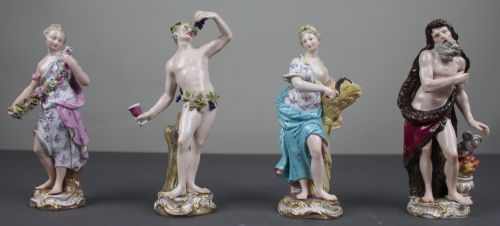
An allegorical porcelain statue embodies abstract concepts such as the Four Seasons, the elements, or continents through human figures holding symbolic attributes. These figures range in scale from cabinet statuettes to substantial nineteenth-century groups modelled after eighteenth-century prototypes.
You will encounter pieces originating from English factories like Bow, Derby, Chelsea, and Royal Worcester, alongside continental makers including Meissen, Volkstedt, and Samson of Paris. The forms appear as single figures or pairs representing counterparts like water and land or the changing seasons.
The subjects draw heavily on mythological and classical themes, transforming philosophical ideas into tangible ceramic sculpture. Such works served as sophisticated table decorations and mantel ornaments for Georgian and Victorian interiors.
Materials and construction
Makers utilised both soft-paste and hard-paste porcelain, shaping the clay through press-moulding and slip-casting before hand-modelling intricate details such as foliage, drapery, and facial expressions. Skilled modellers added delicate elements piece by piece prior to the high-temperature kiln firing.
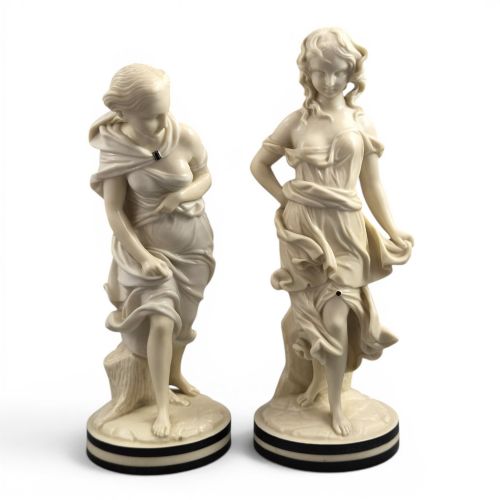
The surface decoration relies on polychrome enamel painting combined with gold leaf and gilding to accentuate the garments and symbolic accessories. Parian ware also appears, offering an unglazed, marble-like finish suited to nineteenth-century neoclassical interpretations.
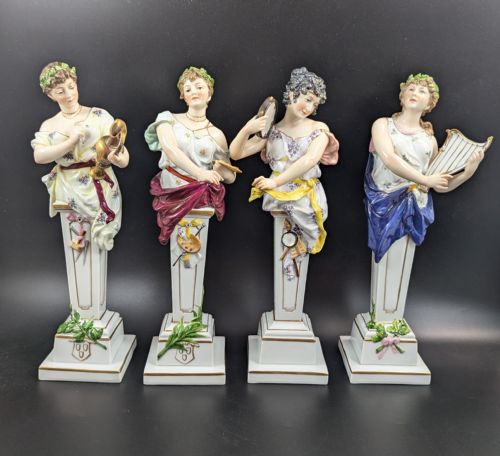
Later nineteenth-century interpretations often employed precise hard-paste porcelain bodies finished with meticulous enamel work and extensive gilding. The firing process required careful placement within the kiln to prevent warping of the outstretched limbs and intricate attributes.
Listings feature both hard-paste and soft-paste porcelain alongside unglazed Parian ware across the eighteenth and nineteenth centuries.
Distinctions in quality
The sophistication of the modelling marks the division between ordinary production and superior artistry. Master modellers achieved expressive faces, convincing musculature, and natural folds in drapery, whereas lesser examples appear stiff and generalized.
The crispness of the porcelain body preserves the sharpness of the original mould detail. Pieces that retain clean, deep relief without blurring demonstrate superior ceramic manufacturing standards.
Royal Worcester·Bow Porcelain·Samson of Paris·Volkstedt Germany·Derby Porcelain·Chelsea Porcelain·Meissen·Royal Berlin·Achille Mollica·Frankenthal
The Allegorical Porcelain Statue Glossary
- Allegory
- The representation of abstract ideas through human figures and symbolic objects. This visual storytelling device dominated European porcelain sculpture during the eighteenth and nineteenth centuries.
- Hard-paste porcelain
- A durable ceramic composition fired at very high temperatures, composed of kaolin and petuntse. Continental factories utilised this material to achieve bright white bodies and sharp modelled detail.
- Soft-paste porcelain
- An early ceramic mixture containing glass frit and white clay, fired at lower temperatures than hard-paste bodies. English factories favoured this formulation for its warm glaze pooling and soft texture.
- Parian ware
- An unglazed, fine-grained porcelain resembling white marble, developed during the nineteenth century. This material gained popularity for classical figures due to its smooth, matte finish.
- Enamel
- Low-fusion glass powder mixed with metal oxides, applied over the fired glaze and subjected to a secondary kiln firing to fix the colours. These vibrant pigments brought life to the modelled garments and attributes.
Allegorical Porcelain Statue: Frequently Asked Questions
How do I identify the subject of my statue?
Look closely at the objects held by the figure or placed near its feet, such as a basket of flowers for spring, ears of corn for summer, or a globe for geography.
Many figures also feature traditional attributes or Latin inscriptions that directly name the season, element, or continent they represent.
Where should I display these porcelain figures?
These decorative statuettes suit stable mantelpieces, enclosed cabinets, or console tables away from direct sunlight and heavy foot traffic.
Because the porcelain bodies and applied details are delicate, placing them at eye level in a protected display space minimises accidental handling.
How do I distinguish eighteenth-century pieces from nineteenth-century revivals?
Examine the base and the glaze under good light to observe the texture of the ceramic body and the style of the factory marks.
Eighteenth-century works often show characteristic glaze pooling and softer potting, while nineteenth-century revival pieces made by factories like Samson display crisper outlines and different paste compositions.
What caused factories to produce allegorical series?
European dining customs and interior decoration demanded coordinated sets that reflected philosophical ideas about nature, geography, and the passing time.
Commissioning sets of the four seasons or four continents allowed patrons to demonstrate their classical education and refined taste to visitors.