


A 2026 Guide by Sellingantiques
Early antique silver teapots appear in the late seventeenth century. Tea was an expensive luxury back then. You only needed a small capacity.
Georgian examples grew larger as tea imports increased. Families wanted bigger pots for the breakfast table.
Check the shape. Queen Anne styling leans towards bullet or pear forms. Later periods introduced oval and octagonal profiles.
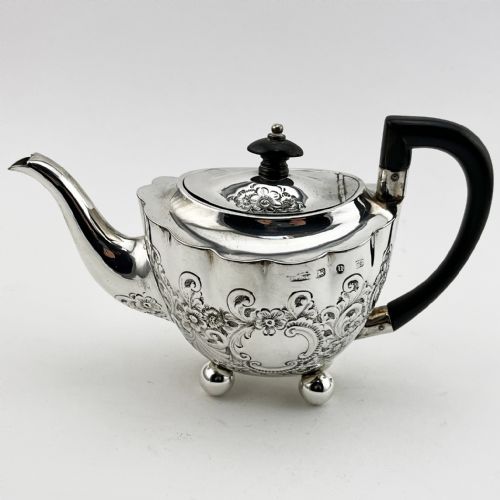
Victorians favoured heavy ornamentation instead of plain metal. They covered surfaces with chased foliage and scrollwork.
Paul de Lamerie worked in London during the early eighteenth century. His silver teapots often feature heavy casting and elaborate chasing.
Hester Bateman managed a busy workshop from 1760. Her firm produced proportioned neoclassical forms with bright-cut engraving.
Working in the early nineteenth century, Paul Storr supplied grand presentation pieces. He favoured heavy gauge metal and bold classical motifs.
The 2026 retail price guide for Antique Silver Teapots is drawn from a proprietary archive of over 1.1 million retail prices indexed by Sellingantiques since 2003. This guide relies exclusively on their own internal data; no external sources or auction records are used.
Analysing nearly 25 years of UK antique market history alongside current retail values, the data indicates that typical UK retail prices for Antique Silver Teapots range between £400 and £2,200. Entry-level prices generally fall under £400 and premium examples upwards of £2,200.
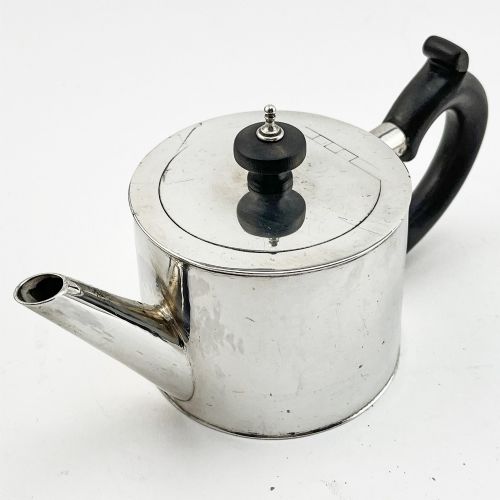
Look at the spout. Early ones are straight and tubular. Later designs use a curved swan-neck profile for better pouring.
Flush hinges are a sign of good work. The hinge sits flush with the lid and body. You barely notice the joint.
Hallmarks often sit under the base or near the handle. They tell you the assay office and date letter.
Early pieces were raised by hand from a single flat sheet. The silversmith hammered the metal over an anvil.
Seaming became common later. Makers rolled the silver into a cylinder and soldered the vertical join near the handle.
Factory production changed things. Victorian workshops used stamping machines to form complex body shapes quickly.
"Some Georgian pots have invisible hinges. The maker hid the joint within the decorative border."
"Engraved armorials often tell a story. Families added their coat of arms to mark a wedding or inheritance."
"Many makers specialised in just one part. Spout makers and handle carvers supplied the main silversmith."
Based on almost 25 years of Sellingantiques UK antique market data, Antique Silver Teapots appeared 1219 times (out of 1,100,000 antiques) which gives it a rarity score of 78/100.
This score measures scarcity within the Sellingantiques archive only and is not a survey of the entire antiques market, so these statistics may not be indicative of the general availability of Antique Silver Teapots elsewhere.
You certainly can use these every day. Hot water will not harm the metal or the solder joints. Just remember to warm the pot slowly.
Swill a little warm water inside before adding the boiling water. Tannin builds up inside over time. A quick rinse after use stops the interior turning black.
Leave the lid open to let it dry. This prevents musty smells forming.
Most collectors prefer to see the metal. A gentle polish with a quality silver foam or cloth removes the dark tarnish without scratching. It brings the piece back to how the maker intended it to look.
Do not use chemical dips. They strip the surface and leave the silver looking flat and white. Go slowly around any engraved areas so you do not wear the pattern down.
A soft bristle brush does the job. Pipe cleaners also work well for the narrow curve.
Avoid anything with a wire core. Hard metals easily scratch the softer silver inside.
A skilled silversmith can carve a replacement. They match the original wood and shape it to fit the existing silver sockets. It takes time but keeps the piece functional.
Sometimes an old split can be glued and clamped if the wood is still solid. The silver pins holding the handle just need gently tapping out first. It is a routine repair for a good restorer.
Please note: This Antique Silver Teapots guide and its associated pricing data are provided for general informational purposes only. It does not constitute formal financial, investment, or appraisal advice and should not be relied upon as the sole basis for any commercial activity, purchasing, or sales decisions. Sellingantiques.co.uk accepts no liability for any actions taken in reliance on this information. Always consult with a qualified professional or independent appraiser.
