


A 2026 Guide by Sellingantiques
Production of antique Prattware jugs began during the late eighteenth century across Staffordshire and Yorkshire potteries.
Commemorative pieces drove early sales. Naval heroes and royalty frequently appear moulded onto the sides of these vessels.
Look for political subjects too. Elections often prompted local potters to issue specific designs for their regional markets.
Changing fashions reduced demand by the mid-nineteenth century. Heavy coloured relief wares slowly fell out of favour.
Felix Pratt of Fenton worked between 1779 and 1813. His name became attached to the entire category, though many other factories made them.
Identifying specific makers is rarely possible. The vast majority of these wares left the kilns without any factory marks.
Yorkshire potteries also produced significant numbers. Firms like the Hawley family in Rotherham turned out similar relief-moulded jugs during the early nineteenth century.
The 2026 retail price guide for Antique Prattware Jugs is drawn from a proprietary archive of over 1.1 million retail prices indexed by Sellingantiques since 2003. This guide relies exclusively on their own internal data; no external sources or auction records are used.
Analysing nearly 25 years of UK antique market history alongside current retail values, the data indicates that typical UK retail prices for Antique Prattware Jugs range between £200 and £800. Entry-level prices generally fall under £200 and premium examples upwards of £800.
Relief moulding defines the shape. The designs stand proud of the surface, creating clear borders for the painters to fill.
Look closely at the handles. Most feature a simple loop shape, sometimes moulded with acanthus leaf details near the terminals.
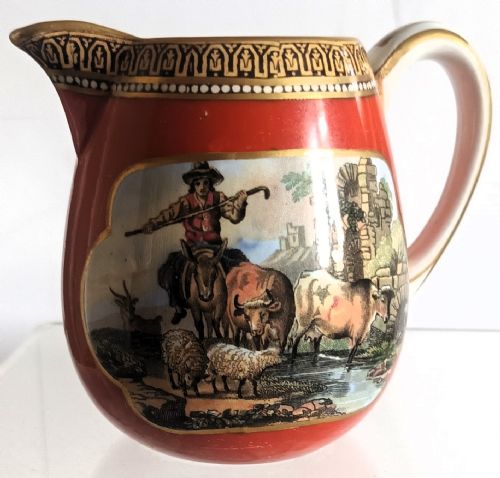
Decorative bands often frame the main scenes. Stiff leaf designs or simple painted lines regularly circle the neck and base of antique Prattware jugs.
Plaster moulds dictated the shape. Potters pressed the clay into two halves before joining them with liquid slip.
Seam lines often remain visible under the handle and spout. This shows where the workmen joined the two sections together.
Painting required steady hands rather than great artistry. Women and children typically applied the oxide colours quickly within the outlines.
"These bright palettes survive centuries underground. Shards found in archaeological digs look just as sharp today as when they left the kiln."
"Some designs functioned as early political advertising. Candidates would order batches of custom jugs to distribute among their loyal voting base."
"The painters worked without seeing the final hues. The true blues and yellows only revealed themselves after the heat of the final firing."
Based on almost 25 years of Sellingantiques UK antique market data, Antique Prattware Jugs appeared 41 times (out of 1,100,000 antiques) which gives it a rarity score of 99/100.
This score measures scarcity within the Sellingantiques archive only and is not a survey of the entire antiques market, so these statistics may not be indicative of the general availability of Antique Prattware Jugs elsewhere.
The Macaroni jug is a specific moulded design found in this category. It features caricatures of fashion-conscious young men from the late eighteenth century.
Potteries used these satirical prints to mock the tall wigs and tight clothing of wealthy youths returning from the Grand Tour. The designs proved popular in taverns.
The blue pooling is a characteristic of the glaze, not a direct indicator of age. Potters added a tiny amount of cobalt to the liquid glaze to disguise the yellowish tint of the local clay.
Where this glaze gathers thickly around the foot rim or in the crevices of the relief moulding, the cobalt concentration increases. This creates the distinct blue tinge that collectors associate with pearlware.
Paint application relied on speed. The workshop decorators worked quickly and often missed small moulded details like faces or hands while brushing on the oxides.
It was piecework. The painters earned their wages by volume rather than precision.
Potteries kept a large stock of plaster moulds in their workshops. When preparing a new batch of jugs, the workmen would sometimes pull mismatched halves from the racks to form the front and back.
There was little concern for thematic consistency in the cheaper markets. A tavern keeper buying a dozen jugs cared more about utility than whether a sailor shared space with a hunting dog.
Please note: This Antique Prattware Jugs guide and its associated pricing data are provided for general informational purposes only. It does not constitute formal financial, investment, or appraisal advice and should not be relied upon as the sole basis for any commercial activity, purchasing, or sales decisions. Sellingantiques.co.uk accepts no liability for any actions taken in reliance on this information. Always consult with a qualified professional or independent appraiser.
