

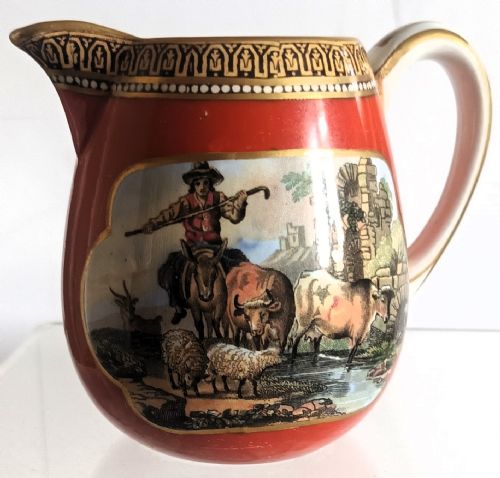

Antique Prattware Jugs
Small English earthenware jugs painted in high-fired underglaze colours over relief moulding, made for pouring and serving at table from the 1780s into the early 19th century.
Antique Prattware Jugs
Prattware is a ware type rather than a workshop: English earthenware decorated in a limited palette of high-temperature underglaze colours, ochre, blue, green and brown, usually laid over moulded relief. Potteries in Staffordshire, Yorkshire and elsewhere made it, and jugs were among its commonest products.
Small is the rule on Sellingantiques. Three of nine sampled titles say cream jug, two more say small, and nothing large or oversized appears in the archive at all. The body is often described as pearlware, the whitened earthenware with a bluish glaze that carries this palette well. One jug in the group has a hinged pewter lid.
Beyond the cream jugs, the group splits a few ways. Two sampled titles are relief-moulded hunting jugs, one from Staffordshire and one given to the Yorkshire Potteries. Two are toby jugs, modelled as seated figures. One is a commemorative jug named for Admiral Duncan, and one is a plain pearlware jug with cabbage-leaf moulding listed alongside the rest.
Dating is worth reading carefully. The dealers' period field is broad, with 19th Century on five listings, Georgian on two and Victorian on two, while the titles themselves give c.1798, circa 1790-1800, C1805, c.1810, C1800-20, c.1820 and c1830. The real clustering is late Georgian, whatever the period tag says.
Where Value Sits
Form does more work than palette. The two toby jugs hold the top two sampled positions, so the figural model rather than the underglaze colouring is what carries the upper end. Plain moulded jugs and the small cream jugs sit at the bottom of the range.
A named or readable moulded subject lifts a jug. The two hunting jugs and the Admiral Duncan commemorative all sit in the upper half of the sample, where a moulded scene or a portrait head gives the piece something to be about beyond its shape.
Specificity in the description tracks the same way. Titles that claim a place of making, Staffordshire or the Yorkshire Potteries, cluster above the unattributed ones, and titles giving a year or a narrow span sit higher than those offering only a period word. Metal mounting is no premium here: the one pewter-lidded jug is the lowest-priced in the sample.
Antique Prattware Jugs Retail Price Guide 2026
Typical UK retail prices for prattware jugs, calculated from the Sellingantiques database of over a million retail prices indexed since 2003. This retail price guide relies exclusively on Sellingantiques data; no external sources or auction records are used, so the figures do not describe the wider market.
19th Century is the period label used most on Sellingantiques for these jugs, with Georgian next and 18th Century third.
The Antique Prattware Jugs Glossary
- Prattware
- Earthenware decorated in high-fired underglaze colours, typically over relief moulding. Five of the nine sampled titles use the word, and it describes the decoration, not a factory.
- Pearlware
- A whitened earthenware body under a faintly bluish glaze, named in two sampled titles. It is the body the Prattware palette usually sits on.
- Cream jug
- A small jug for cream at table, and the commonest size named in this archive. Expect something that fits in one hand.
- Relief moulding
- Decoration raised from the body in the mould rather than painted on flat. It underlies both the hunting jugs and the cabbage-leaf jug here.
- Toby jug
- A jug modelled as a seated figure, appearing in the group in both Prattware and pearlware bodies and in plainer pottery.
- Cabbage leaf moulding
- A jug body formed as overlapping leaves, named once in the sample on an early Staffordshire pearlware jug.
Antique Prattware Jugs: Frequently Asked Questions
How often do these come up for sale?
Rarely. Roughly one Prattware jug is listed on Sellingantiques a year.
Seven different dealers have each handled one, so almost nobody carries them twice. They arrive singly rather than in runs.
Why are the dates so vague in some listings?
The period field dealers fill in is broad by design. Across the archive it gives 19th Century on five listings, Georgian on two, 18th Century on one and Victorian on one, and only one listing carries a clean year.
The titles are much tighter, offering c.1798, C1805, c.1810, C1800-20, c.1820 and c1830. Two entries are filed as Victorian even though the ware is a late Georgian type.
What size are they?
Small. Three of nine sampled titles say cream jug and two more say small.
No large or oversized jug appears anywhere in this archive.
Which potteries made Prattware jugs?
No maker or factory is named in this archive at all. Prattware describes the decoration rather than a workshop, so a title saying Prattware is telling you about palette and moulding.
Place of making is claimed in four sampled titles: twice Staffordshire, twice the Yorkshire Potteries. The Yorkshire attributions are the less common of the two here.
Are toby jugs part of this category?
Yes. Two of the nine sampled titles are toby jugs, jugs modelled as a seated figure, one described as Prattware pearlware from Yorkshire and one as English pottery.
They hold the top two sampled positions, which puts the figural form above the moulded and plain jugs in this group.
What subjects appear on the moulding?
Sporting scenes turn up more than once: a fox hunting jug given to the Yorkshire Potteries and a hunting jug given to Staffordshire.
Commemorative subjects also appear, with one jug titled for Admiral Duncan and dated c.1798. At the plainer end, a pearlware jug is moulded as overlapping cabbage leaves with no figures at all.