37,006  PAGES BROWSED TODAY PAGES TODAY 90  ANTIQUES UPLOADED TODAY NEW ARRIVALS
ID #SA957540
FOR SALE
£6,500
Email
Save
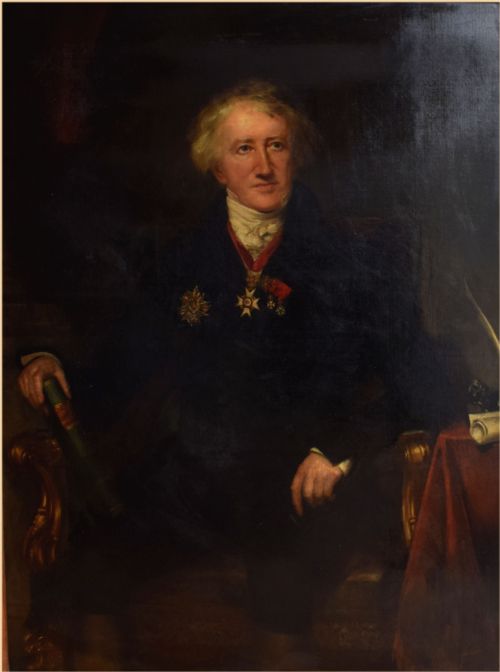
Henry William Pickersgill 1782-1875 Portrait of Jean Leopold Nicolas Frederic, Baron Cuvier 1769-1832
Artware Fineart
for sale €7,605     $8,255
£6,500

Artware Fineart

Sellingantiques Verified Since Sep 2008
View Dealers Stock Page
Id #SA957540
PDF SHARE
SAVE

Henry William Pickersgill 1782-1875 Portrait of Jean Leopold Nicolas Frederic, Baron Cuvier 1769-1832

19th century
For Sale by Artware Fineart
Description

Henry William Pickersgill 1782-1875

PORTRAIT OF JEAN LEOPOLD NICOLAS FREDERIC, BARON CUVIER 1769-1832

oil on canvas

138 x 106 cm.
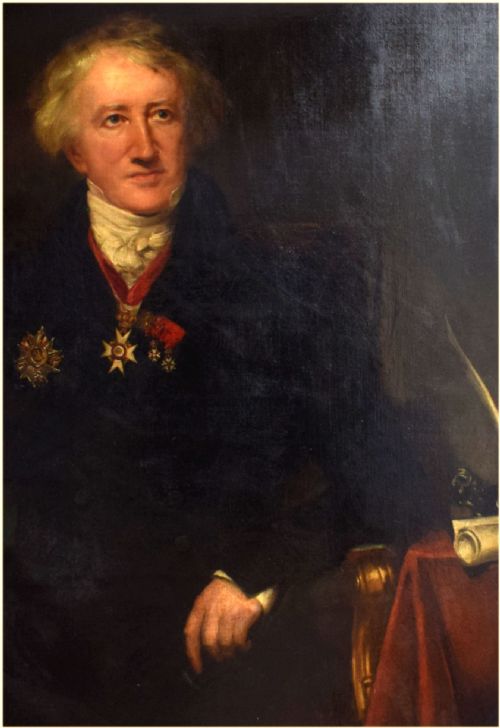
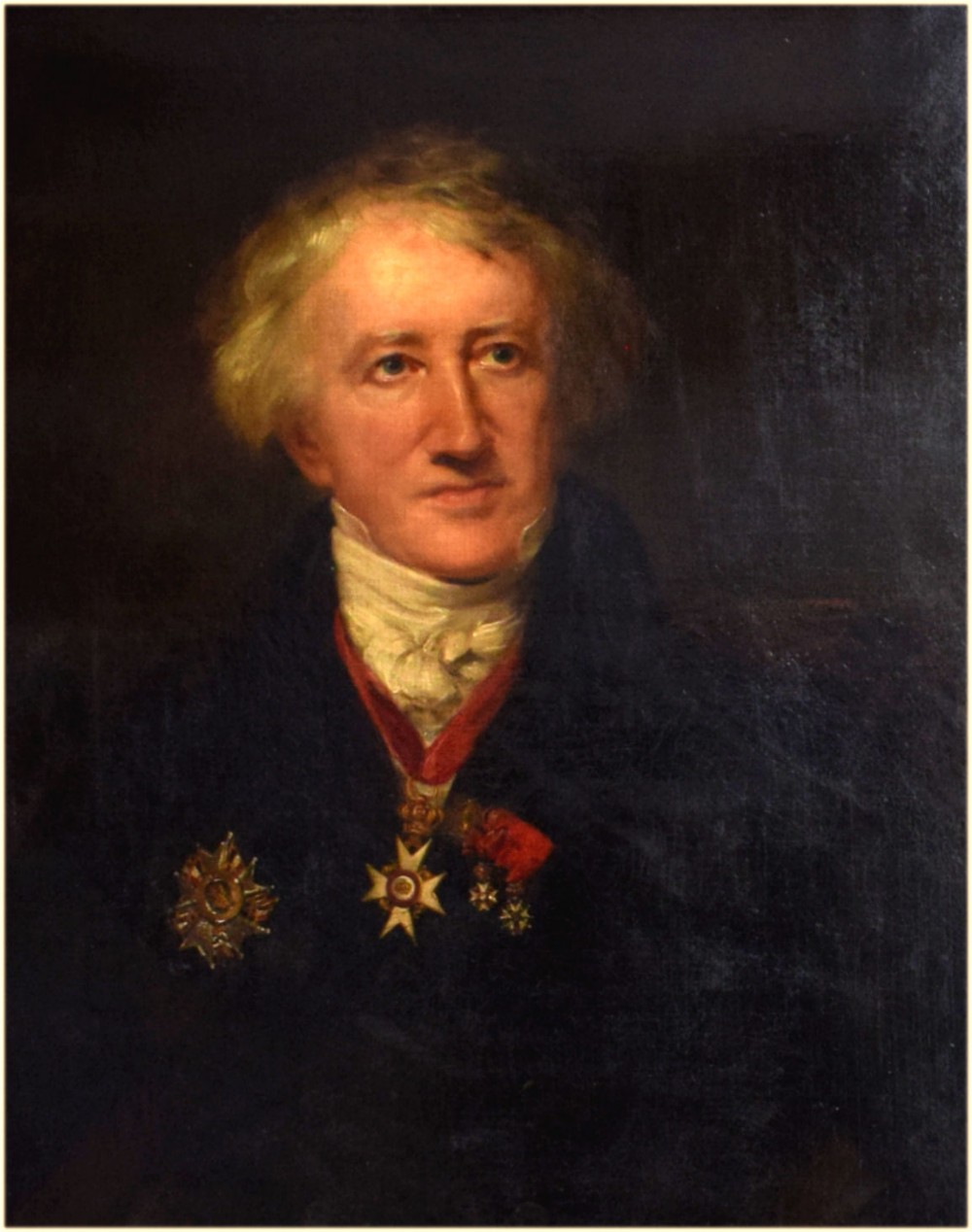
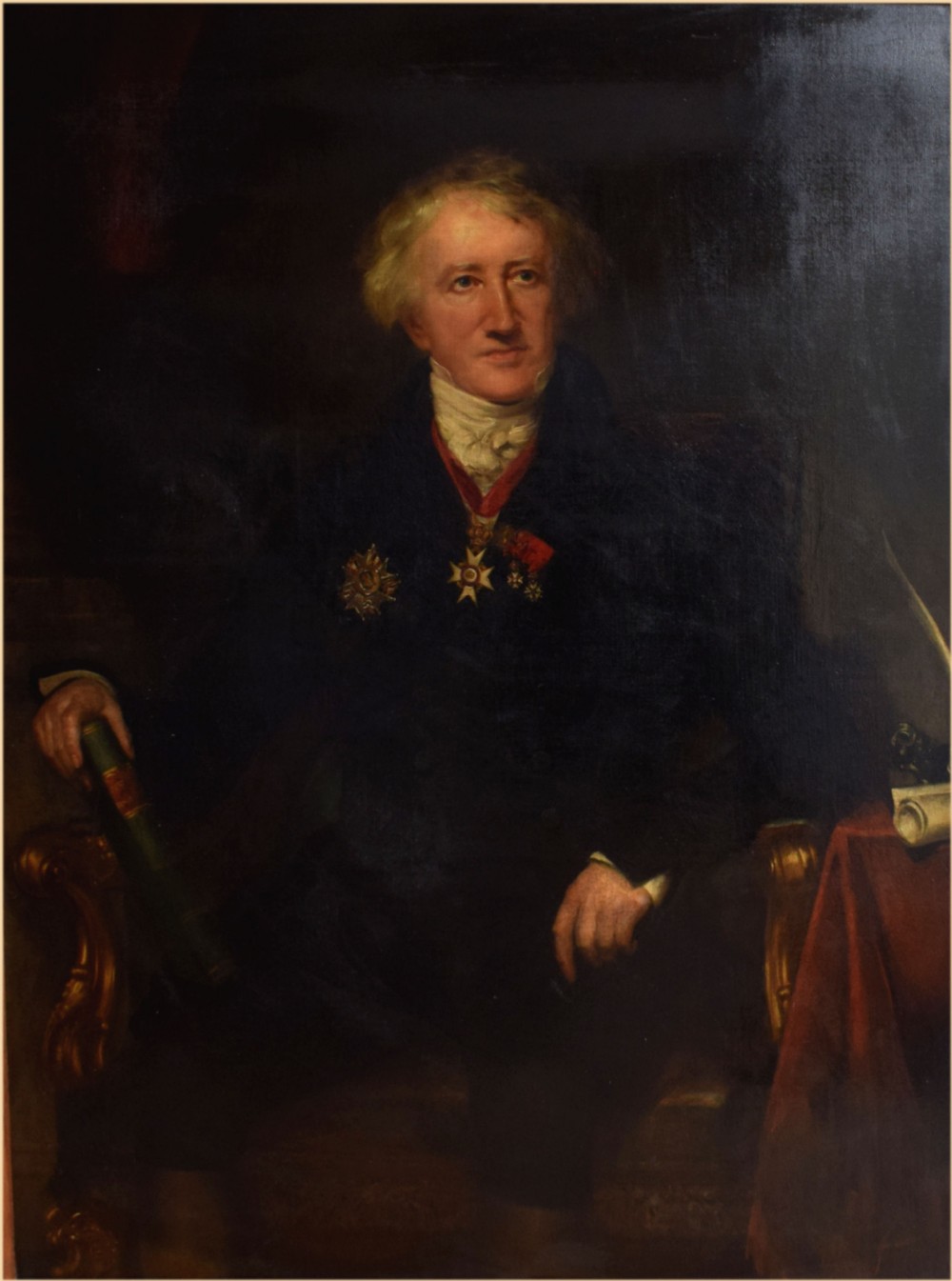
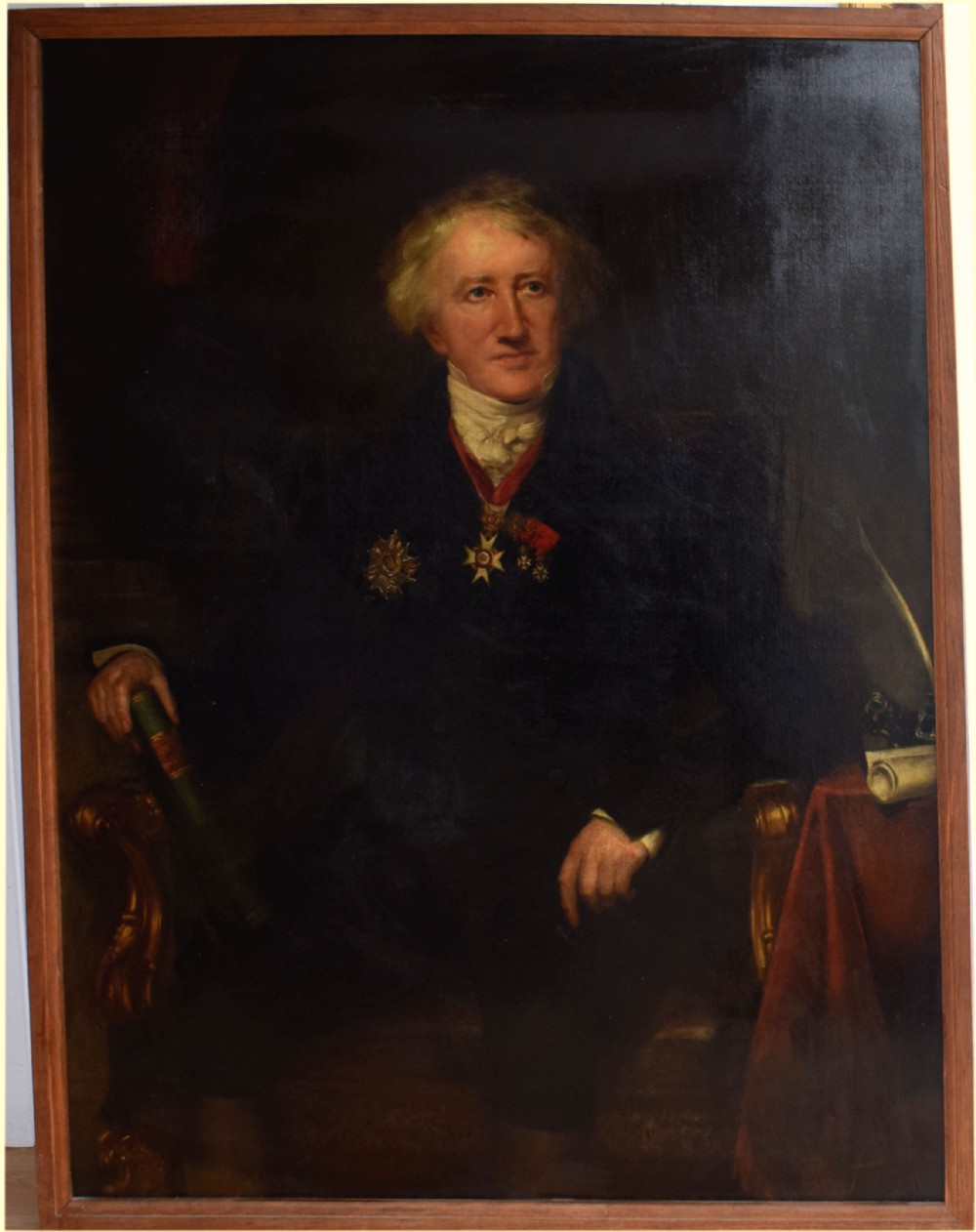
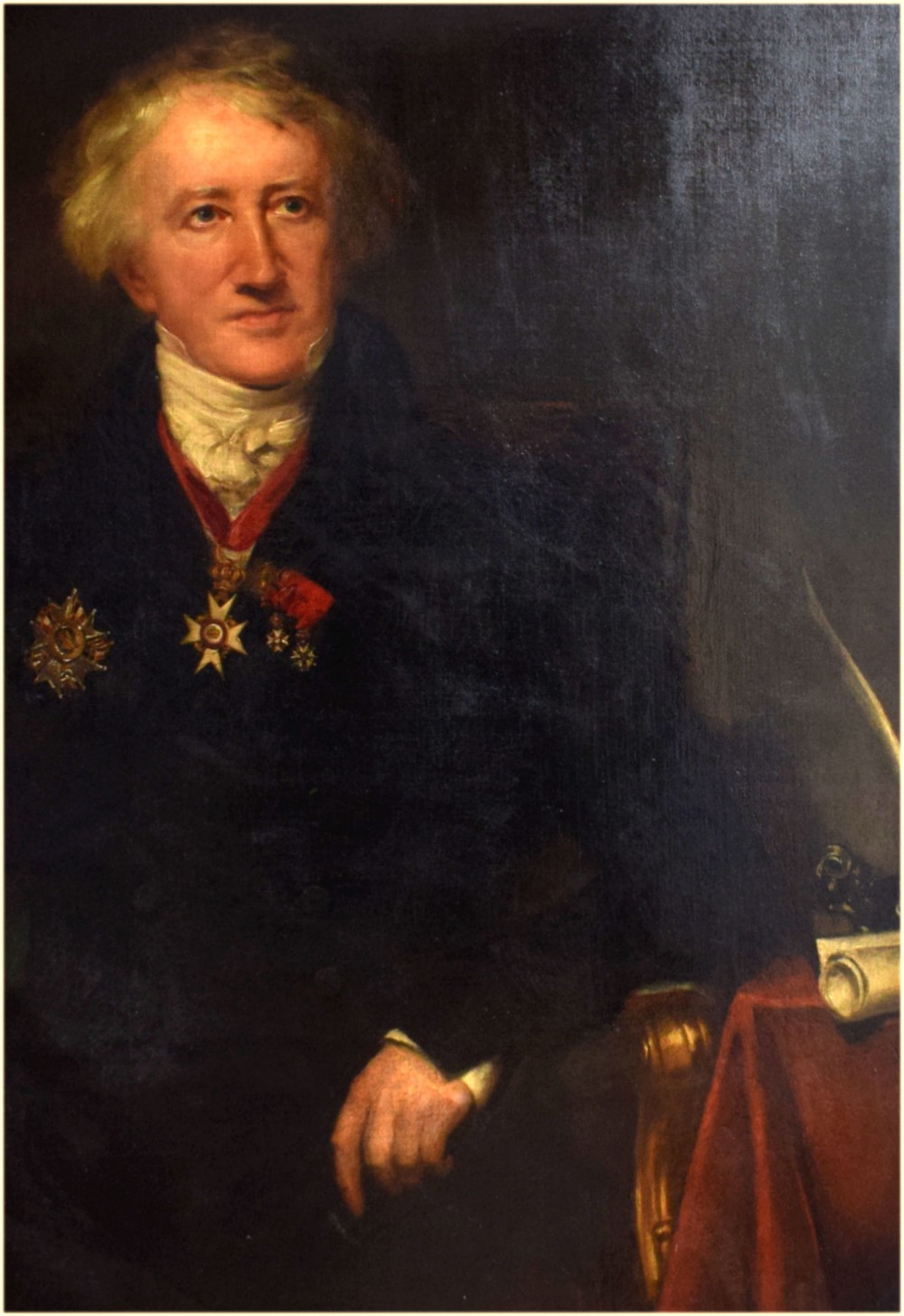
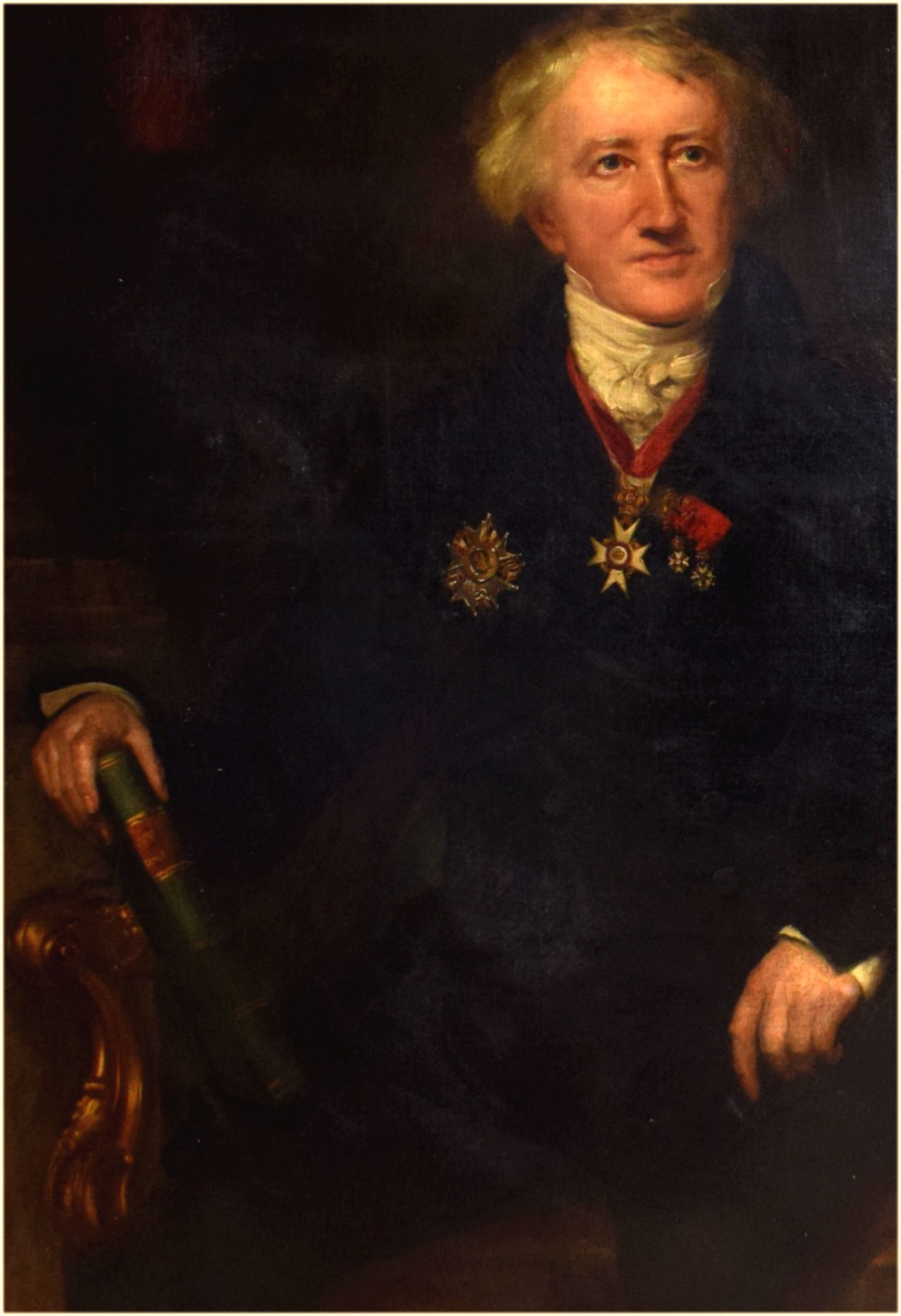
The sitter wears The Wurttemberg Order of The Crown and the Order for the Grand Officer of the Légion d’Honneur

Literature

There is a drawing and watercolour study for this portrait in the Wellcome Trust collection dated 1831 , ref 2320i

Notes

Jean Léopold Nicolas Frédéric, Baron Cuvier (1769 –1832), known as Georges Cuvier, was a French naturalist and zoologist, sometimes referred to as the "founding father of paleontology". Cuvier was a major figure in natural sciences research in the early 19th century and was instrumental in establishing the fields of comparative anatomy and paleontology through his work in comparing living animals with fossils.
Cuvier's work is considered the foundation of vertebrate paleontology, and he expanded Linnaean taxonomy by grouping classes into phyla and incorporating both fossils and living species into the classification. Cuvier is also known for establishing extinction as a fact—at the time, extinction was considered by many of Cuvier's contemporaries to be merely controversial speculation. In his Essay on the Theory of the Earth (1813) Cuvier proposed that now-extinct species had been wiped out by periodic catastrophic flooding events. In this way, Cuvier became the most influential proponent of catastrophism in geology in the early 19th century. His study of the strata of the Paris basin with Alexandre Brongniart established the basic principles of biostratigraphy.
Among his other accomplishments, Cuvier established that elephant-like bones found in North America belonged to an extinct animal he later would name as a mastodon, and that a large skeleton dug up in present-day Argentina was of Megatherium, a giant, prehistoric ground sloth. He named the pterosaur Pterodactylus, described (but did not discover or name) the aquatic reptile Mosasaurus, and was one of the first people to suggest the earth had been dominated by reptiles, rather than mammals, in prehistoric times.
Cuvier is also remembered for strongly opposing theories of evolution, which at the time (before Darwin's theory) were mainly proposed by Jean-Baptiste de Lamarck and Geoffroy Saint-Hilaire. Cuvier believed there was no evidence for evolution, but rather evidence for cyclical creations and destructions of life forms by global extinction events such as deluges. In 1830, Cuvier and Geoffroy engaged in a famous debate, which is said to exemplify the two major deviations in biological thinking at the time – whether animal structure was due to function or (evolutionary) morphology. Cuvier supported function and rejected Lamarck's thinking.
Cuvier also conducted racial studies which provided part of the foundation for scientific racism, and published work on the supposed differences between racial groups' physical properties and mental abilities. Cuvier subjected Sarah Baartman to examinations alongside other French naturalists during a period in which she was held captive in a state of neglect. Cuvier examined Baartman shortly before her death, and conducted an autopsy following her death that disparagingly compared her physical features to those of monkeys.
Cuvier's most famous work is Le Règne Animal (1817; English: The Animal Kingdom). In 1819, he was created a peer for life in honor of his scientific contributions. Thereafter, he was known as Baron Cuvier. He died in Paris during an epidemic of cholera. Some of Cuvier's most influential followers were Louis Agassiz on the continent and in the United States, and Richard Owen in Britain. His name is one of the 72 names inscribed on the Eiffel Tower.

Portrait by François-André Vincent, 1795

Jean Léopold Nicolas Frédéric Cuvier was born in Montbéliard, where his Protestant ancestors had lived since the t

Physical Dimensions
Height
138cm (54.33")
Width
106cm (41.73")
Depth
2cm (0.79")
Declaration

Artware Fineart has dated this Antique Portrait Oil Painting to the 19th Century.

Reference Numbers
Sellingantiques Reference
SA957540
Dealers Internal Reference
4770
Description
Henry William Pickersgill 1782-1875

PORTRAIT OF JEAN LEOPOLD NICOLAS FREDERIC, BARON CUVIER 1769-1832

oil on canvas

138 x 106 cm.

The sitter wears The Wurttemberg Order of The Crown and the Order for the Grand Officer of the Légion d’Honneur.
Artware Fineart
fig 1. An antique oil painting on canvas depicting a seated gentleman with white hair wearing a dark coat decorated with medals, holding a green book beside a red-draped table.
fig 1. Henry William Pickersgill 1782-1875 Portrait of Jean Leopold Nicolas Frederic, Baron Cuvier 1769-1832

Literature

There is a drawing and watercolour study for this portrait in the Wellcome Trust collection dated 1831 , ref 2320i

Notes

Jean Léopold Nicolas Frédéric, Baron Cuvier (1769 –1832), known as Georges Cuvier, was a French naturalist and zoologist, sometimes referred to as the "founding father of paleontology". Cuvier was a major figure in natural sciences research in the early 19th century and was instrumental in establishing the fields of comparative anatomy and paleontology through his work in comparing living animals with fossils.

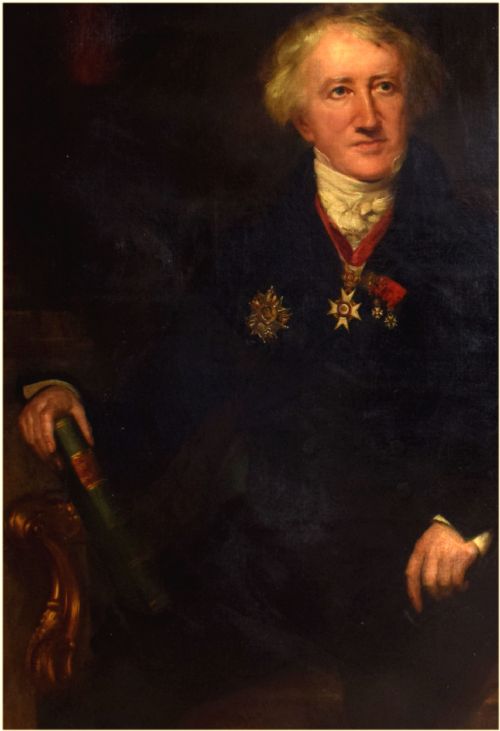
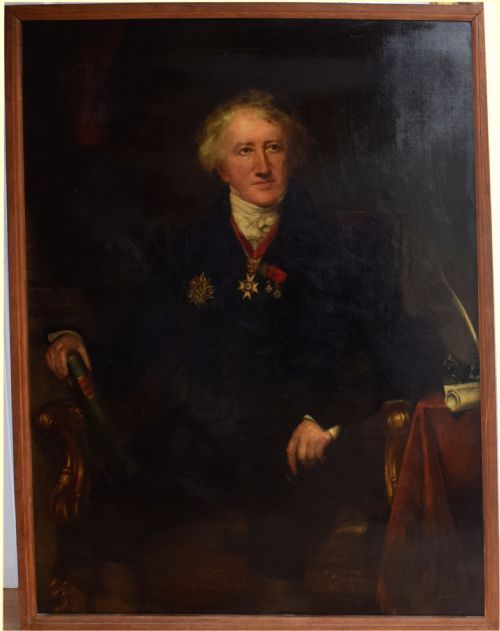
fig 2. An antique oil painting on canvas depicting a seated gentleman with white hair wearing a dark coat decorated with medals, holding a green book beside a red-draped table.
fig 2. Henry William Pickersgill 1782-1875 Portrait of Jean Leopold Nicolas Frederic, Baron Cuvier 1769-1832

Cuvier's work is considered the foundation of vertebrate paleontology, and he expanded Linnaean taxonomy by grouping classes into phyla and incorporating both fossils and living species into the classification. Cuvier is also known for establishing extinction as a fact—at the time, extinction was considered by many of Cuvier's contemporaries to be merely controversial speculation. In his Essay on the Theory of the Earth (1813) Cuvier proposed that now-extinct species had been wiped out by periodic catastrophic flooding events. In this way, Cuvier became the most influential proponent of catastrophism in geology in the early 19th century. His study of the strata of the Paris basin with Alexandre Brongniart established the basic principles of biostratigraphy.

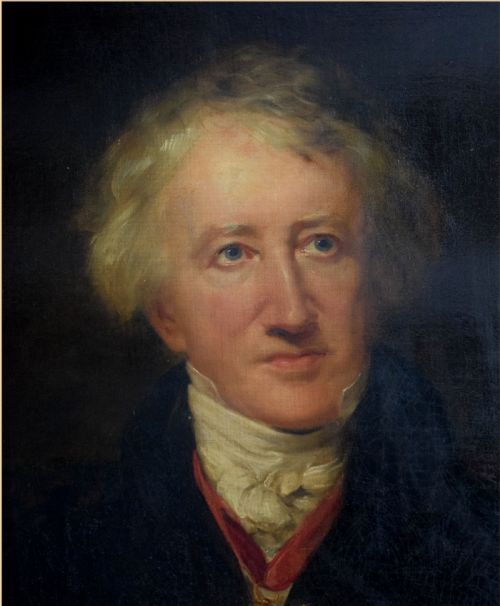
fig 3. An antique oil painting on canvas depicting a seated gentleman with white hair wearing a dark coat decorated with medals, holding a green book beside a red-draped table.
fig 3. Henry William Pickersgill 1782-1875 Portrait of Jean Leopold Nicolas Frederic, Baron Cuvier 1769-1832

Among his other accomplishments, Cuvier established that elephant-like bones found in North America belonged to an extinct animal he later would name as a mastodon, and that a large skeleton dug up in present-day Argentina was of Megatherium, a giant, prehistoric ground sloth. He named the pterosaur Pterodactylus, described (but did not discover or name) the aquatic reptile Mosasaurus, and was one of the first people to suggest the earth had been dominated by reptiles, rather than mammals, in prehistoric times.

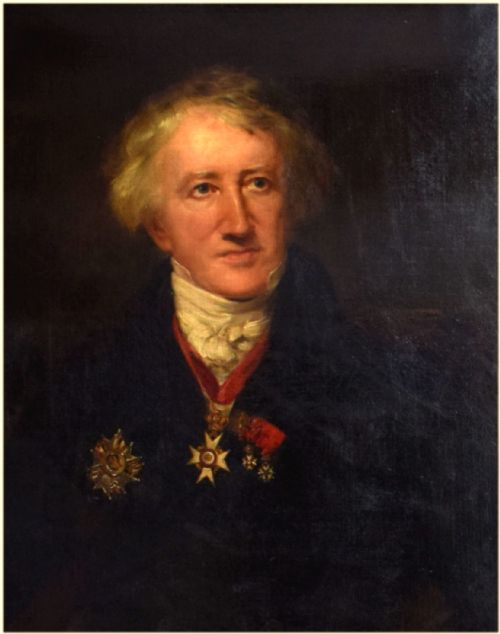
fig 4. An antique oil painting on canvas depicting a seated gentleman with white hair wearing a dark coat decorated with medals, holding a green book beside a red-draped table.
fig 4. Henry William Pickersgill 1782-1875 Portrait of Jean Leopold Nicolas Frederic, Baron Cuvier 1769-1832

Cuvier is also remembered for strongly opposing theories of evolution, which at the time (before Darwin's theory) were mainly proposed by Jean-Baptiste de Lamarck and Geoffroy Saint-Hilaire. Cuvier believed there was no evidence for evolution, but rather evidence for cyclical creations and destructions of life forms by global extinction events such as deluges. In 1830, Cuvier and Geoffroy engaged in a famous debate, which is said to exemplify the two major deviations in biological thinking at the time – whether animal structure was due to function or (evolutionary) morphology. Cuvier supported function and rejected Lamarck's thinking.

fig 5. An antique oil painting on canvas depicting a seated gentleman with white hair wearing a dark coat decorated with medals, holding a green book beside a red-draped table.
fig 5. Henry William Pickersgill 1782-1875 Portrait of Jean Leopold Nicolas Frederic, Baron Cuvier 1769-1832

Cuvier also conducted racial studies which provided part of the foundation for scientific racism, and published work on the supposed differences between racial groups' physical properties and mental abilities. Cuvier subjected Sarah Baartman to examinations alongside other French naturalists during a period in which she was held captive in a state of neglect. Cuvier examined Baartman shortly before her death, and conducted an autopsy following her death that disparagingly compared her physical features to those of monkeys.

fig 6. An antique oil painting on canvas depicting a seated gentleman with white hair wearing a dark coat decorated with medals, holding a green book beside a red-draped table.
fig 6. Henry William Pickersgill 1782-1875 Portrait of Jean Leopold Nicolas Frederic, Baron Cuvier 1769-1832

Cuvier's most famous work is Le Règne Animal (1817; English: The Animal Kingdom). In 1819, he was created a peer for life in honor of his scientific contributions. Thereafter, he was known as Baron Cuvier. He died in Paris during an epidemic of cholera. Some of Cuvier's most influential followers were Louis Agassiz on the continent and in the United States, and Richard Owen in Britain. His name is one of the 72 names inscribed on the Eiffel Tower.

Portrait by François-André Vincent, 1795

Jean Léopold Nicolas Frédéric Cuvier was born in Montbéliard, where his Protestant ancestors had lived since the t

Height
138cm (54.33")
Width
106cm (41.73")
Depth
2cm (0.79")
Date of Manufacture

Artware Fineart has dated this Antique Portrait Oil Painting to the 19th Century.

Reference Numbers
Sellingantiques Ref
SA957540
Dealers Internal Ref
4770
Artware Fineart
Sellingantiques verified Since Sep 2008
Dealer Profile

You can view the stock and full dealer information on the Artware Fineart Profile Page

PDF SHARE
SAVE
An antique oil painting on canvas depicting a seated gentleman with white hair wearing a dark coat decorated with medals, holding a green book beside a red-draped table.
1 / 7
Archive I An antique oil painting on canvas depicting a seated gentleman with white hair wearing a dark coat decorated with medals, holding a green book beside a red-draped table.

Henry William Pickersgill 1782-1875 Portrait of Jean Leopold Nicolas Frederic, Baron Cuvier 1769-1832
Archive II An antique oil painting on canvas depicting a seated gentleman with white hair wearing a dark coat decorated with medals, holding a green book beside a red-draped table. View II
Archive III An antique oil painting on canvas depicting a seated gentleman with white hair wearing a dark coat decorated with medals, holding a green book beside a red-draped table. View III
Archive IV An antique oil painting on canvas depicting a seated gentleman with white hair wearing a dark coat decorated with medals, holding a green book beside a red-draped table. View IV
Archive V An antique oil painting on canvas depicting a seated gentleman with white hair wearing a dark coat decorated with medals, holding a green book beside a red-draped table. View V
Archive VI An antique oil painting on canvas depicting a seated gentleman with white hair wearing a dark coat decorated with medals, holding a green book beside a red-draped table. View VI
Archive VII An antique oil painting on canvas depicting a seated gentleman with white hair wearing a dark coat decorated with medals, holding a green book beside a red-draped table. View VII
FURTHER BROWSING

Visitors also looked at these ⇣

Enlarged Archival View
Telephone 07958 699 645
Location
18 La Gare
51 Surrey Row
London
SE1 0BZ
United Kingdom
Verified Since Sep 2008
Items For Sale 243
Items Sold 223
Artware Fineart
Verified Since Sep 2008
View Dealer Info
Location: 18 La Gare , 51 Surrey Row , London , SE1 0BZ , United Kingdom
Verified
Sep 2008
For Sale
243
Sold
223
An antique oil painting on canvas depicting a seated gentleman with white hair wearing a dark coat decorated with medals, holding a green book beside a red-draped table.
Henry William Pickersgill 1782-1875 PORTRAIT OF JEAN LEOPOLD NICOLAS FREDERIC, BARON CUVIER 1769-1832
Ref: SA957540
An antique oil painting on canvas depicting a seated gentleman with white hair wearing a dark coat decorated with medals, holding a green book beside a red-draped table.
Detail View 1
Detail View 2
Detail View 3
Detail View 4
Detail View 5
Detail View 6
Archival Detail
Every single antique dealer on our platform is individually approved by our internal team. We verify their professional trade history, ethical standards, and photographic quality to ensure a secure, high-standard buying environment. Upon joining, every dealer agrees to a strict 9-point code of conduct. While issues can occasionally arise, our dealers typically resolve them swiftly and directly with the buyer. In fact, since our founding in 2002, Sellingantiques has only had to step in to help resolve an issue on roughly five occasions—a true testament to the quality of our dealers and their dedication to your happiness.
Our dealers are highly experienced in packing and shipping fragile, high-value antiques. Because you are in direct contact with the dealer, you will be able to easily go through all available shipping and insurance options together to ensure your item arrives safely.
Antiques are the ultimate green purchase. By choosing historical pieces over newly manufactured goods, you completely eliminate the carbon footprint of modern mass production while preserving exceptional, timeless craftsmanship.

Early 19th-century British portraiture is defined by formal academic realism, dark backgrounds, and strong chiaroscuro lighting. Sitters were frequently depicted with attributes of their profession, status, or intellect, such as medals, documents, and books.

Portraits from this era were traditionally executed using oil paint composed of natural pigments and linseed oil applied onto stretched linen canvas. Frames were typically carved wood finished with gold leaf gesso.

Authentic period paintings display uniform craquelure across the oil surface consistent with natural aging. The reverse side generally features dark, oxidised canvas linen, hand-cut wooden stretcher bars, and historic gallery or auction labels.

A large oil portrait acts as a focal point when positioned above a fireplace mantelpiece or a timber sideboard. It creates striking visual contrast when hung against contemporary dark paint colours or within a traditional gallery wall arrangement.

Keep the canvas away from direct sunlight, radiators, and areas of high humidity to prevent paint cracking and canvas warping. Dust the surface very gently with a soft dry brush, and consult a professional restorer for varnish cleaning.
items
Add keywords to the filter
Price
£100
£250000
Era
Movements
Material
Origin
Stock Location
Freshness
Online Payments
Categories