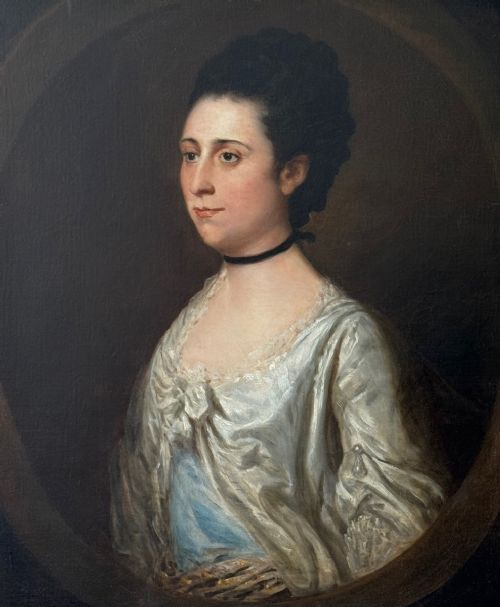
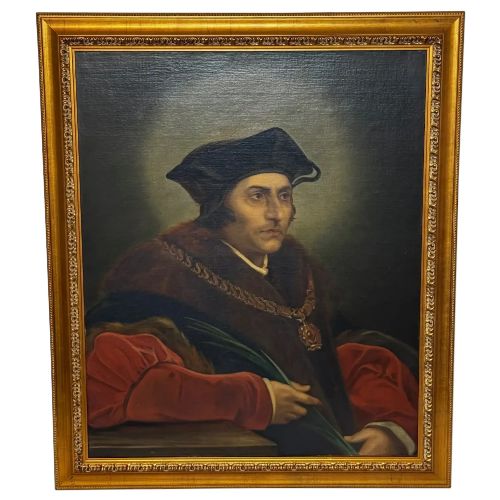
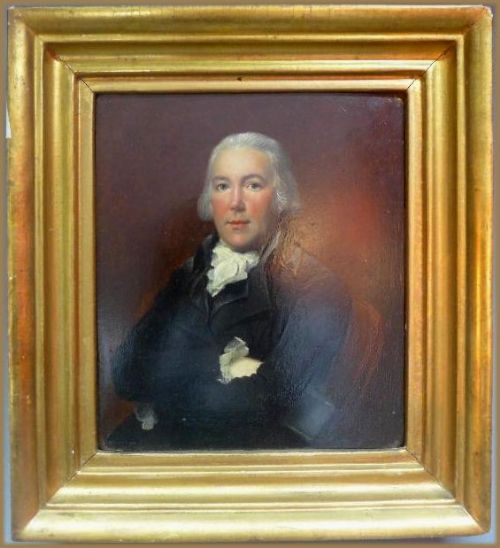
Artware Fineart has dated this Georgian Oil Portrait Painting to the 18th Century.
Portrait of William Woodville, MD, FRS, FLS, 1752–1805, Physician and Botanist
William Woodville, MD, FRS, FLS,
oil on panel, modello
20 x 17 cm . (8 x 7 in.)
inscribed in sepia ink exetsively on the reverse "William Woodville, MD, FRS, FLS, /Physician to the Middlesex Hospital and Small Pox Hospital/ Born at Lowswaid 1752 dield in London 1805/ This portrait was the property of Dr Woodville's friend Dr Piel, and was bequeathed by him together with his own portrait to Joseph Steel esq of Cockermouth who's son Edward Steel presented it to William …….of Birkby
Provenance
Dr Piel
Joseph Steel esq of Cockermouth
Edward Steel
William …….of Birkby
Notes
He came from a family of well-to-do Quakers, and was initially educated at a local grammar school. He began his medical training in 1767 with a short apprenticeship to William Birtwhistle, an apothecary. He later matriculated at Edinburgh University, graduating MD in 1775 with a thesis on irritable fibres. Woodville returned to Cumberland to practise in Papcastle, until a tragic incident in 1778 interrupted his career. One night he fired a gun through a window and killed a man who had been creating a disturbance in his garden. Although this was generally accepted as an accident, Woodville was disowned by his Quaker meeting and left the county to set up practice in Denbigh. By 1782 he had moved to London: there his career flourished. He was appointed physician to the Middlesex Dispensary, admitted as a licentiate of the Royal College of Physicians in August 1784, and became a member of the Physical Society at Guy's Hospital.
Woodville's medical career was distinguished by his contributions to the prevention of smallpox. In 1791 he was appointed physician to the London Smallpox and Inoculation Hospital at St Pancras, a charitable institution offering care to smallpox victims and free inoculation. Woodville became a staunch supporter of the procedure: in 1797 he published a pamphlet aimed at a popular audience, advocating inoculation. By this time he was also writing a major history of inoculation, probably intended as a triumphal history of the steady growth of the procedure, with an emphasis on the role of the hospital in encouraging inoculation and thus helping to control smallpox. The first of the projected two volumes of the History of the Inoculation of the Smallpox (1796) described inoculation techniques used in the Near East and the Far East, its introduction to Britain, and its gradual popularization up to 1770. However, history caught up with the project. In 1799 the second volume was announced as ready for the press but it never appeared, as the previous year Edward Jenner had announced his discovery of vaccination, which attracted considerable attention: although the older procedure was still widely used, the book would have lost much of its original purpose.
Woodville quickly switched his allegiance to vaccination and played an important role in establishing its merits. News of Jenner's discovery had aroused interest among medical men, but his source of vaccine had been lost and further experiments with the new procedure were therefore impossible. Woodville remedied this in January 1799, when he was told of an outbreak of cowpox in a London dairy. Having compared the lesions among the milkers with Jenner's illustration, Woodville took some fluid for use as vaccine at the Smallpox Hospital. The results of this action, the first large-scale trial of vaccination, were published as the Report of a Series of Inoculations for the Variolae vaccinae or Cow Pox (1799). Its case histories of two hundred vaccinations, most of which were
Artware Fineart has dated this Georgian Oil Portrait Painting to the 18th Century.
You can view the stock and full dealer information on the Artware Fineart Profile Page

Lemuel Francis Abbott, 1760-1802 Portrait of William Woodville, Md, Frs, Fls, 1752–1805, Physician and Botanist