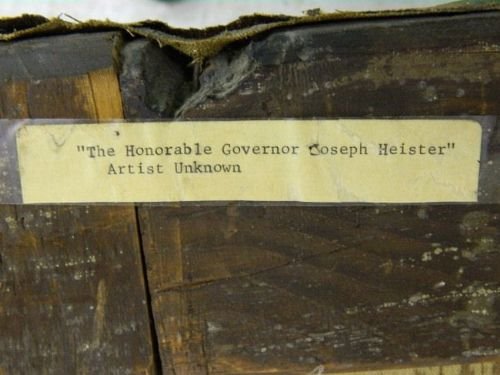
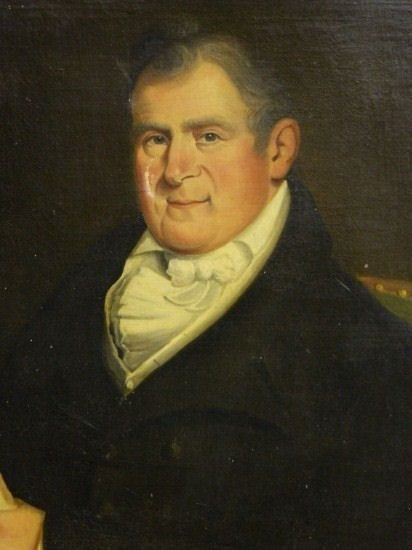
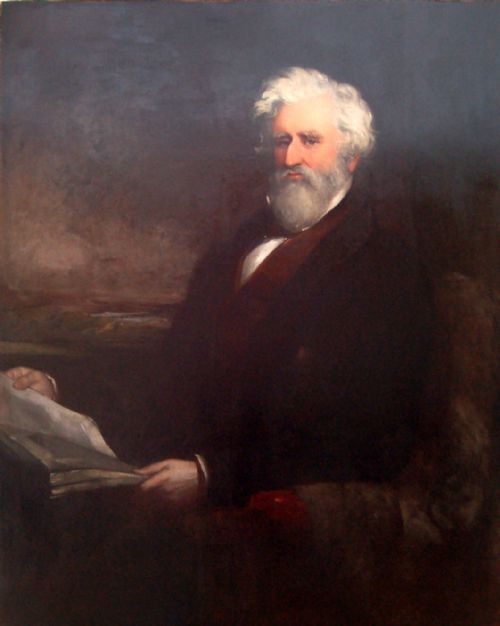
Artware Fineart has dated this 19th Century Portrait Painting to the 1800s.
circa 1810
Oil on Canvas
30 x 25in. (76 x 64cm.)
Six feet tall, weighing two hundred pounds, walking with a Malacca cane, Hiester was known as “Old German Grey,” and spoke with a lingering Pennsylvania German accent. Born November 18, 1752, to a Berks County family, John and Mary Barbara (Epler) Hiester, of the German Reformed faith, Hiester worked on the farm until 1771, when he married Elizabeth Whitman. As a captain of militia, Hiester was zealous in raising soldiers at the beginning of the Revolution and served with distinction. Captured near Long Island, he suffered harsh treatment while confined on British prison ships. After he was released in a prisoner exchange and recovered at his home in Reading, Hiester returned to duty, but was wounded in the head, in the battle of Germantown. He raised and equipped in that town a company with which he took part in the battles of Long Island and Germantown. He was promoted to colonel. He was captured and briefly confined in the prison ship “Jersey,” where he did much to alleviate the sufferings of his fellow prisoners. He was a member of the State conference in 1776 which assumed the government of the colony He was a member of the convention of 1776 that drafted the Articles of Confederation, of the Pennsylvania state constitutional convention which ratified the United States Constitution, and of the state constitutional convention of 1790. He served in the house (1787–1790) and the senate (1790–1794) of Pennsylvania. In 1807, he was appointed one of the two major generals to command the quota of Pennsylvania militia that was called for by the president. In 1779, Hiester was one of the commissioners of exchange, seizing property from Revolutionary “traitors.” From 1780 to 1805, he served five annual terms in the state House of Representatives, four in the state Senate, and then fourteen years in Congress, as well as attending the State Constitutional Convention of 1789–1790. Defeated for governor in 1817 by William Findlay, he returned triumphant in 1820 to occupy the governor’s residence, then at 21 North Front Street in Harrisburg, today the location of the Art Association of Harrisburg. He served in the United States House of Representatives from 1797 until 1805, and again from 1815 until 1820, 14 years altogether. In 1817, he ran for governor, only to be defeated by William Findlay. Hiester faced Findlay again in 1820 and narrowly won a single term in office. Refusing on principle to stand for re-election in 1823,he served until 1824 when he retired from public life. During his term, he presided over the dedication of the first state capitol building in the new capital of Harrisburg. He was elected as a Republican to the Fifth Congress to fill the vacancy caused by the resignation of George Ege; reelected to the Sixth, Seventh, and Eighth Congresses and served from December 1, 1797, to March 3, 1805; major general of Pennsylvania Militia in 1807; elected to the Fourteenth, Fifteenth, and Sixteenth Congresses and served from March 4, 1815, until his resignation in December 1820, having been elected chief executive of the State; Governor of Pennsylvania 1820-1824; Social progress occurred while he was in office, although not credited to the governor, but he is credited with helping to extend additional education for citizens at little cost and he presided over the dedication of the first state capitol building in Harrisburg. Hiester died on June 10, 1832, was originally interred in Reading’s Reformed Church Burying Ground, and later reinterred in Charles Evans Cemetery, Reading. He has a residence hall on the Penn State University Park campus named after him.
Artware Fineart has dated this 19th Century Portrait Painting to the 1800s.
You can view the stock and full dealer information on the Artware Fineart Profile Page

American School 19th Century