12,535  PAGES BROWSED TODAY PAGES TODAY 36  ANTIQUES UPLOADED TODAY NEW ARRIVALS
ID #SA961250
FOR SALE
£2,800
Email
Save
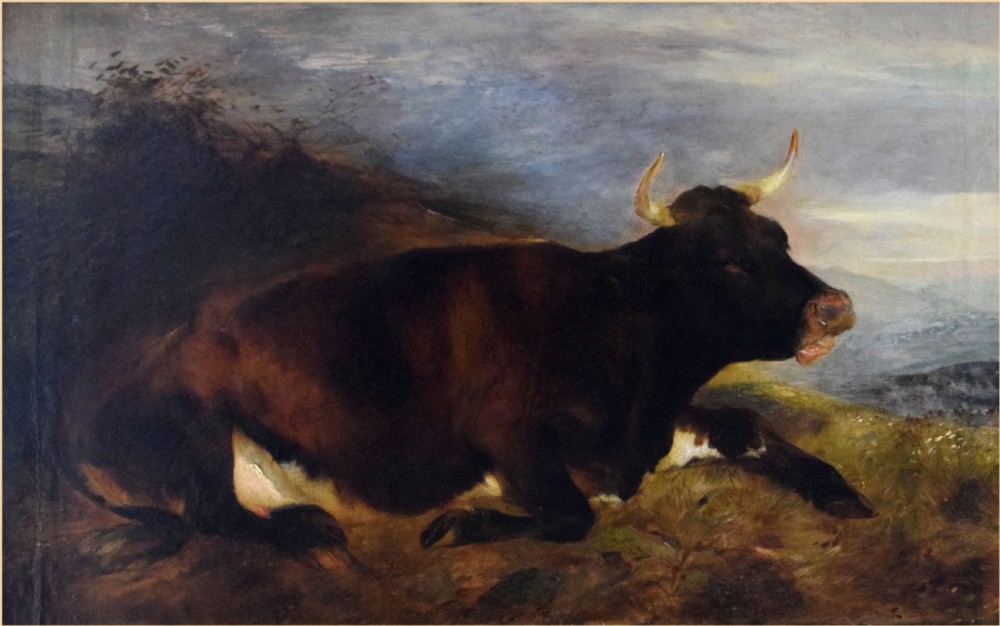
William Huggins 1820 – 1884 A Recumbant Hereford Cow
Artware Fineart
for sale €3,276     $3,556
£2,800

Artware Fineart

Sellingantiques Verified Since Sep 2008
View Dealers Stock Page
Id #SA961250
PDF SHARE
SAVE

William Huggins 1820 – 1884 A Recumbant Hereford Cow

19th century
For Sale by Artware Fineart
Description

William Huggins 1820 – 1884

A Recumbant Hereford Cow

signed inscribed and dated on various labels on the reverse

oil on panel

32 x 52 cm.

inscribed on a label on the reverse " By Wm Huggins Date 1856" and further inscribed on another label " Exchange Art Gallery Oil Painting The Brown C../ William Hu…"

Notes

The Hereford is a British breed of beef cattle originally from Herefordshire in the West Midlands of England. It has spread to many countries – there are more than five million purebred Hereford cattle in over fifty nations worldwide. The breed was first exported from Britain in 1817, initially to Kentucky. It spread across the United States and Canada, through Mexico, to the great beef-raising countries of South America. Today Herefords dominate from Australasia to the Russian steppes, including Israel, Japan, continental Europe and Scandinavia, temperate parts of Australia, Canada, the United States, Kazakhstan and Russia, the centre and east of Argentina, Uruguay, Chile, and New Zealand, where they make up the largest proportion of registered cattle. They are found all over Brazil and in some Southern African countries, notably South Africa, Zambia and Zimbabwe. Their original popularity among ranchers of the American Southwest testified to the hardiness of a breed originating in cool, moist Britain, but shown to thrive in harsher climates on nearly every continent. The World Hereford Council, is based in Britain. There are currently 20 Hereford societies in 17 member-countries and a further eight in 10 non-member countries. In the United States, the official Hereford organization and breed registry is the American Hereford Association, the second-largest society of its kind in the country.

Until the 18th century, the cattle of Herefordshire resembled other cattle of southern England, being wholly red with a white switch, similar to the modern North Devon and Sussex breeds. In the 18th and early 19th centuries, other cattle (mainly Shorthorns) were used to create a new type of draught and beef cattle which at first varied in colour, with herds ranging from yellow to grey and light brown, and with varying amounts of white. By the end of the 18th century the white face characteristic of the modern breed was well established, as was the modern colour during the 19th century.

The Hereford is still seen in the Herefordshire countryside today and featured strongly at agricultural shows. The first imports of Herefords to the United States were made about 1817 by the politician Henry Clay, with larger importation beginning in the 1840s. The Polled Hereford is a hornless variant of Hereford with a polled gene, a natural genetic mutation selected into a separate breed from 1889.

Iowa cattle rancher Warren Gammon capitalised on the idea of breeding Polled Herefords and started the registry with 11 naturally polled cattle. The American Polled Hereford Association (APHA) was formed in 1910. The American Polled Hereford and American Hereford breeds have been combined since 1995 under the same American Hereford Association name. Many strains of Hereford have used other cattle breeds to import desired characteristics, which has led to changes in the breed as a whole. However, some strains have been kept separate and retained characteristics of the earlier breed, such as hardiness and thriftiness. The Traditional Hereford is now treated as a minority breed of value for genetic conservation.

Eye cancer (ocular squamous cell carcinoma) occurs in Herefords, notably in countries with continued bright sunlight and among those that prefer traits of low levels of red pigmentation round the eye. Studies of eye cancer in Hereford cattle in the US and Canada showed lid and corneoscleral pigment to be heritable and likely to decrease the risk of cancer. Vaginal prolapse is considered a heritable problem, but may also be in

Physical Dimensions
Height
32cm (12.60")
Width
52cm (20.47")
Depth
2cm (0.79")
Declaration

Artware Fineart has dated this Victorian Cattle Oil Painting to the 19th Century.

Reference Numbers
Sellingantiques Reference
SA961250
Dealers Internal Reference
4440
Description
William Huggins 1820 – 1884

A Recumbant Hereford Cow

signed inscribed and dated on various labels on the reverse

oil on panel

32 x 52 cm.

inscribed on a label on the reverse " By Wm Huggins Date 1856" and further inscribed on another label " Exchange Art Gallery Oil Painting The Brown C.
Artware Fineart

./ William Hu…"

fig 1. An oil painting depicting a dark brown cow lying down on a grassy hill under a cloudy sky.
fig 1. William Huggins 1820 – 1884 A Recumbant Hereford Cow

Notes

The Hereford is a British breed of beef cattle originally from Herefordshire in the West Midlands of England. It has spread to many countries – there are more than five million purebred Hereford cattle in over fifty nations worldwide. The breed was first exported from Britain in 1817, initially to Kentucky. It spread across the United States and Canada, through Mexico, to the great beef-raising countries of South America. Today Herefords dominate from Australasia to the Russian steppes, including Israel, Japan, continental Europe and Scandinavia, temperate parts of Australia, Canada, the United States, Kazakhstan and Russia, the centre and east of Argentina, Uruguay, Chile, and New Zealand, where they make up the largest proportion of registered cattle. They are found all over Brazil and in some Southern African countries, notably South Africa, Zambia and Zimbabwe. Their original popularity among ranchers of the American Southwest testified to the hardiness of a breed originating in cool, moist Britain, but shown to thrive in harsher climates on nearly every continent. The World Hereford Council, is based in Britain. There are currently 20 Hereford societies in 17 member-countries and a further eight in 10 non-member countries. In the United States, the official Hereford organization and breed registry is the American Hereford Association, the second-largest society of its kind in the country.

fig 2. An oil painting depicting a dark brown cow lying down on a grassy hill under a cloudy sky.
fig 2. William Huggins 1820 – 1884 A Recumbant Hereford Cow

Until the 18th century, the cattle of Herefordshire resembled other cattle of southern England, being wholly red with a white switch, similar to the modern North Devon and Sussex breeds. In the 18th and early 19th centuries, other cattle (mainly Shorthorns) were used to create a new type of draught and beef cattle which at first varied in colour, with herds ranging from yellow to grey and light brown, and with varying amounts of white. By the end of the 18th century the white face characteristic of the modern breed was well established, as was the modern colour during the 19th century.

fig 3. An oil painting depicting a dark brown cow lying down on a grassy hill under a cloudy sky.
fig 3. William Huggins 1820 – 1884 A Recumbant Hereford Cow

The Hereford is still seen in the Herefordshire countryside today and featured strongly at agricultural shows. The first imports of Herefords to the United States were made about 1817 by the politician Henry Clay, with larger importation beginning in the 1840s. The Polled Hereford is a hornless variant of Hereford with a polled gene, a natural genetic mutation selected into a separate breed from 1889.

fig 4. An oil painting depicting a dark brown cow lying down on a grassy hill under a cloudy sky.
fig 4. William Huggins 1820 – 1884 A Recumbant Hereford Cow

Iowa cattle rancher Warren Gammon capitalised on the idea of breeding Polled Herefords and started the registry with 11 naturally polled cattle. The American Polled Hereford Association (APHA) was formed in 1910. The American Polled Hereford and American Hereford breeds have been combined since 1995 under the same American Hereford Association name. Many strains of Hereford have used other cattle breeds to import desired characteristics, which has led to changes in the breed as a whole. However, some strains have been kept separate and retained characteristics of the earlier breed, such as hardiness and thriftiness. The Traditional Hereford is now treated as a minority breed of value for genetic conservation.

fig 5. An oil painting depicting a dark brown cow lying down on a grassy hill under a cloudy sky.
fig 5. William Huggins 1820 – 1884 A Recumbant Hereford Cow

Eye cancer (ocular squamous cell carcinoma) occurs in Herefords, notably in countries with continued bright sunlight and among those that prefer traits of low levels of red pigmentation round the eye. Studies of eye cancer in Hereford cattle in the US and Canada showed lid and corneoscleral pigment to be heritable and likely to decrease the risk of cancer. Vaginal prolapse is considered a heritable problem, but may also be in

Height
32cm (12.60")
Width
52cm (20.47")
Depth
2cm (0.79")
Date of Manufacture

Artware Fineart has dated this Victorian Cattle Oil Painting to the 19th Century.

Reference Numbers
Sellingantiques Ref
SA961250
Dealers Internal Ref
4440
Artware Fineart
Sellingantiques verified Since Sep 2008
Dealer Profile

You can view the stock and full dealer information on the Artware Fineart Profile Page
PDF SHARE
SAVE
An oil painting depicting a dark brown cow lying down on a grassy hill under a cloudy sky.
1 / 6
Archive I An oil painting depicting a dark brown cow lying down on a grassy hill under a cloudy sky.

William Huggins 1820 – 1884 A Recumbant Hereford Cow

Archive II An oil painting depicting a dark brown cow lying down on a grassy hill under a cloudy sky. View II
Archive III An oil painting depicting a dark brown cow lying down on a grassy hill under a cloudy sky. View III
Archive IV An oil painting depicting a dark brown cow lying down on a grassy hill under a cloudy sky. View IV
Archive V An oil painting depicting a dark brown cow lying down on a grassy hill under a cloudy sky. View V
Archive VI An oil painting depicting a dark brown cow lying down on a grassy hill under a cloudy sky. View VI
FURTHER BROWSING

Visitors also looked at these ⇣

Enlarged Archival View
Telephone 07958 699 645
Location
18 La Gare
51 Surrey Row
London
SE1 0BZ
United Kingdom
Verified Since Sep 2008
Items For Sale 243
Items Sold 223
Artware Fineart
Verified Since Sep 2008
View Dealer Info
Location: 18 La Gare , 51 Surrey Row , London , SE1 0BZ , United Kingdom
Verified
Sep 2008
For Sale
243
Sold
223
An oil painting depicting a dark brown cow lying down on a grassy hill under a cloudy sky.
William Huggins 1820 – 1884 A Recumbant Hereford Cow
Ref: SA961250
An oil painting depicting a dark brown cow lying down on a grassy hill under a cloudy sky.
Detail View 1
Detail View 2
Detail View 3
Detail View 4
Detail View 5
Archival Detail
Every single antique dealer on our platform is individually approved by our internal team. We verify their professional trade history, ethical standards, and photographic quality to ensure a secure, high-standard buying environment. Upon joining, every dealer agrees to a strict 9-point code of conduct. While issues can occasionally arise, our dealers typically resolve them swiftly and directly with the buyer. In fact, since our founding in 2002, Sellingantiques has only had to step in to help resolve an issue on roughly five occasions—a true testament to the quality of our dealers and their dedication to your happiness.
Our dealers are highly experienced in packing and shipping fragile, high-value antiques. Because you are in direct contact with the dealer, you will be able to easily go through all available shipping and insurance options together to ensure your item arrives safely.
Antiques are the ultimate green purchase. By choosing historical pieces over newly manufactured goods, you completely eliminate the carbon footprint of modern mass production while preserving exceptional, timeless craftsmanship.

During the nineteenth century, livestock portraiture gained prominence in Britain as landowners sought to showcase prized breeds and pastoral wealth through detailed oil paintings. Artists specialized in capturing anatomical accuracy and rural atmosphere for agricultural patrons.

Nineteenth-century oil paintings were typically executed using ground earth and mineral pigments suspended in linseed oil on stretched linen or cotton canvas. Artists built up layers using glazes and impasto to create depth and realistic light effects.

Authentic Victorian oil paintings often exhibit natural age-related craquelure across the paint surface, historic canvas stretchers, and period signatures or inscriptions. Examination under ultraviolet light can also reveal original varnish layers and historical retouching.

A nineteenth-century pastoral painting can serve as a focal point above a fireplace mantel or sideboard in both contemporary and classic settings. Pairing dark, traditional oil artwork with minimalist furniture or muted walls creates a balanced contrast between heritage fine art and modern design.

Keep oil paintings away from direct sunlight, high humidity, and heat sources to prevent cracking or darkening of the varnish. Light dusting with a soft, clean brush is recommended, while structural cleaning or restoration should be left to professional conservators.
items
Add keywords to the filter
Price
£100
£250000
Era
Movements
Material
Origin
Stock Location
Freshness
Online Payments
Categories