




English Livestock Artwork
English livestock artwork captures the rural economy and pastoral pride of the nineteenth and early twentieth centuries through detailed oils and watercolours.
English Livestock Artwork
English livestock artwork brings the nineteenth and early twentieth-century agricultural landscape directly into domestic interiors through painted depictions of prized cattle, sheep, horses, and poultry.
The pieces appearing here lean heavily into Victorian pastoral realism, Victorian animalier, and English folk art traditions.
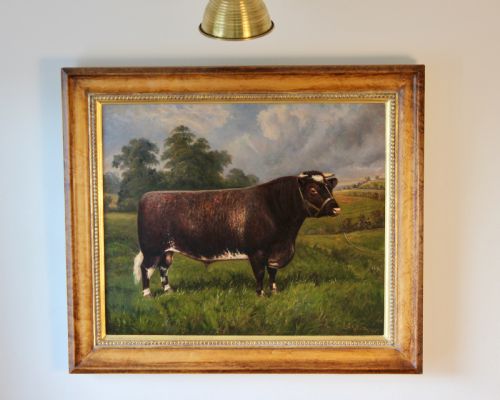
Oil on canvas and watercolour painting dominate the selection, framed typically in period gesso and gilded wood.
Materials and methods
Artists painted primarily in oil on canvas or applied watercolour to paper, employing traditional pigments to capture the texture of coats and fleece.
Many works retain their original gesso and gilded wood frames, showing period techniques in moulding and joining.
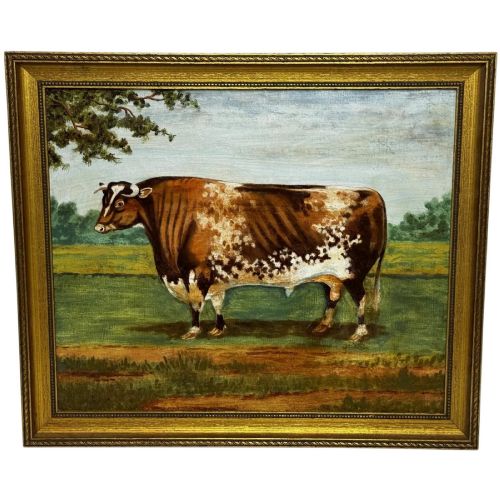
Even prize-winning shorthorns occasionally shared the canvas with cheeky cockerels and wandering chicks.
Judging quality
Quality rests upon the anatomical accuracy of the animal subjects and the naturalism of the surrounding pastoral landscape.
Works by recognised hands command greater attention than naive or anonymous studio pieces, though charm persists across the board.
Frederick Septimus Lewis·Thomas Sidney Cooper·Basil Bradley·Arthur Charles Dodd·W A Clark·Edgar Hunt·Henry Cheadle·William Sidney Cooper·William Huggins·A Davis·Thomas Baker of Leamington
The English Livestock Artwork Glossary
- Animalier
- A term for artists who specialised in the realistic depiction of animals. This focus shaped much of the nineteenth-century pastoral output.
- Gesso
- A plaster-like mixture applied to wooden frames before gilding. It provides a smooth base for intricate decorative moulding.
- Pastoral Realism
- An artistic movement focused on truthful scenes of rural life and agriculture. It prioritised accurate observation of fields and farm animals.
- Watercolour
- A paint consisting of pigment suspended in a water-based solution applied to paper. It offers luminous transparency and fluid detail.
English Livestock Artwork: Frequently Asked Questions
What subjects appear in these paintings?
These works primarily feature cattle, sheep, horses, and poultry depicted within rural or farmyard settings.
Scenes range from solitary prize bulls to herds resting by rivers and streams.
How do I care for these watercolours?
Watercolours on paper require protection from direct sunlight to prevent fading of the pigments.
Keep them in stable room environments away from excessive moisture.
How are these different from general landscapes?
Livestock artwork places specific agricultural focus on domesticated animals as the primary subject rather than scenery.
Human figures and buildings serve merely to contextualise the pastoral economy.