



Traditional Agricultural Art
Traditional agricultural art captures the historic rhythms of rural labour, livestock and the land through oil paintings, watercolours and wooden models.
Traditional Agricultural Art
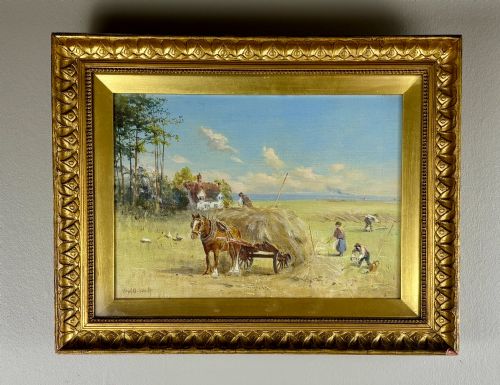
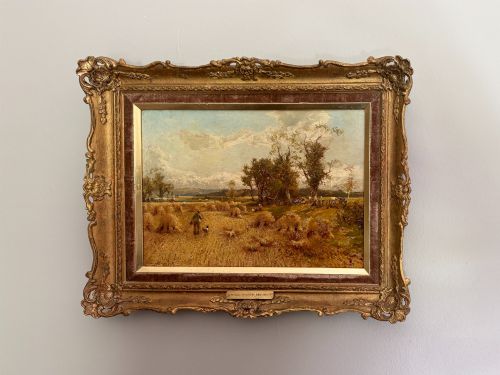
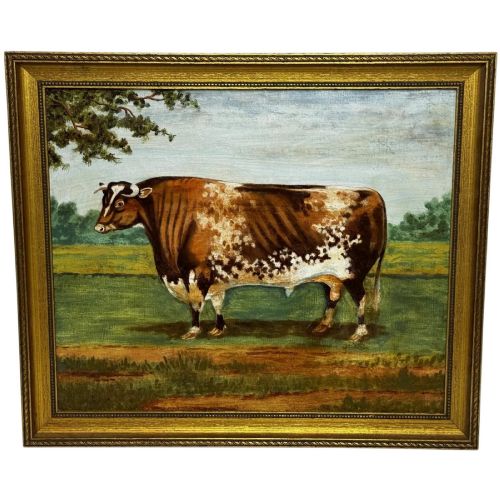
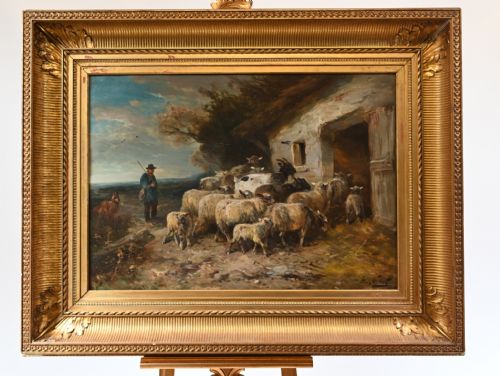
Traditional agricultural art focuses on nineteenth-century and early twentieth-century rural scenes, depicting heavy horses, cattle and farmworkers across British and European landscapes. Buyers encounter oil paintings on canvas alongside watercolours and occasional hand-made wooden models or utilitarian pieces like shoulder yokes.
The dominant forms are framed oil paintings and watercolours depicting haymaking, ploughing and farmyard livestock by named artists. These works record agrarian life through various regional schools and academic traditions from the Victorian era onward.
Materials and construction
Painters utilised oil paint and watercolour applied to stretched canvas or paper, capturing textures of hair, fleece and weathered timber. Canvases frequently sit within period gesso frames that complement the tonal depth of the rural subjects.
Three-dimensional pieces employ carved wood, seen in handmade scale models and steam-bent beech dairy maid's shoulder yokes shaped for physical labour on the farm.
The selection spans from the Victorian period through the nineteen-thirties, using oil on canvas, watercolour, wood and gesso.
Factors of quality
Quality rests upon anatomical precision in rendering animals and the natural handling of light across fields and farmyards. Stronger works demonstrate assured brushwork that defines the weight of heavy horses and the atmospheric conditions of harvest time.
The integration of canvas and period framing contributes significantly to the integrity of a piece. Finer watercolours and oil paintings maintain paper and pigment stability without excessive restoration obscuring the original touch of the hand.
Henry Schouten·James Kyd·Herbert Royle·James William Booth·Thomas Sidney Cooper·George Cole·William Huggins·Ernest Higgins Rigg
The Traditional Agricultural Art Glossary
- Gesso
- A plaster-like material applied to wooden frames before gilding or painting. It provides a smooth ground for decorative mouldings.
- Watercolour
- A painting method where fine pigment is suspended in a water-soluble binder. Artists apply it to paper to create translucent washes.
- Shoulder yoke
- A curved wooden bar fitted to human shoulders for carrying heavy buckets or milk pails. Beech is the standard timber used for strength.
- Oil on canvas
- Pigment bound in oil applied to a woven fabric stretched across a wooden frame. This combination allows for rich colour blending and durability.
Traditional Agricultural Art: Frequently Asked Questions
What subjects appear most often?
These works concentrate heavily on ploughing teams, shire horses, shorthorn bulls and sheep flocks tended by farmworkers. Haymaking and harvest scenes set within rural landscapes also recur frequently.
Artists focused on the daily realities of farming life, recording specific agricultural breeds and regional British or European countryside before mechanisation altered the landscape.
How should I display an oil painting?
Oil paintings on canvas require stable indoor environments away from direct sunlight and sudden temperature shifts. Hang them on internal walls using appropriate fixings suited to the weight of the frame.
Keeping the canvas away from direct heat sources prevents the gesso frame and the woven support from drying out or warping over time.
Are watercolours framed differently?
Watercolours on paper need protection behind glass with acid-free mounts to prevent pigment fading and paper degradation. They are sensitive to bright light and damp conditions.
Ensure the backing board is sealed properly to keep out dust and moisture while allowing the delicate paper surface to breathe safely.
Can I date these pieces accurately?
Dating relies on stylistic clues, artist signatures, framing methods and canvas stamps from period suppliers. Victorian and Edwardian works often carry distinct academic signatures or exhibition labels.
Comparing the clothing, agricultural implements and livestock breeds depicted also helps narrow down the decade of production between the mid-nineteenth and mid-twentieth centuries.