46,840  PAGES BROWSED TODAY PAGES TODAY 182 ANTIQUES UPLOADED TODAYNEW ARRIVALS
182 ITEMS ADDED TODAY
Sort Order
Items Per Page
Browse Categories
Sort order
Relevant Links
Items per page
ID #SA1206531
SOLD
Email
Save
Rare Henry George Murphy Sterling Silver Sugar Sifter Hallmarked 1929
William Morris Antiques
sold SA1206531
Sorry, but this item has been sold.

William Morris Antiques

Sellingantiques Verified Since Jul 2020
View Dealers Stock Page
  • About Us
    Jess william morris established himself in the antiques business in 1999 after being awarded an rics accredited fine art valuation degree
Id #SA1206531
PDF SHARE
SAVE

Rare Henry George Murphy Sterling Silver Sugar Sifter Hallmarked 1929

1920 - 1940
Description

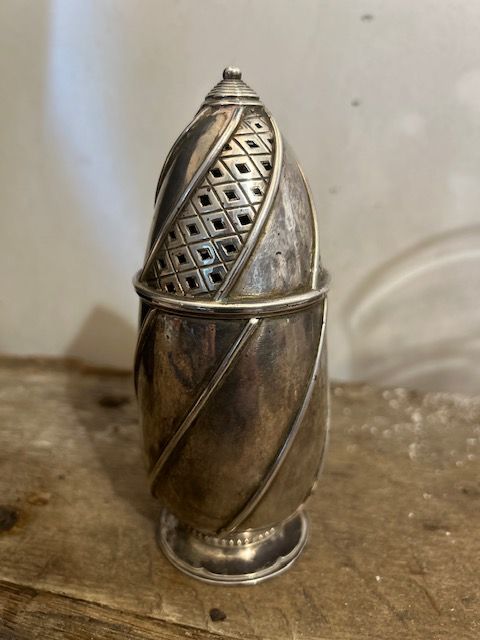
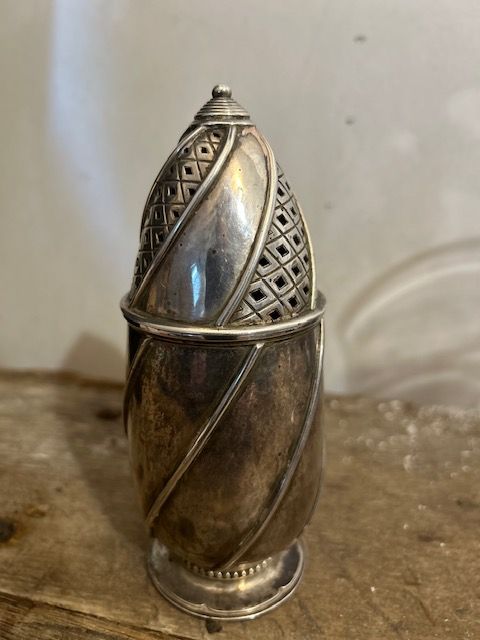
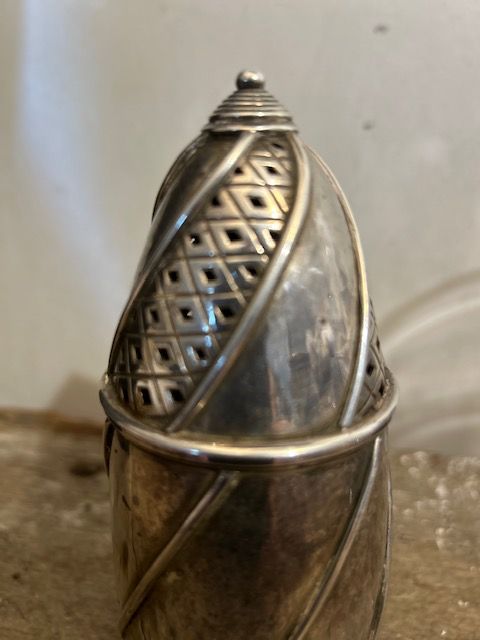
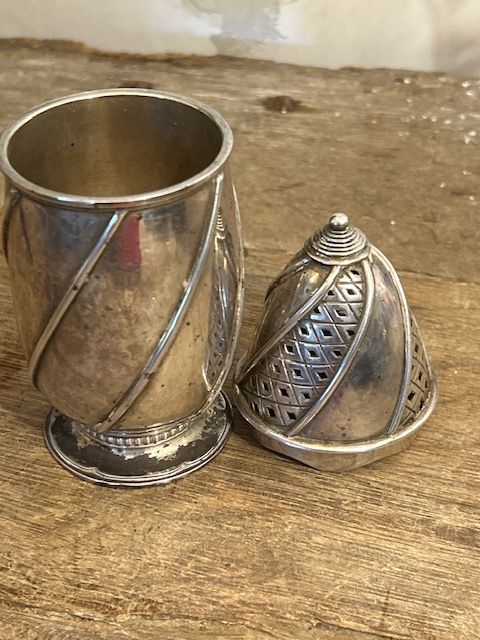
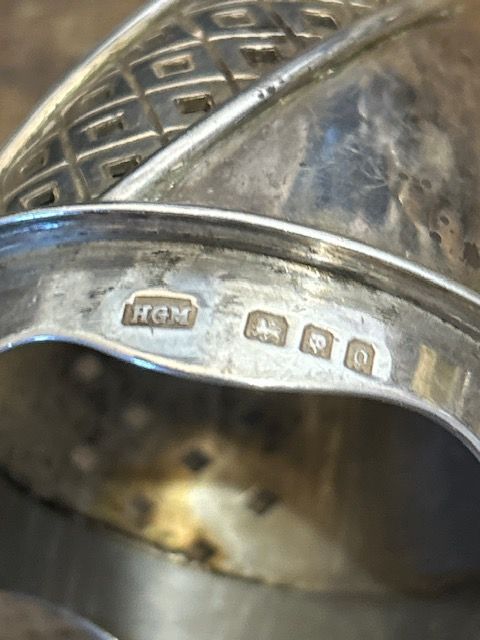
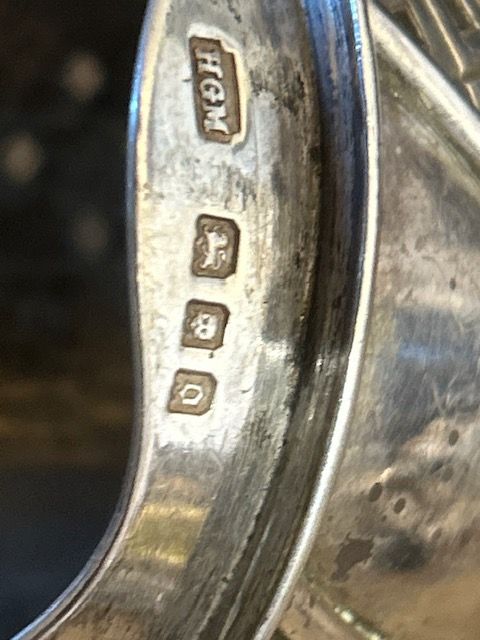
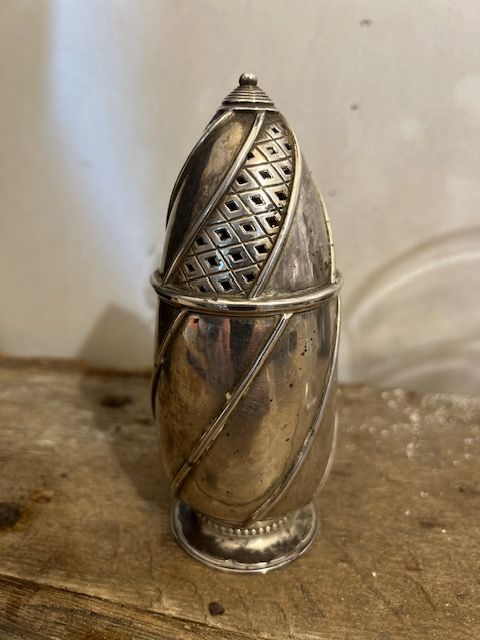
A Rare Henry George Murphy Sterling silver sugar Sifter Hallmarked London 1929.

The quintessential Art Deco design to this bullet shaped sugar sifter was typical of the work of Henry George Murphy.one of the preeminent silversmiths of the early 20thc.
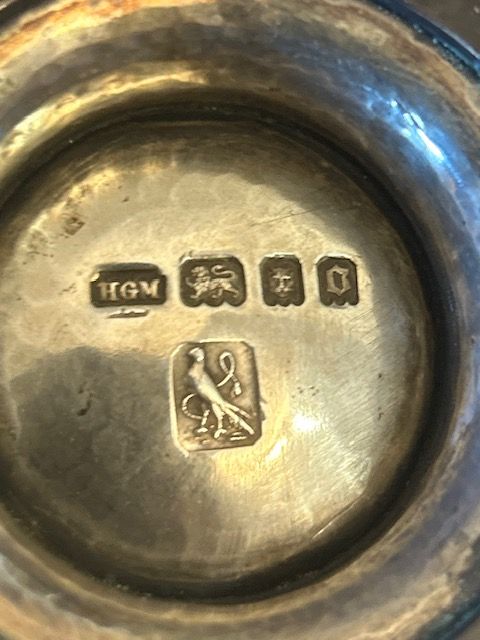
The base also bears the Falcon studio mark used betwen 1928 and 1939.

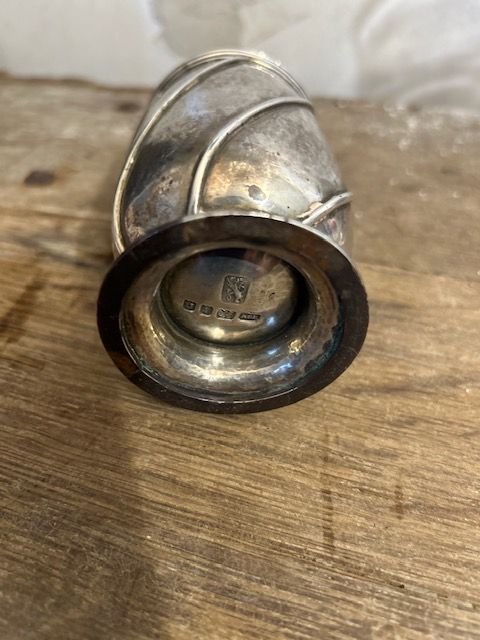
Corresponding hallmarks to inside of the lid.

The piece is in very good overall condition

Dimensions:14cm high

5.5cm diameter

Weight 259 grams
Henry George (Harry) Murphy was born on 27th October 1884 at Birchington, Kent. After the death of his father (1895) the family transferred to London (Kensington) where the young Harry entered in contact with Henry Wilson, member of the Art Workers Guild, being taken as apprentice. When his apprenticeship ended Murphy stayed on at the Wilson's workshop as a full-fledged craftsman working in Kensington and later at Wilson's studio in St Mary's Platt, Kent.
He was inspired by Wilson, whose personal style drew on Gothic and Renaissance designs, favouring the use of bright enamels in intricate settings. Murphy's style evolved a similar look to that of Wilson, developing his skill in the decorative techniques of enamelling and niello to the highest level.
In 1904 Harry enrolled as a student at the Central School of Arts and crafts and, whilst still a student, joined the staff as a teacher at the Royal College of Art.

Left the Royal College of Art (1911), Harry became a teacher of goldsmithing, jewellery and enamelling at the Central School of Arts (1912).
In 1912 Murphy set up his own business and workshop in London where his growing reputation attracted increasing attention and a booming business.

The outbreak of WWI had a devastating effect on his business and in 1915 Murphy closed his workshop and enlisted in The Royal Naval Air Service.
In 1919 Murphy was demobilised and he returned to teaching unable to reopen his workshop premises due to unaffordable rent.

As his work continued to be appreciated and was still very much in demand in 1928 Murphy opened a workshop in Weymouth Street, Marylebone under the style "The Falcon Studio", deriving this name from that of his wife Jessie, being "Jess" the leather strap fastened around each leg of a hawk in falconry.
Despite the success of its production "The Falcon Studio" suffered financial problems and Murphy obtained in 1932 the position of Head of Silversmithing and, soon after, the post of Principal of the Central School of Arts and crafts.
The life of Murphy became increasingly stressful, divided between the work at the school and the trade on "The Falcon Studio".

In 1935 "The Falcon Studio", together with its retail shop, moved to 22 Marylebone High Street. The business side was managed by Jessie who commuted daily to London.

During the latter half of 1938 many years of over work and stress began to take their toll on Murphy's health. During 1939 he became progressively weaker and on July 10th he died.

During his lifetime H.G.Murphy had a reputation second to none being the Britain's leading jewellery designer of the early part of the twentieth century and one of the most influential and accomplished silversmiths of the Art Deco and Arts & Crafts periods. However, the hard war years immediately following his death and the social and cultural changes evident after 1945 simply meant that pre-war Murphy was considered obsolete and irrelevant and his work was simply forgotten.

Fortunately in 2005 the exhibition "At the Sign of the Falcon: H.G. Murphy - Art Deco Silversmith and Jeweller" held at the Goldsmiths' Hall in London have allowed to rediscover an author inexplicably unmentioned by most history books of the latter part of the 20th century and collected by only an avid few.

Physical Dimensions
Height
14cm (5.51")
Width
5.5cm (2.17")
Depth
5.5cm (2.17")
Declaration

William Morris Antiques has dated this Sterling Silver Sugar Sifter to the 1930s.

Reference Numbers
Sellingantiques Reference
SA1206531
Description
A Rare Henry George Murphy Sterling silver sugar Sifter Hallmarked London 1929.
The quintessential Art Deco design to this bullet shaped sugar sifter was typical of the work of Henry George Murphy.
William Morris Antiques

one of the preeminent silversmiths of the early 20thc.

fig 1. An Art Deco sterling silver sugar sifter with a spiral ribbed body and geometric pierced top.
fig 1. Rare Henry George Murphy Sterling Silver Sugar Sifter Hallmarked 1929

The base also bears the Falcon studio mark used betwen 1928 and 1939.

Corresponding hallmarks to inside of the lid.

The piece is in very good overall condition

Dimensions:14cm high

5.5cm diameter

Weight 259 grams

fig 2. An Art Deco sterling silver sugar sifter with a spiral ribbed body and geometric pierced top.
fig 2. Rare Henry George Murphy Sterling Silver Sugar Sifter Hallmarked 1929

Henry George (Harry) Murphy was born on 27th October 1884 at Birchington, Kent. After the death of his father (1895) the family transferred to London (Kensington) where the young Harry entered in contact with Henry Wilson, member of the Art Workers Guild, being taken as apprentice. When his apprenticeship ended Murphy stayed on at the Wilson's workshop as a full-fledged craftsman working in Kensington and later at Wilson's studio in St Mary's Platt, Kent.

fig 3. An Art Deco sterling silver sugar sifter with a spiral ribbed body and geometric pierced top.
fig 3. Rare Henry George Murphy Sterling Silver Sugar Sifter Hallmarked 1929

He was inspired by Wilson, whose personal style drew on Gothic and Renaissance designs, favouring the use of bright enamels in intricate settings. Murphy's style evolved a similar look to that of Wilson, developing his skill in the decorative techniques of enamelling and niello to the highest level.

fig 4. An Art Deco sterling silver sugar sifter with a spiral ribbed body and geometric pierced top.
fig 4. Rare Henry George Murphy Sterling Silver Sugar Sifter Hallmarked 1929

In 1904 Harry enrolled as a student at the Central School of Arts and crafts and, whilst still a student, joined the staff as a teacher at the Royal College of Art.

Left the Royal College of Art (1911), Harry became a teacher of goldsmithing, jewellery and enamelling at the Central School of Arts (1912).

fig 5. An Art Deco sterling silver sugar sifter with a spiral ribbed body and geometric pierced top.
fig 5. Rare Henry George Murphy Sterling Silver Sugar Sifter Hallmarked 1929

In 1912 Murphy set up his own business and workshop in London where his growing reputation attracted increasing attention and a booming business.

The outbreak of WWI had a devastating effect on his business and in 1915 Murphy closed his workshop and enlisted in The Royal Naval Air Service.

fig 6. An Art Deco sterling silver sugar sifter with a spiral ribbed body and geometric pierced top.
fig 6. Rare Henry George Murphy Sterling Silver Sugar Sifter Hallmarked 1929

In 1919 Murphy was demobilised and he returned to teaching unable to reopen his workshop premises due to unaffordable rent.

As his work continued to be appreciated and was still very much in demand in 1928 Murphy opened a workshop in Weymouth Street, Marylebone under the style "The Falcon Studio", deriving this name from that of his wife Jessie, being "Jess" the leather strap fastened around each leg of a hawk in falconry.

fig 7. An Art Deco sterling silver sugar sifter with a spiral ribbed body and geometric pierced top.
fig 7. Rare Henry George Murphy Sterling Silver Sugar Sifter Hallmarked 1929

Despite the success of its production "The Falcon Studio" suffered financial problems and Murphy obtained in 1932 the position of Head of Silversmithing and, soon after, the post of Principal of the Central School of Arts and crafts.

fig 8. An Art Deco sterling silver sugar sifter with a spiral ribbed body and geometric pierced top.
fig 8. Rare Henry George Murphy Sterling Silver Sugar Sifter Hallmarked 1929

The life of Murphy became increasingly stressful, divided between the work at the school and the trade on "The Falcon Studio".

In 1935 "The Falcon Studio", together with its retail shop, moved to 22 Marylebone High Street. The business side was managed by Jessie who commuted daily to London.

During the latter half of 1938 many years of over work and stress began to take their toll on Murphy's health. During 1939 he became progressively weaker and on July 10th he died.

During his lifetime H.G.Murphy had a reputation second to none being the Britain's leading jewellery designer of the early part of the twentieth century and one of the most influential and accomplished silversmiths of the Art Deco and Arts & Crafts periods. However, the hard war years immediately following his death and the social and cultural changes evident after 1945 simply meant that pre-war Murphy was considered obsolete and irrelevant and his work was simply forgotten.

Fortunately in 2005 the exhibition "At the Sign of the Falcon: H.G. Murphy - Art Deco Silversmith and Jeweller" held at the Goldsmiths' Hall in London have allowed to rediscover an author inexplicably unmentioned by most history books of the latter part of the 20th century and collected by only an avid few.

Height
14cm (5.51")
Width
5.5cm (2.17")
Depth
5.5cm (2.17")
Date of Manufacture

William Morris Antiques has dated this Sterling Silver Sugar Sifter to the 1930s.

Reference Numbers
Sellingantiques Ref
SA1206531
William Morris Antiques
Sellingantiques verified Since Jul 2020

Jess william morris established himself in the antiques business in 1999 after being awarded an rics accredited fine art valuation degree

Dealer Profile

You can view the stock and full dealer information on the William Morris Antiques Profile Page
PDF SHARE
SAVE
An Art Deco sterling silver sugar sifter with a spiral ribbed body and geometric pierced top.
1 / 9
Archive I An Art Deco sterling silver sugar sifter with a spiral ribbed body and geometric pierced top.

Rare Henry George Murphy Sterling Silver Sugar Sifter Hallmarked 1929

Archive II An Art Deco sterling silver sugar sifter with a spiral ribbed body and geometric pierced top. View II
Archive III An Art Deco sterling silver sugar sifter with a spiral ribbed body and geometric pierced top. View III
Archive IV An Art Deco sterling silver sugar sifter with a spiral ribbed body and geometric pierced top. View IV
Archive V An Art Deco sterling silver sugar sifter with a spiral ribbed body and geometric pierced top. View V
Archive VI An Art Deco sterling silver sugar sifter with a spiral ribbed body and geometric pierced top. View VI
Archive VII An Art Deco sterling silver sugar sifter with a spiral ribbed body and geometric pierced top. View VII
Archive VIII An Art Deco sterling silver sugar sifter with a spiral ribbed body and geometric pierced top. View VIII
Archive IX An Art Deco sterling silver sugar sifter with a spiral ribbed body and geometric pierced top. View IX
Enlarged Archival View
Telephone 0800 324 7028
Location
115 St Georges Road
Brighton
East Sussex
BN2 1EA
United Kingdom
Verified Since Jul 2020
Items For Sale 17
Items Sold 263
William Morris Antiques
Verified Since Jul 2020
View Dealer Info
Location: 115 St Georges Road, Brighton, East Sussex, BN2 1EA, United Kingdom
Verified
Jul 2020
For Sale
17
Sold
263
An Art Deco sterling silver sugar sifter with a spiral ribbed body and geometric pierced top.
Rare Henry George Murphy Sterling Silver Sugar Sifter Hallmarked 1929
Ref: SA1206531
An Art Deco sterling silver sugar sifter with a spiral ribbed body and geometric pierced top.
Detail View 1
Detail View 2
Detail View 3
Detail View 4
Detail View 5
Detail View 6
Detail View 7
Detail View 8
Archival Detail
Every single antique dealer on our platform is individually approved by our internal team. We verify their professional trade history, ethical standards, and photographic quality to ensure a secure, high-standard buying environment. Upon joining, every dealer agrees to a strict 9-point code of conduct. While issues can occasionally arise, our dealers typically resolve them swiftly and directly with the buyer. In fact, since our founding in 2002, Sellingantiques has only had to step in to help resolve an issue on roughly five occasions—a true testament to the quality of our dealers and their dedication to your happiness.
Our dealers are highly experienced in packing and shipping fragile, high-value antiques. Because you are in direct contact with the dealer, you will be able to easily go through all available shipping and insurance options together to ensure your item arrives safely.
Antiques are the ultimate green purchase. By choosing historical pieces over newly manufactured goods, you completely eliminate the carbon footprint of modern mass production while preserving exceptional, timeless craftsmanship.

Designed primarily during the 18th to early 20th centuries, a silver sugar sifter or caster was created to sprinkle fine granulated or powdered sugar over fruit, pastries, and desserts at the dining table.

Artisan silversmiths raised or spun high-grade sterling silver into form, adding hand-chased ornamentation, geometric lattice piercing on the dome lid, and hallmarked assay stamps.

Authentic British sterling silver casters bear official assay hallmarks, including the lion passant mark for silver purity, an assay town symbol, a date letter, and a registered silversmith makers mark.

Display the piece on a dining sideboard, open kitchen shelving, or a bar cart alongside glass decanters to add historical metalwork texture to modern decor.

Wash the silver gentle warm soapy water, dry thoroughly, and lightly buff with a soft cotton polishing cloth and specialized silver cream, avoiding abrasive sponges.
items
Add keywords to the filter
Price
£100
£250000
Era
Movements
Material
Origin
Stock Location
Freshness
Online Payments
Categories