It was listed by The English Interior. Sold pieces stay on Sellingantiques as a record of what has passed through, and the next one is rarely far away.
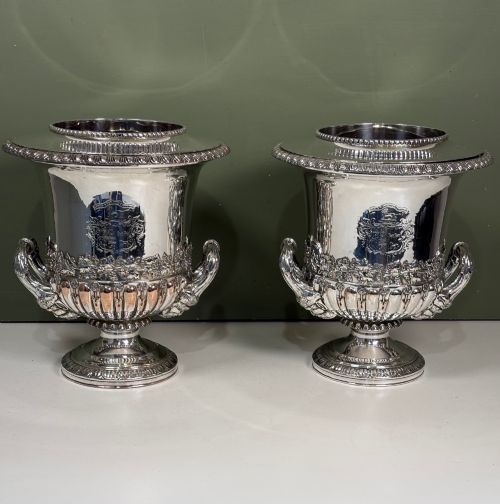
The English Interior has dated this Victorian Silver Plated Wine Cooler to the 19th Century.
In wonderful condition.

Benjamin Smith
Benjamin Smith II, London silversmith. Originally of Birmingham, born 15 December 1764, first marriage 1788. Grimwade records first mention of Benjamin Smith through a 3rd party recommendation as ‘an Ingeneous Chaser’ in 1790 to Matthew Boulton at Birmingham. By September 1792 the firm of Boulton and Smith, latchet manufacturers was in existence. In 1801 Benjamin withdrew from the partnership and went to London.

On 1 February 1802, Benjamin married for a second time to Mary Shiers at Greenwich Church and was presumably setting up the workshop there. First mark, in partnership with Digby Scott, 4 October 1802. Second mark together, 21 March 1803. The partnership apparently dissolved by 11 May 1807, when Smith entered a third separate mark. Fourth mark, 25 June 1807. Fifth mark in partnership with his brother James 1809. Sixth separate mark, 1812. Seventh mark, 1814. Eighth mark in partnership with his son Benjamin, 1816. Ninth mark alone again, 1818.

By his first marriage Smith had four sons, of whom Benjamin was the eldest and three daughters, and by Mary Shiers a fourth daughter in 1803 at Greenwich. His third son Digby, born 2 June 1797, may be assumed to be the godson of Digby Scott.

It appears that Smith was of a difficult and probably irascible nature and is this borne out by the variations in his entry of marks with and without partners. His firm was of course, together with Storr, manufacturing almost entirely for Rundell and Bridge, and it seems that the later may have supported Smith’s move to London. The firm’s most important production is probably The Jamaica Service of 1803 in The Royal Collection. The silver-gilt trays, baskets, and wine coasters with open-work vine borders are among the most distinctive and accomplished achievements. The designs, so closely related to those of Storr, most almost certainly stemmed from central control by Rundell and Bridge.
Measures: 26cm high, 24cm across fluted top, 18cm internal width.
Unmarked
Lacking liner and with very little (if any) wear to silver plate
The English Interior has dated this Victorian Silver Plated Wine Cooler to the 19th Century.
Specialist dealer in 17th century to the 20th century fine art, furniture and decorative antiques for your home.
You can view the stock and full dealer information on the The English Interior Profile Page

Victorian Silver Plated Wine Cooler - Benjamin Smith II London Maker