

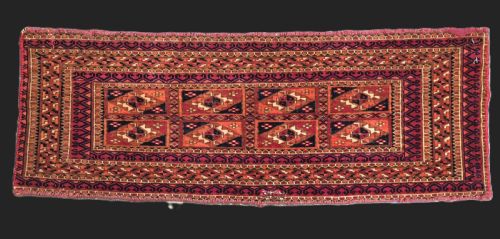
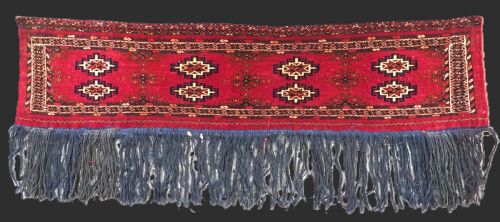


Woven Wool Torba Face
Woven wool torba face examples are traditional Central Asian tribal storage bag fronts that bring rich nomadic heritage into modern interiors.
Woven Wool Torba Face
A woven wool torba face represents the front portion of a traditional Turkmen nomadic storage bag, originating primarily from nineteenth-century Central Asian tribes such as the Tekke, Yomut, Saryk, and Ersari. These textiles served practical household functions within tribal life, often utilised for storing personal possessions inside portable dwellings.
The pieces encountered on this page span the period from the mid-nineteenth century through the early twentieth century, reflecting varied regional weaving traditions. Collectors frequently encounter individual bag faces separated from their original plain-weave wool backs, preserved specifically for their intricate geometric designs.
Tribal makers employed distinct medallion patterns known as guls, alongside secondary motifs like the curled leaf or kedjebe design, to signify specific clan lineages. Examples range from compact square formats to elongated rectangular formats, sometimes including fragments or complete storage bag assemblies.
Materials and construction
These textiles rely predominantly on hand-spun wool for both the pile and foundation structures, combined with natural dyes derived from local plants and minerals. Artisans occasionally integrated cotton foundations and silk highlights to accentuate specific pattern details within the field.
Weavers utilised asymmetric or symmetric knots tied tightly onto wool warps, producing structures that range from standard tribal densities to exceptionally fine weaves. The resulting fabric combines durability with supple handling, characteristics suited to the nomadic lifestyle of the makers.
The listings feature wool, natural dyes, hand-spun wool, silk, and cotton across nineteenth-century Central Asian tribal traditions.
Assessing quality and execution
Quality in these textiles depends heavily upon the precision of the drawing and the saturation of the natural palette, where clear contrast makes the repeating gul motifs stand out. Finer knots per square inch generally allow for sharper geometric definition and more intricate secondary ornamentation.
Condition and completeness also influence the character of each piece, distinguishing intact bag faces from fragmentary survivals. Survivals that retain balanced proportions, original side corduroy finishes, and well-preserved natural dyes represent the higher tier of tribal weaving artistry.
The Woven Wool Torba Face Glossary
- Torba
- A small Turkmen storage bag used traditionally for domestic items inside a yurt. These pieces were hung against the lattice walls.
- Gul
- A primary medallion motif repeated across tribal rugs and bag faces. Each design often corresponds to a specific tribal group or clan.
- Mafrash
- A rectangular storage bag or bedding sack produced by nomadic tribes. The faces were frequently preserved as independent decorative items.
- Kedjebe
- A camel-litter design often depicted in tribal weaving as a stepped lattice structure enclosing smaller motifs. It holds significant symbolic value in nomadic iconography.
- Natural Dyes
- Colourants extracted from roots, leaves, and insects prior to the introduction of synthetic alternatives. They yield rich, variable hues that mature gracefully over time.
Woven Wool Torba Face: Frequently Asked Questions
What is a torba face?
A torba face is the decorative front panel of a traditional Turkmen storage bag created by nomadic tribes in Central Asia. These panels were removed from their utilitarian wool backs over time to be displayed as standalone textile art.
Collectors prize them for their concentrated geometric patterns and rich natural dyes that reflect specific nineteenth-century tribal identities.
How were these bags used?
Nomadic families utilised these bags inside portable yurt dwellings for storing clothing, valuables, or domestic utensils. They hung against the lattice walls of the tent, combining practical storage with tribal status display.
Because the front panels bore the intricate weaving and primary visual designs, they survived even when the plain utility backs wore out.
How do I display a bag face?
Many collectors mount these textile panels onto neutral fabric backings or display them directly as wall hangings using specialised conservation clips. Their flat weave and balanced proportions make them suitable for framing or hanging in traditional and contemporary interiors alike.
Protection from direct sunlight helps preserve the natural wool pile and botanical dyes against fading.
How can I tell different tribes apart?
Tribal attribution relies primarily on the specific gul medallions, secondary border ornaments, and overall colour palette employed by the weavers. For instance, Tekke and Saryk pieces often feature precise octagonal guls, while Yomut examples frequently display hooked kepse motifs.
Examining the structure, wool quality, and knotting style provides further clues to regional origins across the Trans-Caspian steppes.