

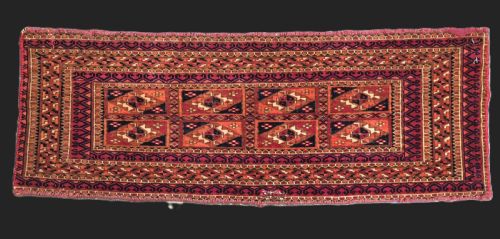
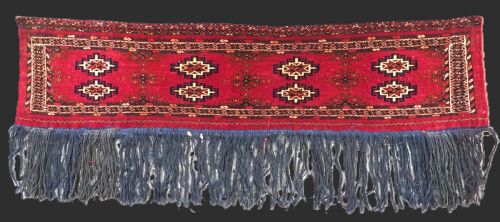
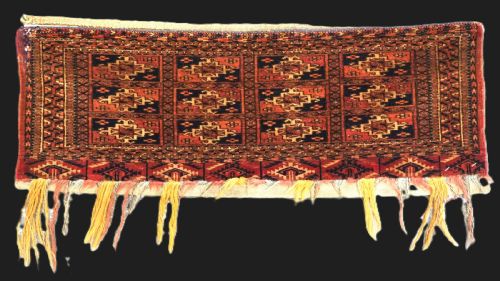


Red Wool Turkmen Torba
A red wool turkmen torba is a tribal storage bag woven by nomadic groups in Central Asia, prized by collectors for its intricate geometric guls and rich madder dyes.
Red Wool Turkmen Torba
Surviving examples on this page primarily appear as individual bag faces or complete pieces featuring plain weave backs, often retaining tassels or specific tribal formats. The corpus spans several distinct tribal traditions, including Tekke, Saryk, Yomut, and Ersari groups, each bringing their own distinct structural and decorative vocabulary to the red wool turkmen torba format.
Materials and Construction
The foundation of a red wool turkmen torba relies on hand-spun wool for the pile and structure, frequently paired with cotton or wool warps and wefts. Certain pieces incorporate supplementary materials like silk highlights for specific motifs or utilise flatweave techniques alongside pile construction.
Natural dyes provide the characteristic palette across these textiles, anchored by deep madder reds and complemented by ivory grounds, dark browns, and indigo blues. Weavers executed these designs with tight knots and structured layouts, occasionally producing very fine weaves on smaller formats.
Nomadic weavers packed these bags with blankets and dowry goods, meaning every surviving torba has spent decades leaning against the felt walls of a yurt.
Assessing Quality and Execution
Quality in a red wool turkmen torba is determined by the precision of the drawing, the saturation and depth of the natural dyes, and the density of the knotting. Finer weaves with crisp, well-proportioned guls and balanced colour distribution represent the higher end of tribal production.
The presence of complete original elements, such as plain weave backs, closing flaps, and hanging tassels, distinguishes complete functional bags from single cut faces or fragments. Additionally, scarcer design variations and unusual structural formats elevate specific examples within the broader corpus.
Tekke Tribes·Yomut Tribes·Saryk Turkmen·Ersari Turkmen
The Red Wool Turkmen Torba Glossary
- Torba
- A small Turkmen storage bag traditionally used inside a yurt. These rectangular pieces were hung against the tent wall to hold personal belongings or dowry items.
- Gul
- A repeating medallion motif used by Central Asian weavers to identify specific tribal groups and clans. These octagonal or gabled designs form the primary structure of many torba faces.
- Mafrash
- A larger rectangular storage container or bag often associated with nomadic bedding and household goods. They share construction methods with torbas.
- Asmalyk
- A large pentagonal or trapezius-shaped camel trapping used in wedding processions. Their design vocabulary occasionally influences smaller bag faces.
- Flatweave
- A textile constructed without pile by interlacing warp and weft threads together. Examples include banded designs and Soumak techniques.
Red Wool Turkmen Torba: Frequently Asked Questions
What were red wool turkmen torba bags used for?
Nomadic families utilised these bags inside traditional tents to store clothing, domestic utensils, and valuable possessions. They functioned as both practical storage units and decorative elements within the domestic space.
Many pieces also formed part of a bride's dowry, displaying the skill and status of the weaving family through intricate tribal motifs and rich red wool.
How do you identify a Tekke torba?
Tekke examples typically feature orderly rows of primary guls, such as the major gul flanked by secondary motifs, executed in a fine weave with a dominant madder red ground. The drawing tends to be precise and regular.
They also frequently display characteristic border arrangements and well-balanced proportions that separate them from Yomut or Ersari equivalents.
What is an Ersari torba with an ikat design?
Ersari weavers occasionally incorporated pattern styles borrowed from Central Asian silk ikat resist-dyed textiles into their woollen pile or flatweave torbas. This cross-cultural borrowing creates a distinct aesthetic.
These pieces combine traditional tribal framing with flowing, undulating patterns that differ from the strict geometric guls of the Tekke or Saryk traditions.
How do I care for an antique torba?
Protect the wool textile from direct sunlight to prevent natural dye fading, and ensure the room maintains stable humidity levels. Gentle vacuuming through a mesh screen helps remove dust without damaging the pile.
If hung on a wall, distribute the weight evenly using a padded sleeve or proper conservation mounting rather than piercing the fabric.