
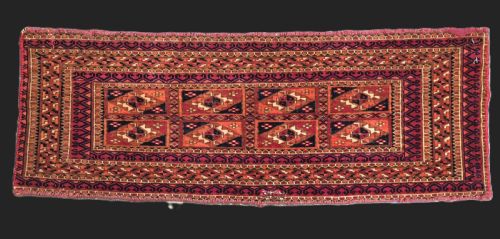
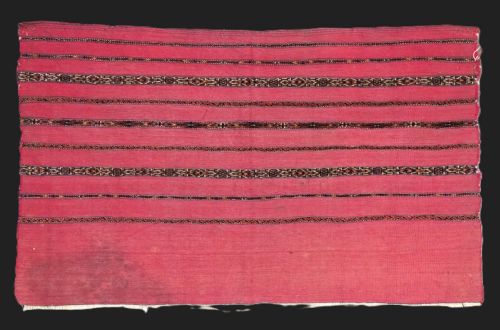


Tekke Rug Face
When you search for a tekke rug face, you enter the sophisticated world of Central Asian tribal weaving from the nineteenth century.
Tekke Rug Face
A tekke rug face represents the detached front panel of a larger nomadic storage sack, such as a chuval, torba, or mafrash, woven by Turkmen tribes. These pieces survive from the nineteenth century, including examples from the eighteenth century, originating from regions like the Merv Oasis.
The designs on these textile fragments typically feature repeating major motifs known as guls, including the aina gul, kizil, and ak variations, alongside secondary ornaments like turreted Salor guls or curled leaf patterns. Collectors encounter these objects as complete faces or fragments, often retaining original hanging loops or panel divisions.
As a primary form of tribal art, a tekke rug face showcases the distinct cultural identity and nomadic heritage of Central Asian weavers through disciplined geometry and symbolic patterning.
Evaluating Quality and Execution
The quality of a tekke rug face rests primarily in the fineness of the weave and the precision of the knotting, where exceptionally dense knot counts indicate superior craftsmanship. Tighter construction allows intricate drawing within the guls and secondary motifs to appear crisp and well-defined.
Purity and depth of the natural dyes separate standard examples from exceptional ones, particularly when the palette retains vibrant saturation and subtle tonal variations. The clarity of the drawing and the execution of scarce design variations also elevate certain pieces above standard tribal production.
The inventory records formats including torbas, chuvals, and mafrash fragments originating from Central Asian nomadic groups.
The Tekke Rug Face Glossary
- Gul
- A primary octagonal medallion motif repeated across Turkmen carpets and bag faces, often serving as a tribal emblem or signature design element. Different variations distinguish specific clans and weaving groups.
- Chuval
- A large tent storage bag produced by nomadic tribes for household possessions, of which only the decorative face is typically preserved. These pieces display multiple guls arranged in strict grid formations.
- Torba
- A smaller horizontal storage bag used within the Turkmen tent, generally featuring rows of guls or specialised designs like the kedjebe pattern. They share the meticulous knotting and palette of larger chuvals.
- Mafrash
- A rectangular storage container or bedding bag, sometimes represented by surviving panels showing tree designs or geometric layouts. These fragments illustrate the broader utility of nomadic textile production.
- Elem
- The decorated lower end panel of a rug or bag face, often filled with floral or plant-inspired motifs that anchor the primary field design. This border element provides stylistic contrast to the main repeating guls.
Tekke Rug Face: Frequently Asked Questions
What is a tekke rug face?
A tekke rug face is the decorative front section of a nomadic storage sack woven by the Tekke Turkmen tribes of Central Asia during the nineteenth century. These panels were cut from utilitarian bags used inside tents for storing household belongings.
Today, these survivors are mounted and collected as independent works of textile art, prized for their intricate geometric guls and saturated natural dye palettes.
How were these bags used?
Nomadic families utilised these woven sacks inside their yurts for storing clothing, bedding, and precious household possessions. The structures were designed to hang against the lattice walls of the tent.
Over generations, as the base fabrics wore out, the decorative face panels were preserved and separated from the utilitarian backs, which explains why they survive today as individual panels.
How do I date a piece?
Dating relies on assessing the wool quality, the chemical composition of the natural dyes, and the structural fineness of the weave. Pieces from the first half of the nineteenth century often exhibit looser, highly tactile structures and deeper colour variations.
Later examples from the late nineteenth century tend towards finer, more compressed weaves and slightly different secondary ornamentation while maintaining strict traditional tribal canons.
How should I display a textile?
These textile fragments require mounting behind conservation-grade materials or hanging flat away from direct sunlight to protect the natural wool and dyes. Proper support prevents the weight of the weave from straining the old foundation threads.
Keeping the piece in a stable environment with moderate humidity ensures the wool remains supple and the natural colours stay preserved over time.