


Wooden Knife Urn
These wooden knife urn pieces are formal dining room vessels designed to store cutlery, bringing Georgian elegance to any sideboard.
Wooden Knife Urn
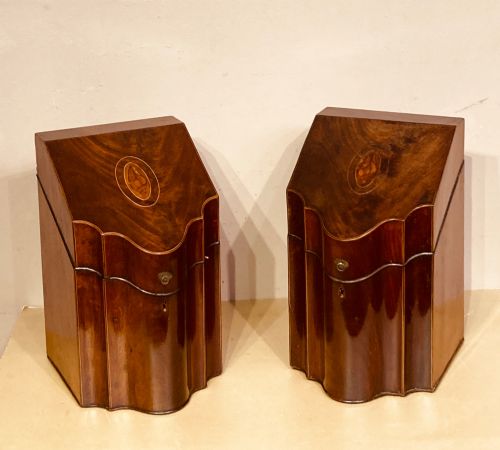
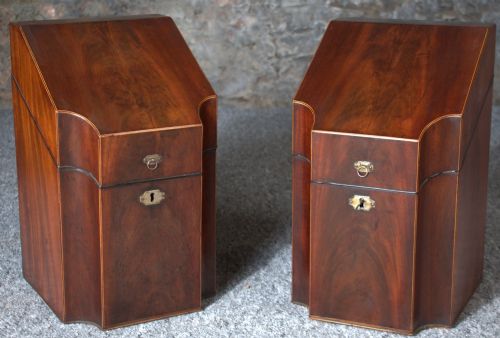
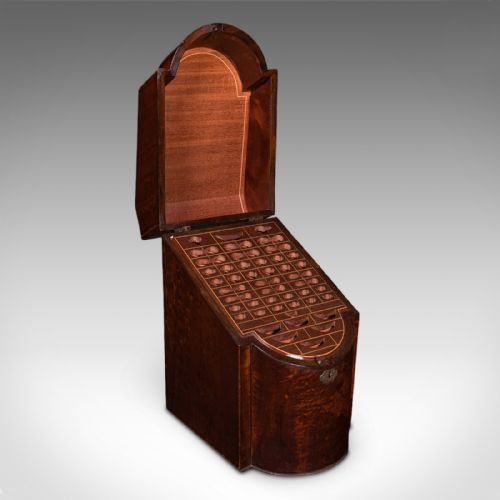
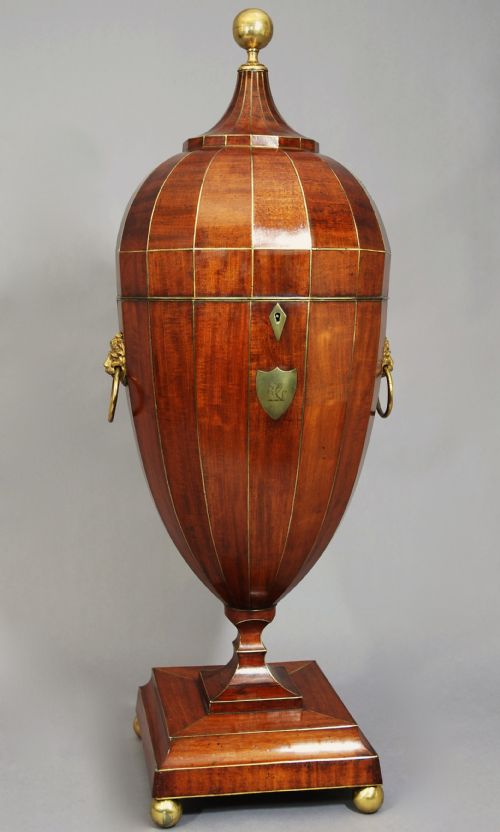
When you search for wooden knife urn, you are looking at tall, urn-shaped or sloping-fronted receptacles created to hold dining knives and forks. Most examples found here date from the Georgian and George III periods, though later Victorian interpretations also appear.
The primary forms on this page include classical cutlery urns alongside serpentine and sloped knife boxes or storage boxes. These pieces often survive in pairs to balance symmetrical dining room furniture of the eighteenth century.
How they were made
Cabinet makers constructed these vessels chiefly using solid mahogany and figured mahogany veneers over secondary timbers. Workshops applied boxwood inlay, stringing, and decorative wood inlay to accent the curving surfaces.
Metal hardware such as brass fittings, escutcheons, and hinges completed the construction. Artisans shaped the timber into serpentine fronts and tapering urn profiles using traditional joinery and turning techniques.
Materials across the selection include mahogany, boxwood, satinwood, bone, brass fittings, and wood inlay.
What varies in quality
The distinction between ordinary and superior pieces rests on the choice of timber and the crispness of the shaping. Figured mahogany with rich grain patterns elevates a serpentine knife box above a plain standard version.
Fine craftsmanship shows in the precision of the wood inlay and the weight of the brass fittings. Urns and boxes that retain their balanced proportions and original internal fittings represent the higher end of the range.
The Wooden Knife Urn Glossary
- Serpentine front
- A furniture shape featuring a double-curved front that bulges outward in the centre and curves inward at the sides. This contour appears frequently on Georgian knife boxes.
- Mahogany
- A durable tropical hardwood prized for its deep reddish-brown colour and stability in cabinet making. It serves as the primary material for the majority of these pieces.
- Boxwood inlay
- Contrasting pale wood inserted into the surface of a darker timber to create geometric borders or decorative motifs. It is a defining detail of George III Neoclassical design.
- Cutlery urn
- A tall, lidded, vase-shaped wooden vessel designed to sit on a sideboard for formal dining service. They were often made in matching pairs.
Wooden Knife Urn: Frequently Asked Questions
What were wooden knife urns used for?
These vessels were placed on sideboards in grand dining rooms to store and present silver-handled knives and forks before and after meals.
Servants would retrieve the cutlery from the lidded containers when setting the dining table for guests.
How do I date a wooden knife box?
Dating relies on examining the timber species, the style of the brass hardware, and the presence of decorative wood inlay. Georgian pieces often feature serpentine shapes and boxwood stringing typical of the eighteenth century.
Later Victorian interpretations tend to replicate these earlier George III and Georgian Neoclassical forms with slight variations in the turning and finish.
Are these pieces usually found in pairs?
Many examples survive as matching pairs to satisfy the demand for symmetry in formal dining room arrangement. Single pieces also occur among the listed storage boxes and cutlery boxes.
Pairs offer a balanced display when placed at either end of a traditional sideboard or console table.
How do I live with a knife urn?
These tall wooden vessels function well as sculptural display items on sideboards, console tables, or mantels. Their interiors can also serve to hold modern stationery or small household items.
Keep them away from direct heat sources and strong sunlight to protect the polished mahogany surfaces and delicate boxwood inlay.