
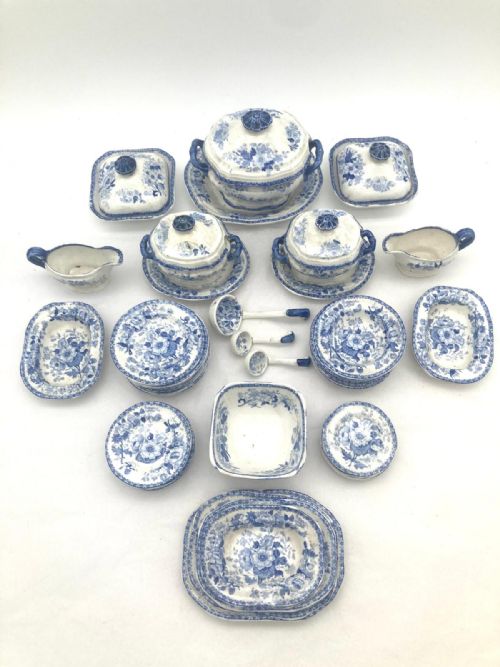


White Earthenware Dinnerware
White earthenware dinnerware brings nineteenth-century transfer-printed blue patterns to the table, offering robust ceramic service plates and complete dinner sets.
White Earthenware Dinnerware
When you search for white earthenware dinnerware, you encounter nineteenth-century ceramic plates, platters, and complete dinner services produced across the Georgian, Victorian, and Edwardian eras. These domestic items display transfer-printed decorations in blue and white, ranging from standard landscape scenes to botanical studies.
The pieces on this page lean heavily towards nineteenth-century production, featuring traditional forms such as miniature child's services, large dinner services, and matched sets of plates. Makers utilised durable earthenware bodies to create functional tableware for daily dining as well as decorative display.
Geographic origins centre on English potteries operating during the early to late 1800s. Collectors find both individual plates and comprehensive services displaying historical patterns like Willow, Italian, and London Bridge.
How white earthenware dinnerware was made
Potters shaped ceramic bodies from refined clay and applied glazes to create smooth white surfaces suitable for transfer printing. Cobalt ink was transferred from engraved copper plates onto tissue paper and then applied to the ceramic before firing.
Earlier pieces incorporate pearlware bodies with subtle bluish glaze pooling, while later nineteenth-century examples utilise standard earthenware with crisp white grounds. Enamel highlights occasionally supplement the blue and white transfer prints on specific botanical or Chinoiserie patterns.
Listings feature white earthenware dinnerware from the nineteenth century, including specific periods like Georgian, Victorian, 1920, and 1900.
What varies in quality
Quality in white earthenware dinnerware rests upon the crispness of the transfer print and the uniformity of the glaze. Finer examples display sharp, detailed lines without smudging in the cobalt ink, whereas lesser pieces show blurred pattern registration from worn copper plates.
The completeness of a service and the complexity of the transfer pattern dictate desirability. Matched sets with consistent glaze tone across multiple plates command greater attention than mismatched assemblages gathered over time.
Minton·Booths·Wedgwood·Elkin and Newbon·Spode·John Rogers and Son·Copeland Spode
The White Earthenware Dinnerware Glossary
- Earthenware
- A porous ceramic body fired at lower temperatures than stoneware or porcelain. It requires a protective glaze to remain waterproof for dining use.
- Transfer printing
- A decoration technique using an engraved copper plate to print patterns onto tissue paper, which is then pressed onto the ceramic body. This process allowed factories to produce uniform designs rapidly.
- Pearlware
- A refined earthenware developed in the late eighteenth century featuring a thin glaze with a faint bluish tint. It bridged the gap between creamware and later brilliant white bodies.
- Chinoiserie
- European decorative style imitating Chinese artistic motifs. It frequently appears on nineteenth-century blue and white transfer-printed tableware.
- Blue and white
- A traditional two-colour ceramic decorative scheme utilising cobalt oxide pigment under a clear glaze. It remains the defining aesthetic of nineteenth-century English transferware.
White Earthenware Dinnerware: Frequently Asked Questions
What is white earthenware dinnerware?
White earthenware dinnerware comprises nineteenth-century ceramic plates, platters, and service sets decorated with transfer-printed patterns.
These pieces reflect the domestic dining habits of the Georgian and Victorian periods, combining utilitarian function with blue and white ornamentation.
How do I care for antique dinnerware?
Antique earthenware requires gentle hand washing with mild soap to preserve the nineteenth-century glaze and cobalt transfer prints. Avoid dishwashers and harsh abrasives.
Store plates with felt dividers between them to prevent surface scratching on the glazed ceramic bodies.
Are these services safe for food?
While these pieces were originally designed for dining, nineteenth-century ceramic bodies and glazes can contain historical components.
Many collectors prefer to use white earthenware dinnerware primarily for display or light service rather than heavy daily dining.
How do I identify a transfer pattern?
Transfer patterns on white earthenware usually depict specific historical, botanical, or architectural scenes applied in cobalt ink under the glaze.
Consulting manufacturer backstamps and documented nineteenth-century pattern books helps match unnamed plates to specific English potteries.
What periods do these pieces span?
The listings span the nineteenth century, including Georgian, Victorian, and Edwardian eras.
Production dates range from early pearlware services of 1815 through to late Victorian and 1900 Copeland Spode iterations.