


Walnut Nesting Tables
Walnut nesting tables offer a clever space-saving arrangement that combines rich timber figure with practical versatility.
Walnut Nesting Tables
Walnut nesting tables serve as a compact multi-tiered solution for entertaining and daily living, sliding together into a single footprint when not in use. Sets range from trios and quartettos to larger groups of five tables sharing a common design.
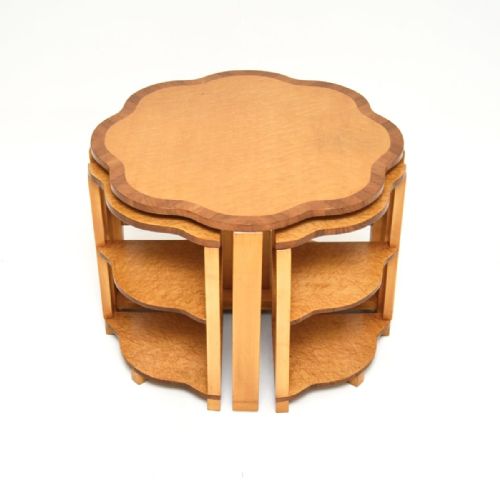
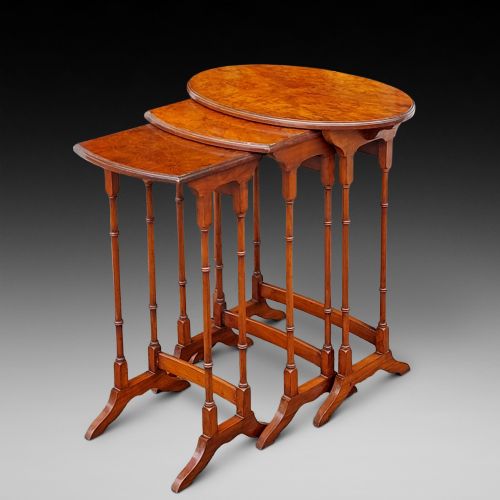
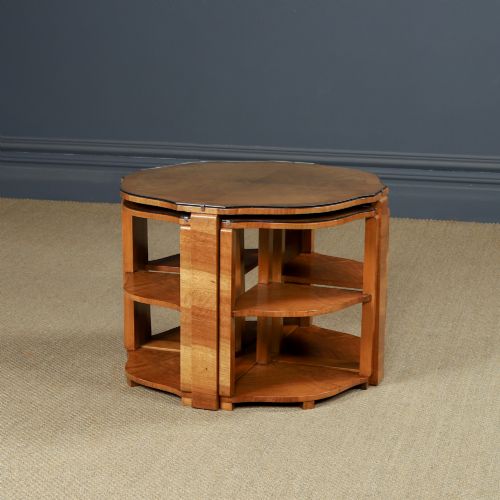
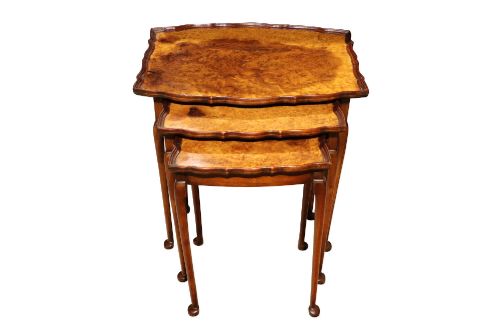
Edwardian examples and Art Deco iterations dominate the selection, often taking the form of graduating rectangular or round surfaces. The materials span plain walnut, burr walnut, and birds eye maple veneer over a sturdy hardwood frame.
Makers and workshops of the early twentieth century produced these tiered sets in various revival styles, including Queen Anne and Louis XVI. Buyers frequently encounter sets featuring parquetry tops and floral inlay alongside streamlined modernist curves.
Judging quality in construction and grain
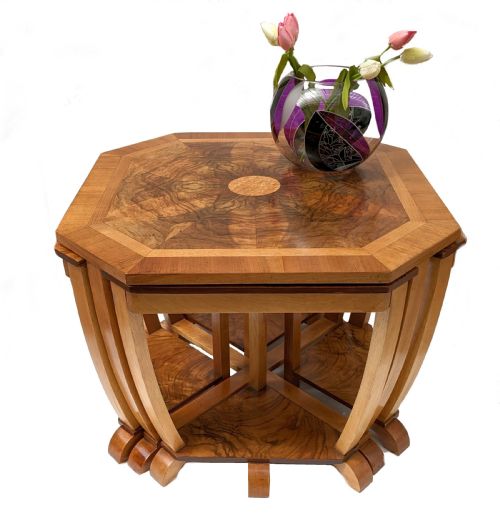
Quality rests heavily on the selection and matching of the veneer, particularly with burr walnut where symmetrical grain creates a striking visual impact. Sets that maintain consistent timber figure across all graduating tiers demonstrate superior craftsmanship.
Structural integrity of the joints and the smoothness of the sliding action indicate the maker's precision. Finer examples display careful parquetry, clean inlay work, and robust hardwood framing that withstands repeated pulling and stacking.
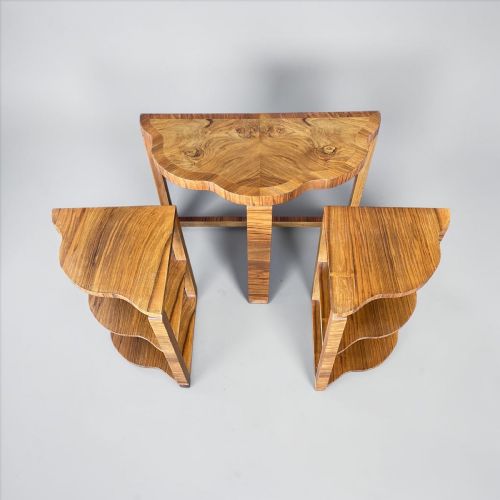
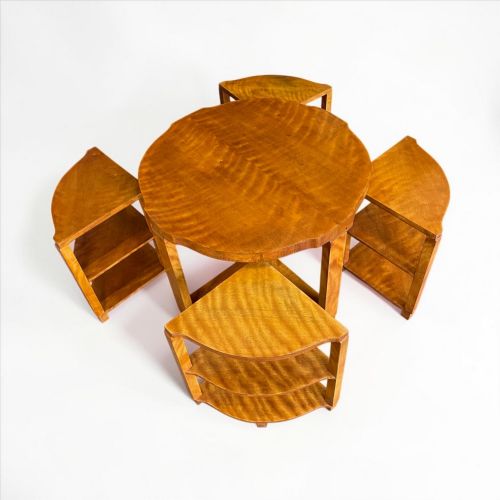
Some Art Deco sets include up to five tables, creating a miniature wooden matrioshka doll of coffee drinking.
Harry and Lou Epstein·Heal's·Emile Galle·Gordon Russell
The Walnut Nesting Tables Glossary
- Burr walnut
- Timber taken from the growth excrescence on a walnut tree, yielding intricate and highly decorative grain patterns. Cabinetmakers sliced this wood into thin veneers for decorative table tops.
- Quartetto
- A matched set of four graduating tables designed to nest together. This term frequently appears in Edwardian and early twentieth-century descriptions.
- Parquetry
- Geometric patterns formed by fitting small pieces of wood veneer together. These patterns often ornament the top surfaces of Edwardian and later sets.
- Veneer
- A thin slice of superior wood applied over a stable secondary timber base. This technique allowed makers to display dramatic grain without warping solid planks.
- Ebonised
- Wood treated with a dark finish to resemble ebony. This treatment provided stark contrast against lighter walnut sections in twentieth-century pieces.
Walnut Nesting Tables: Frequently Asked Questions
How do I care for burr walnut?
Keep walnut furniture away from direct sunlight and steady heat sources to prevent the timber veneer from drying out and splitting over time. Regular dusting with a soft, dry cloth preserves the polished surface.
Avoid using silicone-based polishes or harsh chemical sprays which can damage the historic finish. Occasional application of a suitable quality wax helps nourish the wood.
What periods are most common?
Edwardian and 1930s Art Deco pieces appear most frequently in walnut nesting table selections. These eras favoured compact furniture solutions for smaller drawing rooms and apartments.
Earlier nineteenth-century examples and 1920s designs also surface, showing shifts from traditional revival styles to streamlined modernism.
Can I use them as coffee tables?
The main table in a nest often functions as a low central surface, while the smaller pull-out units serve as side or lamp tables. This modular arrangement adapts easily to changing seating layouts.
Care should be taken with hot cups or moisture, using coasters to protect the delicate veneer and polished timber surfaces during daily use.
What is a quartetto set?
A quartetto set consists of four graduating tables designed to slide neatly beneath one another into the space of the largest piece. This configuration was particularly popular during the Edwardian period.
Each table decreases incrementally in height and width, allowing the entire group to occupy a minimal floor area when stored.