



Vintage Table Globe
A vintage table globe brings geography and history onto a desk, offering a tangible piece of the world from past decades.
Vintage Table Globe
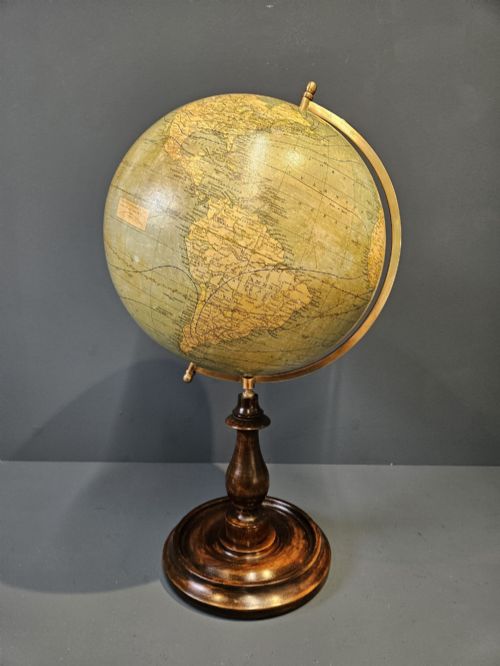
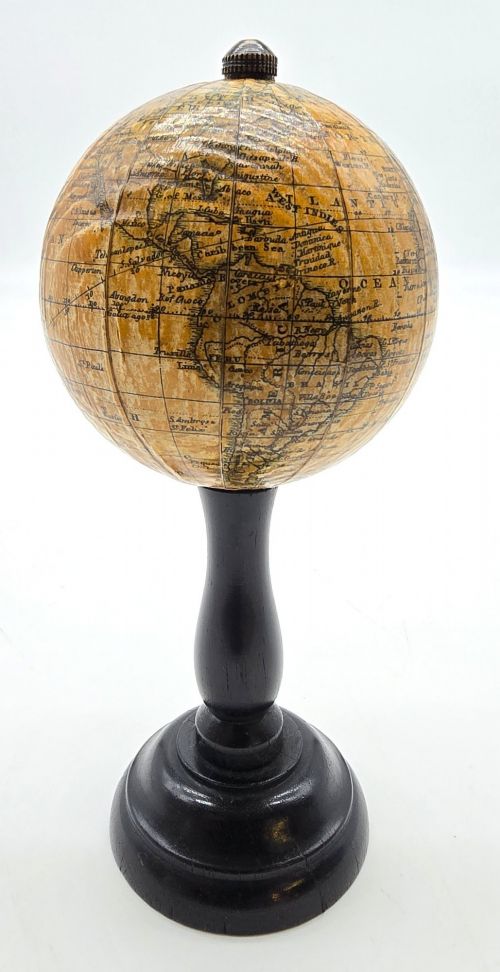
A vintage table globe is a small-scale representation of the Earth designed to sit upon a desk, table, or cabinet. When searching for a vintage table globe, buyers encounter pieces originating from the nineteenth century through the mid-twentieth century.
The selections available range from compact English miniature desk globes to larger twelve-inch geographical models supported on walnut feet or wooden stands. These terrestrial instruments reflect the cartography, politics, and decorative tastes of their respective manufacturing eras.
Makers and publishers such as Bacon's, Geographia, J. Forest, Malby's, and Carl Adami created these educational and decorative objects. They serve as both historical records of changing world borders and tactile decorative items for interiors.
How they were made
Manufacturers constructed globe spheres using paper, paper mâché, and plaster over which detailed printed paper gores were meticulously applied by hand. These fragile geographical spheres required precise alignment so that the cartography matched seamlessly across the globe.
Stands and mountings utilised traditional materials including wood such as walnut and ebony, brass, and heavy plaster or ceramic bases. The combination of delicate paper gores with sturdy metal and wooden mountings ensured the instruments remained stable on desktop surfaces.
Vintage Table Globe Retail Price Guide 2026
Typical asking prices for vintage table globe among the pieces listed under this phrase on Sellingantiques today, from the lower quarter to the upper quarter. They describe what is for sale here now, not the wider market.
Historical globe makers sometimes included exotic sea monsters and ornate sailing ships across empty ocean spaces to fill uncharted waters.
What varies in quality
The distinction between standard and superior pieces rests largely upon the clarity and preservation of the cartographic print on the paper gores. Crisp, legible geography with vibrant original colouring commands greater attention than faded or heavily discoloured surfaces.
Engineering and materials of the base also dictate the grade of a piece, with heavy turned walnut feet, detailed brass mountings, and stable ebony stands representing superior craftsmanship over simpler constructions.
Bacon's·Geographia·J. Forest·Malby's·Carl Adami·Chandy Charan and Co
The Vintage Table Globe Glossary
- Gores
- The printed paper segments shaped like narrow triangles that are applied to the spherical surface of a globe. Precise alignment of these gores is essential for accurate cartography.
- Terrestrial globe
- A scale model of the Earth displaying landmasses, oceans, countries, and major cities. These instruments provide a geographical snapshot of the world at the time of their publication.
- Miniature desk globe
- A small-scale terrestrial globe specifically manufactured for placement on a writing desk or small table. They combine functional geography with compact decorative utility.
- Paper mâché
- A composite material consisting of paper pieces or pulp reinforced with glue or paste, moulded into shape. This material formed the lightweight core of many historical globe spheres.
Vintage Table Globe: Frequently Asked Questions
How do I date a globe?
Dating a globe involves examining the country names, borders, and capital cities depicted on the paper gores. Major geopolitical shifts, such as the renaming of cities or the creation of new nations, provide a reliable after which the globe was made.
Publishers often included publication dates near the cartouche, though many historical pieces rely entirely on internal cartographic evidence for an accurate period attribution.
Where should I display a globe?
These pieces suit placement on wooden desks, library tables, or sideboards where they can be viewed close up. Their compact size allows them to sit comfortably alongside books and writing instruments.
Positioning the globe away from direct sunlight protects the delicate paper gores and printed colours from fading over time, ensuring the cartography remains clear.
How do I clean a globe?
Dusting requires a soft, dry cloth or a gentle feather duster to remove surface particles without disturbing the aged paper. Moisture must be avoided entirely, as water causes paper gores to bubble, lift, or detach from the underlying sphere.
Harsh cleaning chemicals or abrasive cloths will strip the historical finish and damage the printed cartography permanently. Gentle, dry maintenance preserves the fragile materials.
Are older globes historically accurate?
Historical globes reflect the geographical knowledge and political boundaries of the exact year they were published. As a result, older examples display historical place names and borders that differ significantly from modern maps.
This lack of modern accuracy is precisely what makes them collectible, offering a tangible window into how previous generations viewed the world.