




Antique Cartography Globe
An antique cartography globe is a miniature sphere mapping the world, prized for holding centuries of geographical discovery in a domestic room.
Antique Cartography Globe
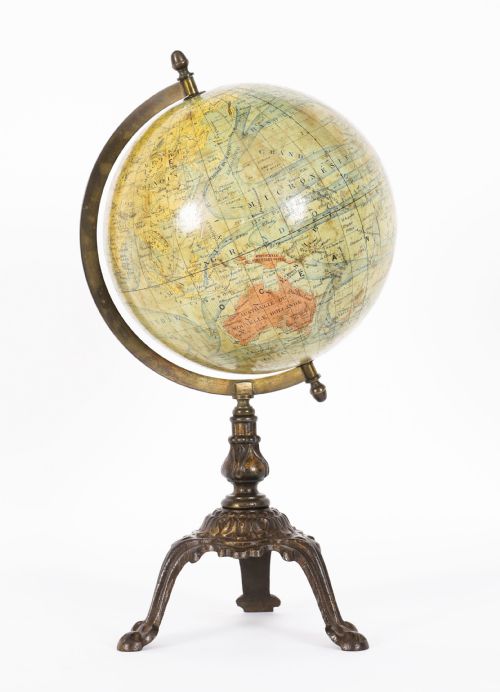
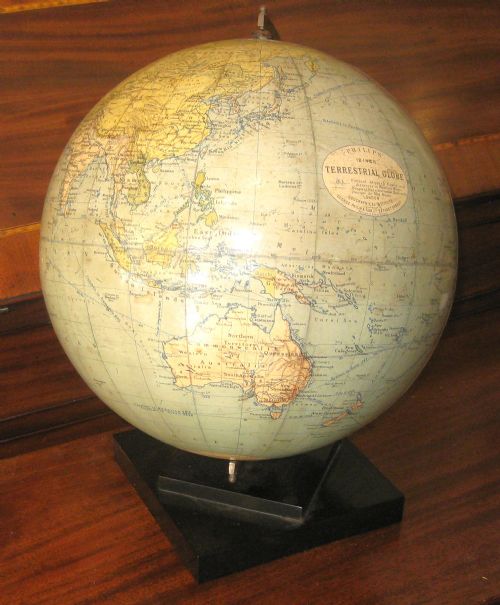
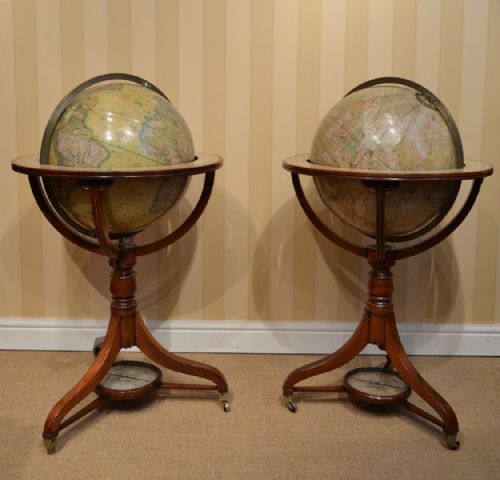
When you search for an antique cartography globe, you encounter terrestrial spheres, celestial pairs, and library globes spanning several centuries. The selection ranges from small desk models and table globes to substantial floor-standing pieces supported by timber stands.
Victorian and Edwardian examples sit alongside nineteenth-century French models, mid-century pieces, and earlier eighteenth-century miniature table globes. Related cartography books and maps also appear within this sphere of items.
The most common formats on this page are twelve-inch and eighteen-inch terrestrial table globes housed in brass or wood mountings. Pairs of terrestrial and celestial globes also feature among the heavier library pieces.
Materials and construction methods
Paper gores are printed with map details and applied by hand to a spherical plaster core. This delicate skin of paper carries the cartographic history of the period.
Mountings rely on turned mahogany, ebonised wood, and cast iron for the stands, paired with graduated brass meridian rings that allow the sphere to tilt and rotate.
Antique Cartography Globe Retail Price Guide 2026
Typical asking prices for cartography globe among the pieces listed under this phrase on Sellingantiques today, from the lower quarter to the upper quarter. They describe what is for sale here now, not the wider market.
Some globes record vanished empires and obsolete sea monster illustrations, capturing transient geographical fantasies on plaster spheres.
Markers of quality and execution
Quality rests in the precision of the paper gores and the clarity of the geographical engraving. Finer makers achieve seamless alignment where the printed paper segments meet at the poles.
The structural integrity of the plaster sphere and the stability of the timber or cast iron stand determine the durability of the piece. Original metal meridians and undamaged wooden mountings elevate the standing of a globe.
Lebegue and Cie·Phillips·Malby·Carey·M Vivien·Bacons·Crunchley·Geographia
The Antique Cartography Globe Glossary
- Terrestrial globe
- A spherical model of the Earth displaying landmasses, oceans, shipping routes, and political boundaries. These pieces document how cartographers understood the world at a specific date.
- Celestial globe
- A sphere mapping the stars, constellations, and astronomical coordinates relative to Earth. They frequently appear paired with terrestrial equivalents on large stands.
- Gores
- Printed paper segments shaped like liquescent triangles that are pasted onto the plaster sphere. Accurate application ensures the map aligns correctly across the curved surface.
- Meridian ring
- The graduated brass or metal ring encircling the globe in which the sphere pivots. This ring allows the user to measure angles and align the globe to latitude.
- Library globe
- A large-scale terrestrial or celestial globe, often measuring eighteen inches or more across, supported by a heavy floor stand. These were designed for institutional rooms and substantial studies.
Antique Cartography Globe: Frequently Asked Questions
What is the difference between a terrestrial and a celestial globe?
Terrestrial globes display the geography of the Earth, including countries, oceans, and historical place names. They reflect the borders and cartographic knowledge of their specific production era.
Celestial globes map the night sky, showing constellations and stars rather than landmasses. They were traditionally used for astronomical calculations and navigational studies.
How do I determine the date of an antique globe?
Makers usually printed the publication or revision date directly onto the cartographic gores near the cartouche. Examining the depicted national boundaries, railway lines, and colonial territories provides further chronological clues.
Comparing the place names on the globe to historical maps helps narrow down the decade of manufacture. Certain prominent cartographic firms also updated their plates during specific operational windows.
Where should I place a globe in a room?
Globes require stable surfaces away from direct sunlight, which can fade the delicate printed paper gores over time. Table models suit sturdy desks and sideboards where their rotation can be easily accessed.
Floor-standing library globes need a dedicated corner with sufficient clearance for the horizon ring and wooden stand. Keeping them away from excessive heat sources prevents the plaster core and wooden elements from drying out.
How should I clean an antique globe?
Dust the surface gently with a soft, dry microfibre cloth or a clean artist's brush. Avoid applying any liquids, damp cloths, or cleaning solvents, as moisture will dissolve the historic glue and ruin the paper map.
Metal components like brass meridian rings can be dusted carefully without touching the adjacent paper gores. Professional conservators should handle any deep cleaning or structural repairs.