
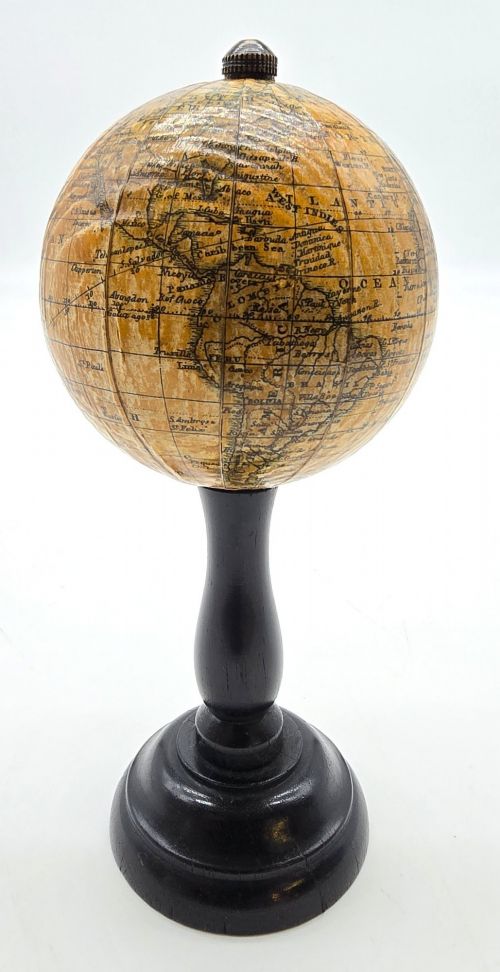


Vintage Desktop Globe
A vintage desktop globe brings a tactile fragment of geography to your study, combining period cartography with domestic craftsmanship.
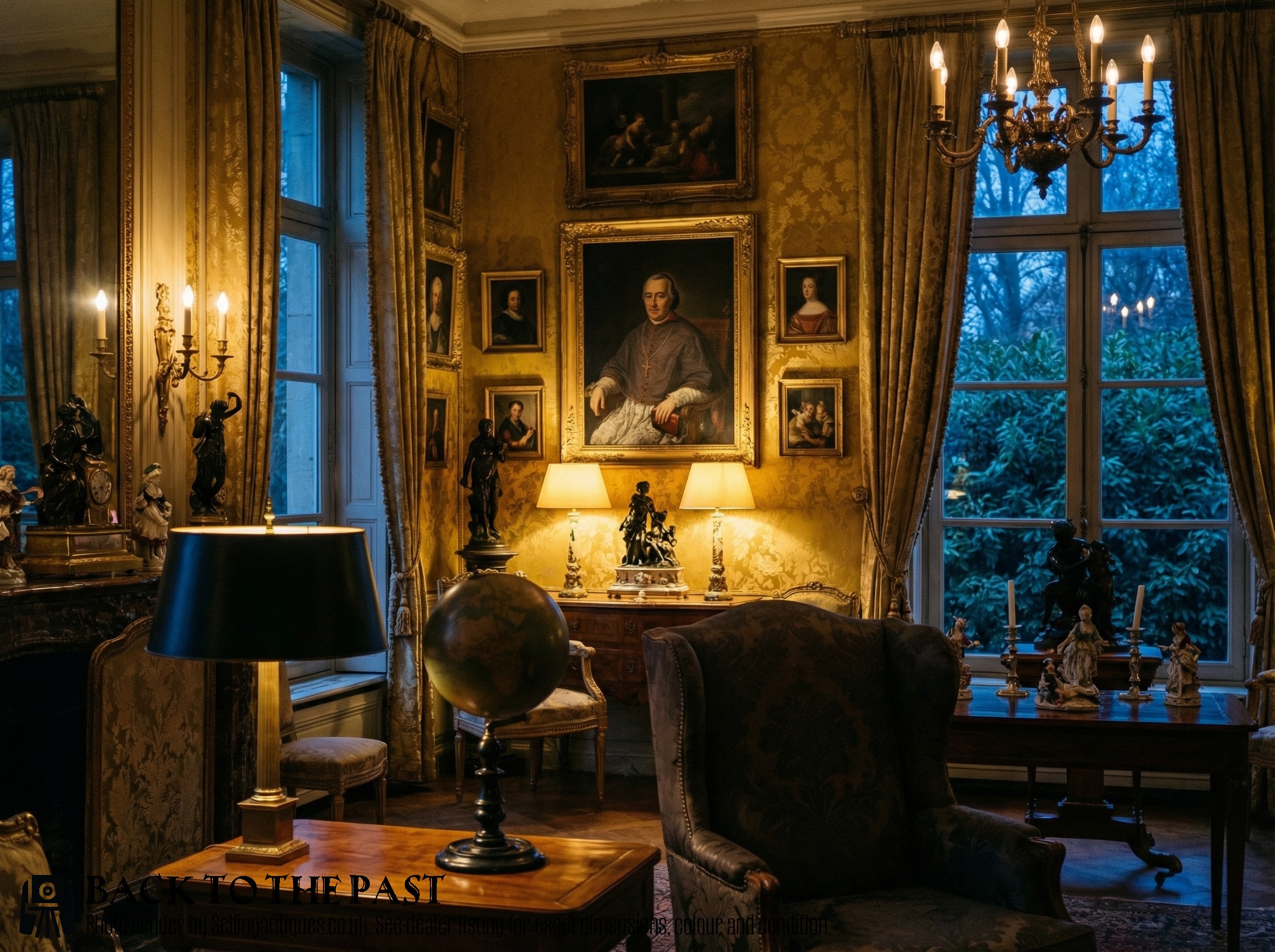
Vintage Desktop Globe
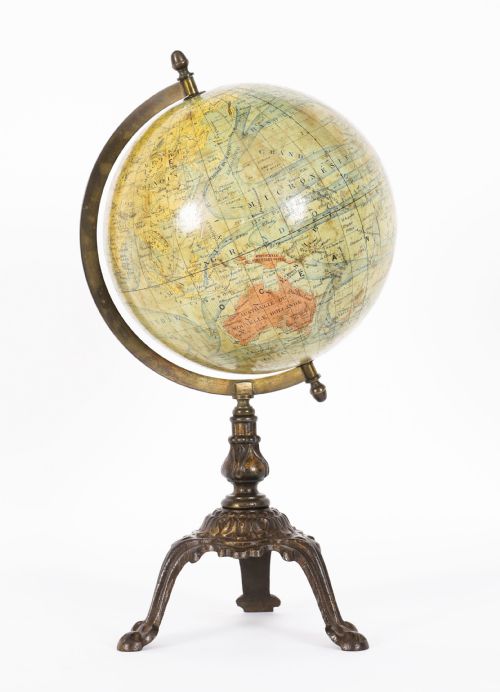
A vintage desktop globe is a portable geographical sphere designed to sit upon a table, desk or pedestal rather than stand on the floor. When searching for a vintage desktop globe, buyers encounter instruments spanning from the late nineteenth century through to the interwar period.
The selections on this page demonstrate a distinct preference for terrestrial models over celestial ones, often produced by notable mapmakers of the Victorian, Edwardian and Interwar eras. These pieces range from miniature globes measuring just a few inches across to substantial twelve-inch library examples.
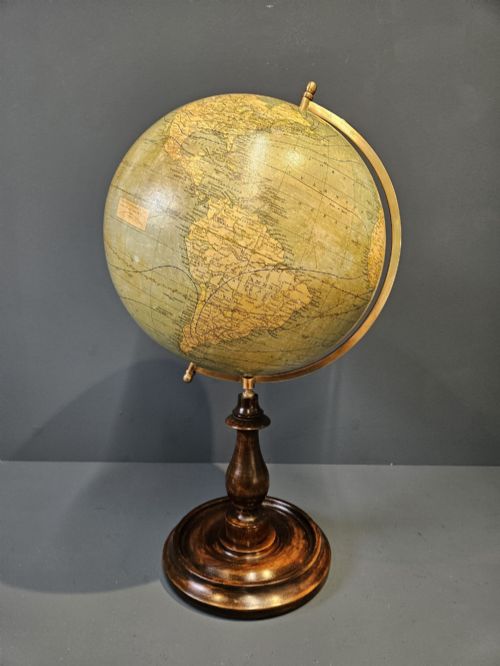
Most items you will meet take the form of terrestrial globes mounted on turned stands of walnut, ebonised wood or cast iron. They serve simultaneously as historical documents of shifting political borders and as decorative objects for a study or library.
Materials and construction
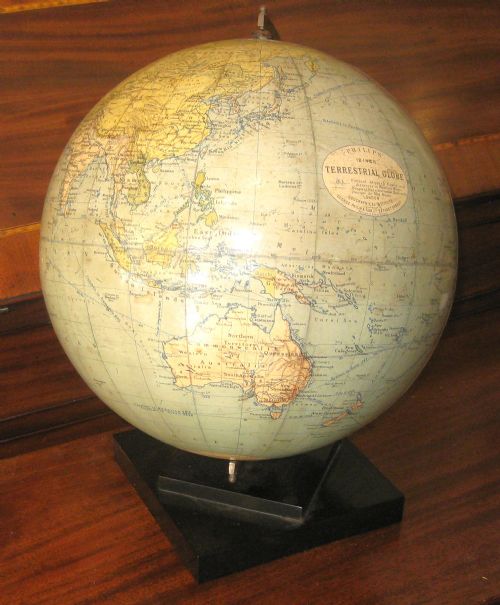
The sphere itself is typically constructed from plaster over a lightweight core or formed from papier-mâché, upon which printed paper gores are hand-applied in precise segments. Cartographers then aligned these segmented strips meticulously to ensure the lines of latitude and longitude met correctly across the sphere.
Stands and mountings rely on traditional cabinet timbers such as walnut and ebony, alongside turned brass half-meridians and heavy cast iron bases. These dense materials anchored the globe securely while allowing the sphere to rotate smoothly on its axis.
Vintage Desktop Globe Retail Price Guide 2026
Typical asking prices for vintage desktop globe among the pieces listed under this phrase on Sellingantiques today, from the lower quarter to the upper quarter. They describe what is for sale here now, not the wider market.
Some nineteenth-century globes still mark empires in bold pinks and yellows long since rewritten by history.
Distinguishing quality
Quality in a vintage globe rests primarily upon the clarity and detail of the cartography printed on the paper gores, as well as the precision with which those paper segments were laid down without overlap or distortion. Finer examples exhibit crisp typography and hand-colouring that remain legible across distant territories and shipping routes.
The material and execution of the stand dictate the overall grade of the piece, moving from simple turned wood to weighted brass mountings and heavy cast iron feet. Makers who invested in robust brass half-meridians and well-figured walnut bases produced instruments intended to endure decades of daily consultation.
Lebegue and Cie·Parkes and Hadley·Bacon·Phillips·Geographia·J Forest·Malby·M Vivien
The Vintage Desktop Globe Glossary
- Gore
- A tapering, pointed strip of printed paper specifically shaped to be applied to a sphere without creasing or tearing. Sets of these gores map the entire globe when pasted together.
- Terrestrial globe
- A spherical representation of the Earth showing landmasses, oceans, political boundaries and shipping routes, as opposed to the stars.
- Half-meridian
- The graduated brass or metal semi-circle surrounding the globe that holds it at an angle and allows it to rotate from pole to pole.
- Orrery
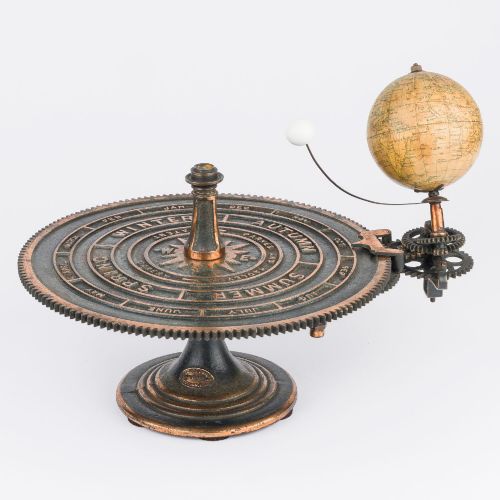
- A mechanical model of the solar system that illustrates the relative positions and motions of the planets and moons around the sun.
- Plaster core
- The solid foundation material formed inside a mould to create the spherical body before the paper map is applied.
Vintage Desktop Globe: Frequently Asked Questions
How do I date a desktop globe?
You date a globe by examining the political boundaries, colonial names and capital cities printed upon the paper gores, which often reflect the geopolitical reality of the specific decade in which they were published.
Additional clues come from the mounting style, typography and the maker's imprint found near the equator or legend.
Can these globes be spun regularly?
While these instruments were built to rotate on their axes, historical paper gores and delicate brass meridians require gentle handling to prevent wear and tear over time.
Frequent rotation should be done carefully by the meridian or horizon ring rather than by flicking the fragile paper sphere directly.
Where were these globes originally used?
These pieces were primarily manufactured for domestic studies, schoolrooms, libraries and professional offices as both educational references and decorative furnishings.
Their compact desktop scale allowed scholars and travellers to consult geographical information without needing a large floor-standing library globe.