




Mid Century Globe
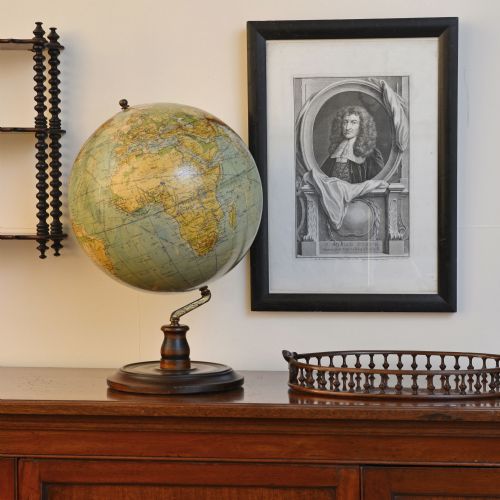
A mid century globe brings geography and striking design together, offering a tangible piece of history that anchors a room.
Mid Century Globe
A mid century globe represents geographical mapping fused with period decorative arts, spanning terrestrial models and experimental furniture forms. These pieces serve both educational and aesthetic purposes within an interior space.
The versions most commonly met on this page range from compact paper mache globes to elaborate coffee tables and specialised desk models. They originate from various international makers and reflect distinct twentieth century design movements.
How they were made
Construction relies heavily on traditional materials such as paper applied to papier mache spheres, supported by turned wood, brass, and metal mountings. Artisans utilised wood veneers and copper elements to finish stands and structural frames.
Cartography application involved precise printing onto gores which were then carefully pasted onto the spherical bodies by hand. Metal components were cast or turned to ensure the globe tilt accurately represented the axis of the earth.
The listings on this site feature globes constructed from paper, metal, wood, brass, and copper, spanning periods from nineteen hundred to nineteen sixty.
What varies in quality
The sophistication of the cartography and the crispness of the printing dictate the primary level of distinction between examples. Finer pieces demonstrate superior geographical detail and more complex mechanical mountings.
Materials utilised for the base and meridian ring also establish the standing of an object, with solid turned wood and heavy brass outperforming simpler constructions. The integrity of the paper surface and the richness of the wood veneer determine the overall finish.
George Philips and Son Ltd·Geographia·Ernest Hemingway collection·Chandy Charan and Co·Raths Physikalischer·Wyld·Joslin
The Mid Century Globe Glossary
- Terrestrial globe
- A spherical map representing the earth, showing continents, oceans, and political boundaries. These objects were standard educational tools as well as decorative items.
- Paper mache
- A composite material consisting of paper pieces or pulp bound with glue, used to form the lightweight core of the globe sphere. It provides a stable and durable surface for map gores.
- Wood veneer
- A thin layer of wood applied to a commoner base material to provide a decorative surface finish. This technique appears on furniture pieces incorporating globe designs.
- Meridian
- A brass or metal ring surrounding the globe that holds it at the correct tilt and allows it to spin on its axis. The graduation markings on this ring assist in navigation and measurement.
Mid Century Globe: Frequently Asked Questions
How do I date a globe?
Dating relies primarily on the political boundaries and place names printed on the cartography, as borders changed frequently throughout the twentieth century. Examining the materials of the base and the style of the mounting also provides strong chronological indicators.
Makers often included publication dates near the cartouche, though globes were sometimes updated and reprinted over extended periods. Comparing the typography and manufacturing techniques to known examples helps narrow down the decade of production.
Where were these globes placed?
These pieces sat predominantly on library desks, study tables, and dedicated floor stands within domestic and institutional settings. Smaller desk globes functioned as accessible reference tools for daily reading and correspondence.
Larger furniture integrations, such as globe coffee tables, combined practical surface space with cartographic display in principal reception rooms. Their placement usually reflected both scholarly utility and interior decoration.
How should I clean my globe?
Maintenance requires a gentle approach using a soft, dry cloth to remove dust from the paper sphere and metal mountings. Moisture must be avoided entirely to prevent damage to the paper gores and printed inks.
Wooden bases benefit from occasional treatment with appropriate traditional furniture waxes applied sparingly. Keeping the piece away from direct sunlight preserves the original colours of the map.
What is a gore?
A gore is a tapering segment of printed paper shaped like a litchi slice, designed to be pasted accurately onto a sphere. Multiple gores fit together to cover the entire globe without wrinkling or overlapping incorrectly.
The accuracy of the gore alignment indicates the skill of the maker during assembly. Flaws in gore application often help distinguish hand-assembled pieces from later mass-produced items.