


Vintage Map Sphere
A vintage map sphere brings the geography of earlier centuries into a room, offering a tactile representation of the world as past generations mapped it.
Vintage Map Sphere
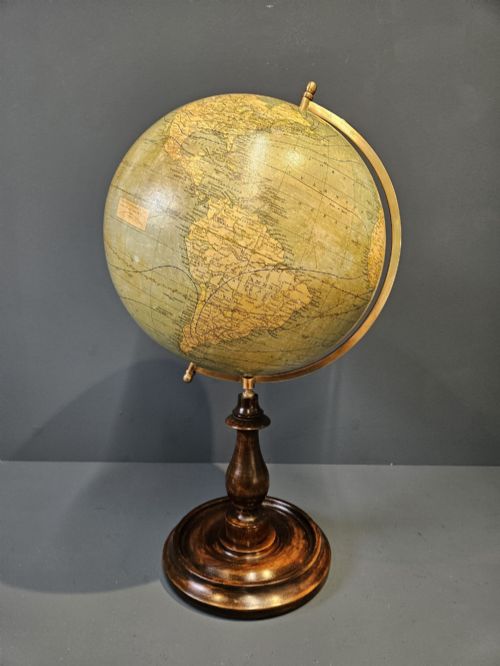
When you search for a vintage map sphere, you are looking at terrestrial and celestial globes spanning the Victorian, Edwardian, interwar, and mid-century periods. These objects serve as both scientific instruments and decorative pieces, capturing the cartography of their respective decades.
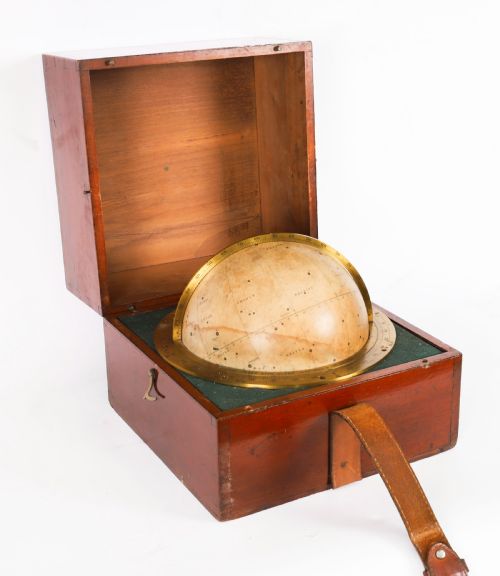
The versions you are most likely to meet on this page include desktop globes, portable cased celestial examples, and larger floor-standing pieces. They originate from makers and publishers working in Britain, Germany, and beyond during the late nineteenth and twentieth centuries.
Materials vary across these forms, incorporating paper gores applied to plaster or papier-mâché spheres, mounted on timber stands or metal bases. Each piece preserves a distinct snapshot of international borders and geographical nomenclature from its manufacturing era.
How they were made
Makers constructed these globes by applying printed paper gores - wedge-shaped strips of map - onto a core typically formed from plaster, papier-mâché, or solid material. This meticulous process required precise alignment so that the cartography wrapped seamlessly around the sphere.
Some nineteenth-century travellers carried pocket-sized celestial spheres in velvet-lined mahogany boxes to consult the stars on the move.
What varies in quality
The distinction between standard examples and finer items rests in the clarity of the cartographic printing and the fidelity of the paper gores to their underlying spheres. Crisp typography and well-preserved surface colour indicate a superior manufacturing standard.
Construction details of the mounting also separate pieces, with heavy turned wooden feet, robust brass meridians, and original fitted timber cases demonstrating a higher grade of craftsmanship than simpler metal bases.
Bacon's·Hughes & Son·Geographia·Carl Adami·Raths
The Vintage Map Sphere Glossary
- Gore
- A wedge-shaped paper strip printed with a portion of a map, designed to be applied to a sphere. Multiple gores cover the entirety of a globe.
- Terrestrial globe
- A spherical map representing the earth. These instruments show landmasses, oceans, and political boundaries specific to the date of publication.
- Celestial globe
- A sphere mapping the stars and constellations as viewed from the earth. They often accompany navigational instruments.
- Paper mache
- A composite material made from paper pulp or reinforced paper sheets, used as a lightweight core for the sphere. It provides a stable surface for the applied map gores.
Vintage Map Sphere: Frequently Asked Questions
How do I date a globe?
You date a globe by examining the political boundaries, country names, and shipping routes printed on the paper gores. Cartographic revisions often reflect historical events of the manufacturing period.
Additional clues appear in the typography, the style of the mounting stand, and any publisher stamps or publication dates printed near the cartouche.
What is the difference between terrestrial and celestial spheres?
Terrestrial spheres depict the geography of the earth, including countries, oceans, and cities. They function as geographical reference tools.
Celestial spheres map the night sky, showing constellations and star magnitudes relative to an imaginary celestial sphere surrounding the earth.
Where were these pieces used?
These pieces were used primarily in studies, libraries, classrooms, and offices as working navigational and educational instruments. Larger floor-standing models occupied prominent positions in grand rooms.
Portable versions, such as cased celestial globes, travelled with astronomers and mariners for fieldwork and navigation.
How do I care for a paper globe?
You care for a paper globe by keeping it away from direct sunlight to prevent the printed gores from fading and discolouring. Stable indoor humidity protects the paper and the underlying plaster or papier-mâché core.
Dusting should be done gently with a dry, soft cloth, avoiding any liquid cleaners that might damage the paper surface.