


Library Desk Globe
A library desk globe is a tangible record of a changing world, built to sit at hand on a table or work surface.
Library Desk Globe
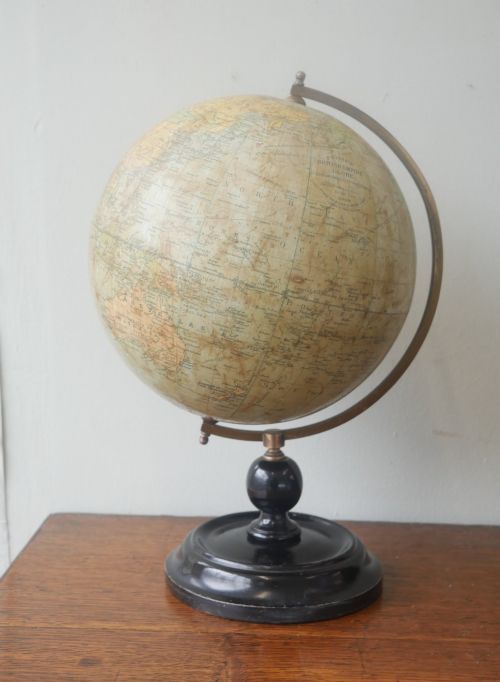
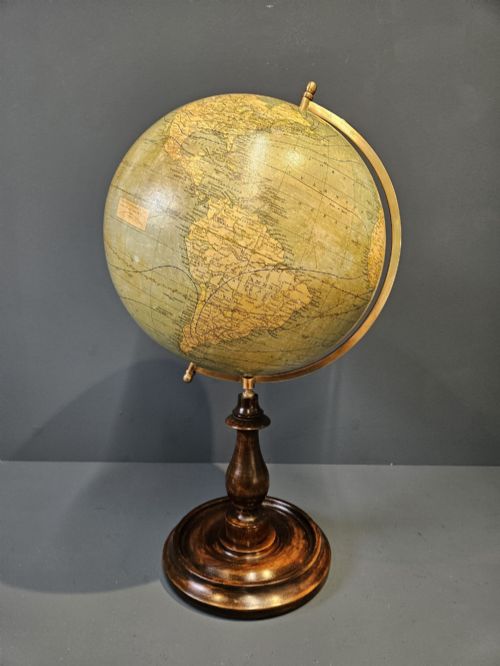
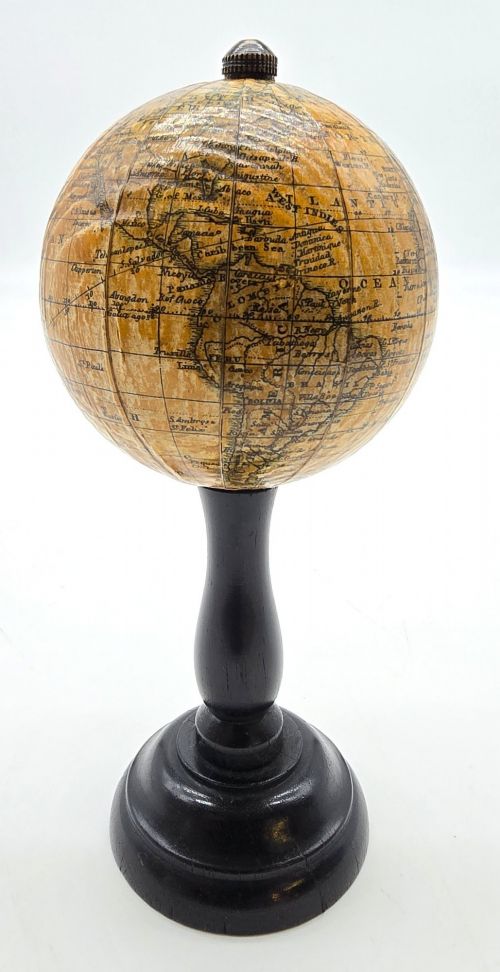
A library desk globe brings geographical knowledge and craftsmanship together in a compact form designed for close study. When you search for a library desk globe, you are looking at terrestrial spheres that range from miniature versions to twelve-inch or larger examples resting on stands.
The pieces on this page span several eras, from the eighteenth century through the Victorian and Edwardian periods into the interwar years of the twentieth century. You will encounter globes by notable makers alongside unmarked geographical instruments intended for everyday consultation.
Forms vary from simple table globes on turned wooden feet to bronze Atlas figures supporting celestial or terrestrial spheres. Each object reflects the cartography, political boundaries, and aesthetic tastes of its specific decade.
How they were made
Makers constructed the spherical bodies using plaster built over a core, onto which printed paper gores were carefully applied by hand. These gores required exact alignment to ensure the geographical lines and text met without distortion.
Mountings and stands relied on traditional cabinetmaking and metalworking materials, utilising mahogany, walnut, ebonised wood, and cast iron. Brass rings and hardware held the spheres at the correct axial tilt for geographical demonstration.
Atlas occasionally takes a rest from holding up the heavens to double as a nineteenth-century bronze desk lamp.
What varies in quality
Quality in a library desk globe rests primarily on the clarity of the cartographic engraving and the precision with which the printed paper gores align across the plaster sphere. Finer examples display crisp typography and detailed hand-colouring that remain legible across the oceans and landmasses.
The integrity of the supporting stand contributes significantly to the overall merit of the piece, distinguishing standard utilitarian globes from those housed in substantial mahogany or walnut bases with calibrated brass meridian rings.
Geographia·Phillips·Bacon's·J. Forest·Malby's·Chandy Charan and Co·Carl Adami·Crunchley·Newton
The Library Desk Globe Glossary
- Gore
- A tapering printed paper strip shaped to cover a sphere. Multiple gores are pasted onto the plaster ball to form the complete map.
- Meridian ring
- A graduated metal ring surrounding the globe in which the sphere pivots. It allows the user to measure latitude and tilt the globe to different angles.
- Terrestrial globe
- A scale model of the Earth. It displays continents, oceans, shipping routes, and political boundaries specific to the date of publication.
- Table globe
- A small globe designed to sit directly on a desk or table without a large floor-standing frame. These pieces often feature short turned wooden feet.
- Atlas lamp
- A figural lighting fixture depicting the mythological figure Atlas carrying a sphere. In antique examples, this form occasionally incorporates globe elements.
Library Desk Globe: Frequently Asked Questions
How do I read date clues on a globe?
Cartographers often updated political boundaries and place names when printing new gores, which helps narrow down the decade of production. Examining the spelling of cities and the attribution of colonial territories provides a reliable chronological anchor.
Comparing these printed details against known publishing eras allows collectors to establish a sensible date range without relying solely on the accompanying stand.
Were these globes used for navigation?
Library desk globes served primarily as educational reference tools and decorative objects for studies, libraries, and offices. They offered users a tangible way to visualise geographical discoveries and global politics.
While accurate for their time, their small scale and stationary desk mounts meant they were not practical instruments for active maritime navigation.
How should I clean a paper globe?
Paper gores and plaster spheres require gentle maintenance and must be kept away from excessive moisture and direct sunlight. Dusting should be done very carefully with a soft, dry brush.
Liquid cleaners will damage the historic paper and the adhesives beneath, so professional conservation is advised for any deeper cleaning.
What is the difference between a table globe and a library globe?
Table globes are generally smaller in diameter and designed to occupy minimal space on a desk or bureau. Library globes traditionally implied a slightly more substantial format meant for serious study.
In practice, antique listings often use these terms interchangeably for portable desk-sized instruments.