


Retro Desk Globe
A retro desk globe brings functional geography and mid-century character to a workspace, offering a tangible connection to mid-century design.
Retro Desk Globe
When you search for a retro desk globe, you are looking at practical and decorative cartographic items designed for desktop use. These pieces span periods from the Victorian era up to the 1940s, capturing the shifting aesthetic tastes of each decade.
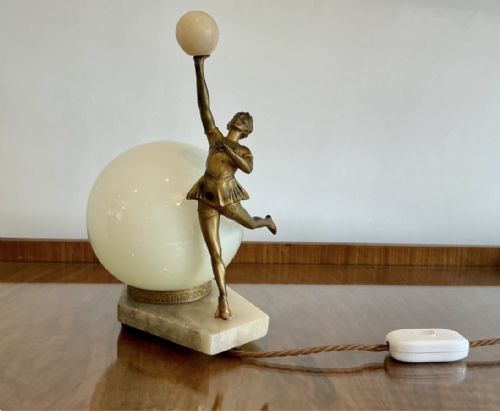
The selections available here range from traditional paper mache globes to spherical forms incorporated into sculptural table lamps. You are most likely to encounter examples reflecting Art Deco and Mid-Century Modern styles, alongside earlier Victorian and Edwardian iterations.
While some items focus purely on terrestrial geography, others combine illumination with cartography, functioning simultaneously as desk lamps. These dual-purpose objects reflect the inventive domestic lighting solutions of the early twentieth century.
Materials and construction methods
Makers utilised paper and paper mache to form the spherical cartographic bodies of the globes, applying printed map gores by hand. These lightweight materials were durable enough for daily reference while maintaining a smooth surface for detailed geographical printing.
Supporting structures frequently incorporated brass and chrome for stability, alongside marble bases that provided necessary weight. In pieces that doubled as desk lamps, glass elements such as opaline shades were combined with metal armatures to house electrical components.
Listings in this category span the Victorian era, Edwardian period, and the 1920s through to the 1940s.
Judging the quality of these items
Quality in a retro desk globe rests upon the clarity of the cartographic printing and the crispness of the geographical boundaries. Finer examples display meticulous alignment of the paper gores where they meet at the poles, ensuring seamless geographical continuity.
The choice of base materials also distinguishes standard utilitarian pieces from more ambitious commissions. Heavy marble plinths, substantial brass mounts, and polished chrome fittings indicate higher manufacturing standards and greater material longevity.
The Retro Desk Globe Glossary
- Gore
- A tapering printed paper strip shaped like a lunate slice, used to cover the spherical surface of a globe. Multiple gores are precisely pasted side by side to form a complete world map.
- Terrestrial globe
- A scale model of the Earth representing landmasses, oceans, countries, and major cities. These instruments serve as both reference tools and decorative objects.
- Opaline glass
- A milky, translucent glass popular in light fittings and decorative objects during the nineteenth and early twentieth centuries. It diffuses light evenly without harsh glare.
- Art Deco
- A design style characterised by sleek geometric lines, stylised figures, and modern industrial materials that dominated the interwar period. It heavily influenced domestic lighting and desk accessories.
- Paper mache
- A composite material consisting of paper pieces or pulp reinforced with glue or paste, moulded while moist and hardening into a strong shell. It provided a lightweight core for cartographic globes.
Retro Desk Globe: Frequently Asked Questions
What periods do these globes come from?
The pieces listed across this marketplace span from the Victorian and Edwardian eras through the 1920s, 1930s, and 1940s.
This range encompasses traditional cartography alongside later modernist and Art Deco interpretations of desktop geography.
Are these globes illuminated?
Some items catalogued as desk globes function primarily as non-electrical reference spheres, while others combine cartography with lighting.
Evidence shows several configurations where globe forms are integrated with table lamp designs utilising brass, chrome, and opaline glass.
What materials were used to make them?
Makers constructed these items using a combination of paper mache for the spherical bodies and durable metals for the stands.
Common mounting and structural materials include brass, chrome, and marble, paired occasionally with glass components.
How do I identify Art Deco styles?
Art Deco pieces from the 1920s, 1930s, and 1940s often feature streamlined geometric forms, polished metals, and modernist silhouettes.
In this category, spherical shapes are frequently paired with chrome armatures, bakelite details, or figural lamp bases.