
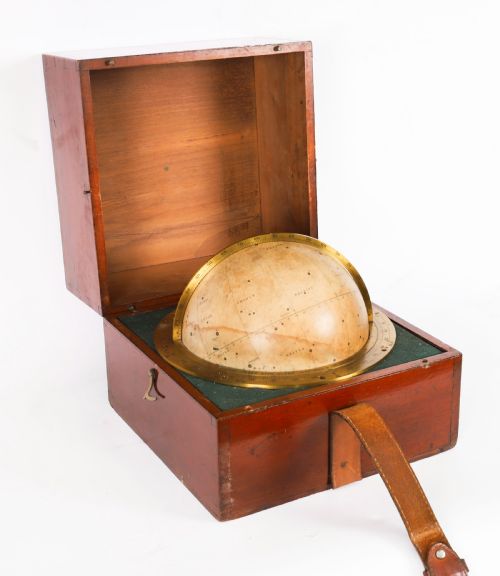


Vintage Map Globe
A vintage map globe brings the geography of a bygone era into your room, offering tangible history and classic cartography.
Vintage Map Globe
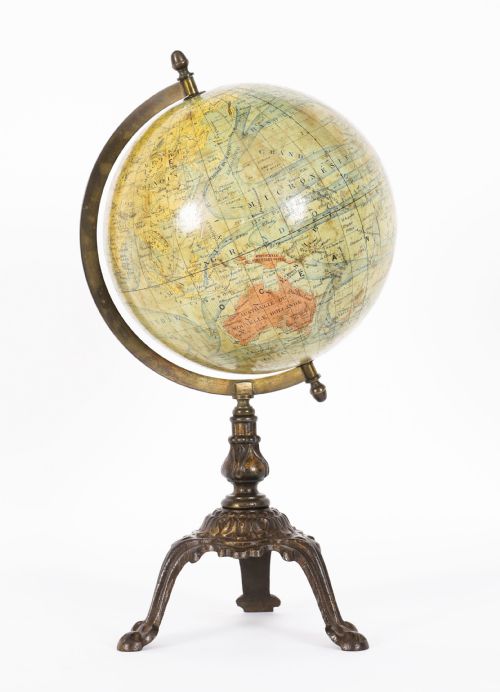
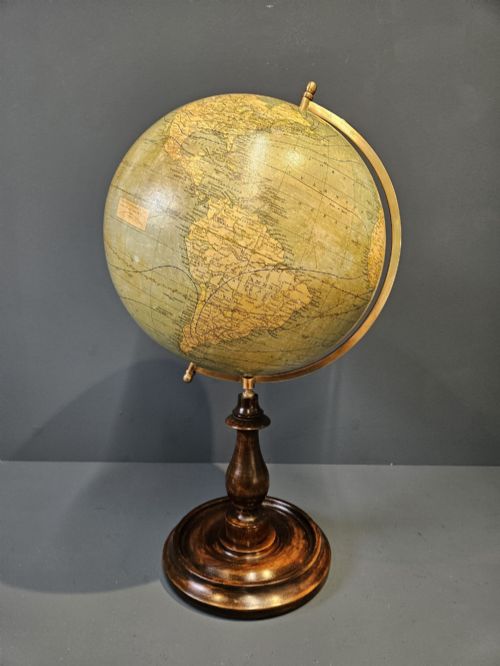
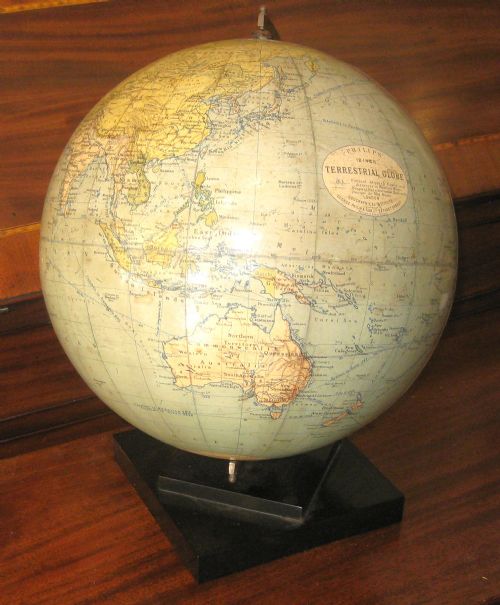
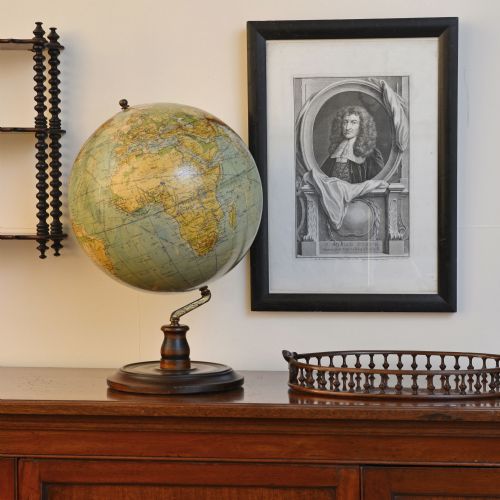
A vintage map globe represents geographical knowledge from past decades and centuries, typically taking the form of terrestrial or celestial spheres mounted on stands. Buyers seeking a vintage map globe encounter desktop instruments, floor-standing models, and even specialised coffee tables or oil lamp shades. These pieces range from Victorian scientific instruments to mid-century educational tools, reflecting the cartographic standards of their respective eras.
The materials and mountings vary significantly across the selection, featuring wooden feet, brass details, and cast iron bases. Most items date from the late nineteenth century through the mid-twentieth century, including works by notable cartographic publishers. Whether you select a small pocket globe or a large floor-standing model, each object serves as both a historical document and a decorative focal point.
How they were made
Cartographers typically printed gores - laminated paper segments bearing map details - and applied them by hand onto spheres made from plaster, paper papier-mâché, or metal. The precision of this application determined how accurately the cartography aligned across the surface of the sphere.
Makers mounted these spheres on turning axes attached to bases fashioned from mahogany, walnut, brass, or cast iron. Stands often incorporated turned wood or metal hardware designed to allow the globe to spin freely at an angle corresponding to the Earth's axial tilt.
Listings span the nineteenth and twentieth centuries, featuring materials such as mahogany, brass, cast iron, and paper mache.
What varies in quality
Quality in these globes rests upon the clarity and detail of the cartography, alongside the fidelity of the geographical boundaries shown. Globes produced by established publishers often feature finer hand-colouring and more precise topographical detailing.
The integrity of the physical materials also dictates worth, particularly the condition of the paper gores and the stability of the wooden or metal base. Finer examples retain their original varnishes and mountings without major structural losses or extensive surface restoration.
Lebegue and Cie·Geographia·Bacon·Phillips·George Philips and Son Ltd·Hughes and Son·M Vivien·Carl Adami·Raths
The Vintage Map Globe Glossary
- Terrestrial globe
- A spherical representation of the Earth showing landmasses, oceans, and political boundaries of a specific period. These instruments served as educational tools and desktop references.
- Celestial globe
- A sphere mapping the stars, constellations, and astronomical coordinates rather than the geography of the Earth. These are often found in portable cased sets.
- Gores
- The tapered paper strips printed with map sections that are pasted onto the spherical core of a globe. Aligning these accurately required considerable skill from the maker.
- Paper mache
- A composite material made of paper pulp or reinforced paper sheets mixed with glue, used to form lightweight spherical cores. It provided a stable surface for applying map gores.
Vintage Map Globe: Frequently Asked Questions
How do I date a vintage globe?
Dating relies primarily on the political boundaries, country names, and capital cities printed on the cartography. Publishers sometimes included publication dates in the cartographic cartouche on the sphere.
Examining the style of the wooden stand, the typography, and the mounting hardware also helps narrow down the decade of manufacture.
What is the difference between terrestrial and celestial globes?
Terrestrial globes depict the surface of the Earth, including continents, oceans, and historical political borders. They were used for geography and navigation.
Celestial globes map the night sky, displaying constellations and star positions from an outside perspective. They were historically used for astronomy and astrological calculations.
Can these globes be rotated?
Most models are mounted on a semi-meridian ring and a desktop or floor stand designed to let the sphere spin. You should turn them gently by the horizon ring or axis rather than pressing directly on the paper surface.
Older mechanisms may be delicate, so test the movement carefully before rotating.