



Vintage Paper Globe
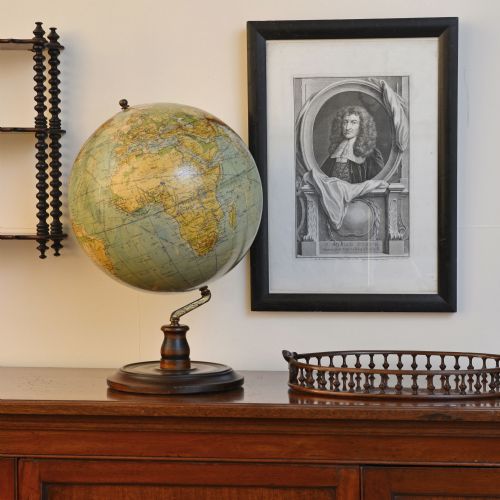
A vintage paper globe brings geography into the room on a turned stand, mapping the world through the printed gores of past decades.
Vintage Paper Globe
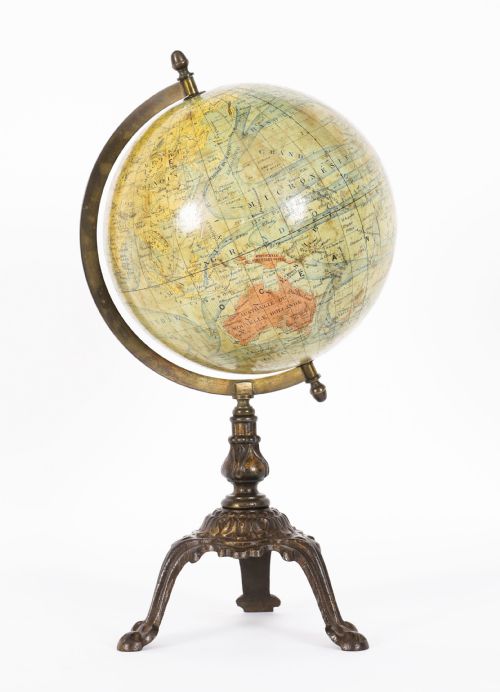
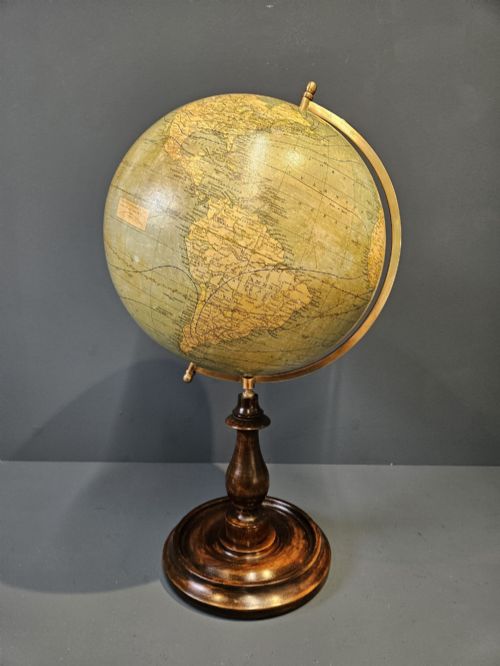
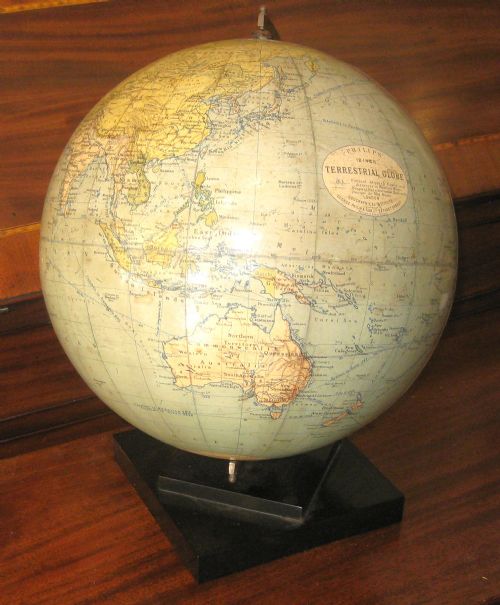
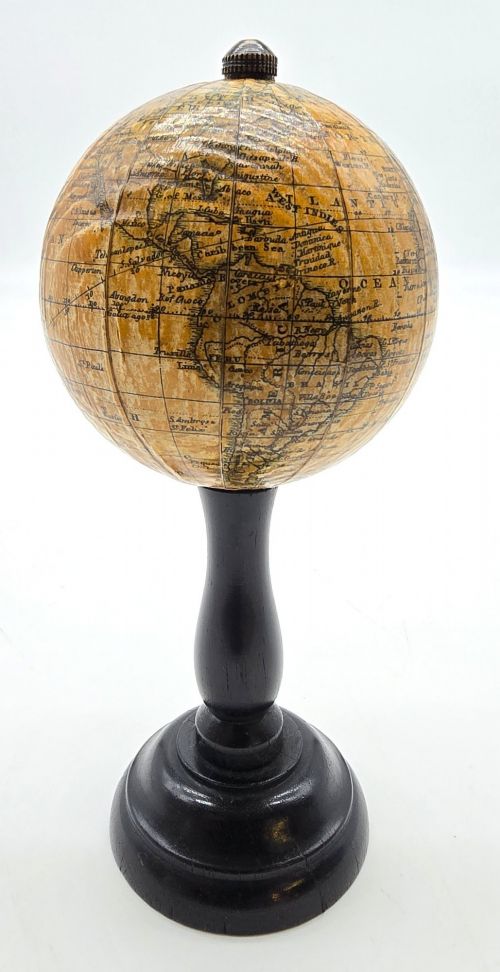
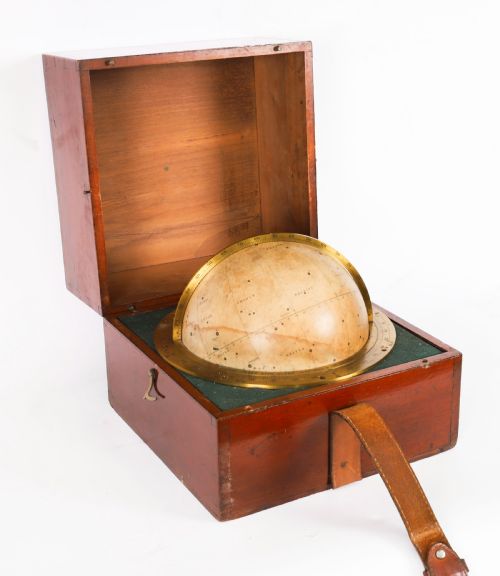
A vintage paper globe is a terrestrial or celestial sphere designed for a desk, table or floor, originating from workshops across the nineteenth and twentieth centuries. These pieces take the form of small miniature globes measuring four inches across, larger twelve-inch classroom or office models, and portable cased examples.
The versions most likely to meet a buyer on this page belong to the interwar period and the Victorian era, spanning English, French and German makers. They appear as standalone globes on wooden feet, mounted within brass meridians, or set upon ebonised stands.
Makers ranged from London map publishers to Parisian cartographers and Calcutta firms, producing globes that served both as working scientific instruments and as library ornaments.
Materials and Technique
Paper gores - individually printed curved segments of map - are dampened and carefully applied by hand over a sphere of plaster or paper mache. This technique requires precise alignment at the poles to ensure the cartography meets seamlessly.
The supporting structures combine turned wood such as mahogany, walnut and ebonised timber with cast iron and brass for the horizon rings and meridians. Stands are constructed to support the weight of the globe while allowing it to rotate on its axis.
Listings feature paper, brass, wood, metal, plaster, ebonised wood, mahogany, and cast iron across Victorian, interwar, and mid-century styles.
Craft and Condition
Quality rests in the precision of the gores' alignment and the clarity of the engraved or printed cartography, where finer examples show crisp political boundaries and legible place names without distortion. The choice of stand material also distinguishes the work, with solid walnut or heavy brass mounts indicating a higher grade of production than simpler secondary timbers.
The preservation of the original varnish and paper surface dictates the desirability of a piece. Examples retaining deep, undisturbed patination on the wooden feet and unblemished printed paper demonstrate superior survival through the decades.
Lebegue and Cie·Geographia·Bacon·George Philips and Son Ltd·Hughes and Son·J Forest·Malby's·M Vivien·Chandy Charan and Co·Carl Adami·Raths·Crunchley
The Vintage Paper Globe Glossary
- Gores
- The tapered paper segments printed with map details that are pasted onto the sphere. These strips require exact alignment during manufacture to prevent cartographic distortion.
- Meridian
- The brass or metal ring surrounding the globe that holds it in place and allows rotation. It is often graduated with degrees to measure latitude.
- Terrestrial
- A globe mapping the earth, showing continents, oceans, countries and shipping routes. These form the majority of historical desk and table models.
- Celestial
- A globe mapping the stars and constellations from an Earth-centred perspective. These are frequently found in portable cased sets alongside navigational instruments.
- Paper Mache
- A composite material made of paper pulp mixed with glue and pressed into a mould to form a lightweight sphere. Plaster is then applied to create a smooth drawing surface.
Vintage Paper Globe: Frequently Asked Questions
How do I read the date on an old globe?
Makers often printed the publication year directly onto the cartouche, though political boundaries offer a reliable secondary clue.
Changes in national borders and colonial names help narrow down the decade of manufacture when a direct date is absent.
Where were these placed in a Victorian home?
Table globes sat on library desks, antechamber tables, or dedicated stands beside reading chairs.
Larger versions stood directly on the floor in studies and parlours as both reference tools and symbols of learning.
How do I care for paper gores?
Keep paper globes away from direct sunlight to prevent the printed inks and colours from fading over time.
Dust them gently with a dry, soft cloth and maintain a stable room humidity to protect the plaster and paper.
What is the difference between terrestrial and celestial?
Terrestrial globes represent the surface of the Earth, detailing landmasses, oceans and historical political territories.
Celestial globes depict the night sky, charting stars and constellations for astronomical study and navigation.