
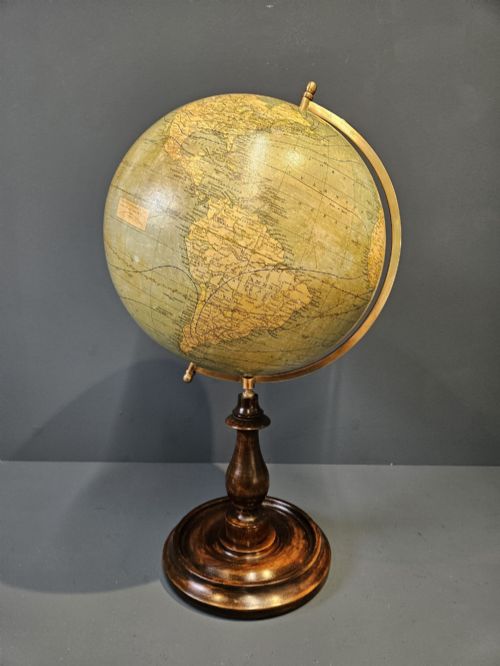
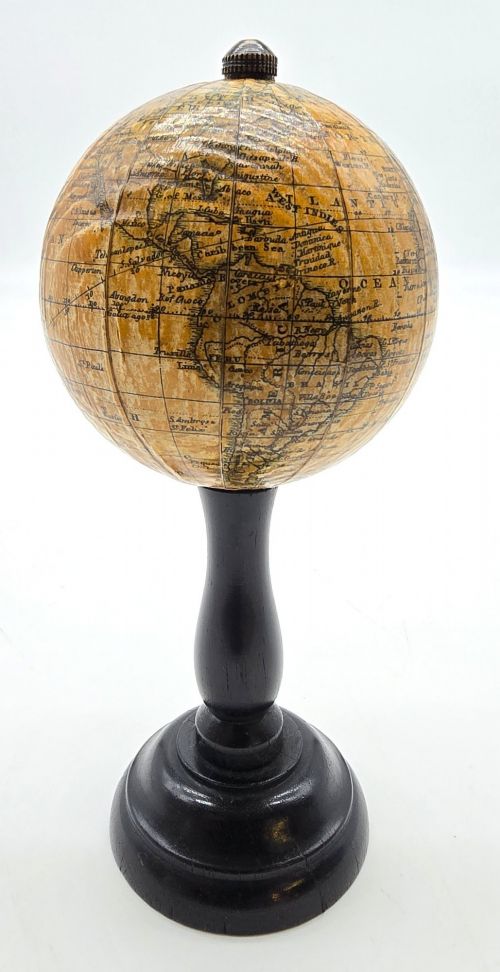


Library Table Globe
A library table globe brings the expanse of the world onto a desk or surface, prized for its geography and craftsmanship.
Library Table Globe
A library table globe is a portable geographical sphere designed for desk or table use, spanning periods from the eighteenth century to the mid-twentieth century. These items appear in various forms including terrestrial globes, celestial globes, desk globes, and table lamps.
The version most likely to meet a buyer on this page is the Victorian or nineteenth-century terrestrial globe. Examples range from miniature desk globes to large library editions mounted on wood stands.
Materials and construction
These globes were constructed using paper gores applied over plaster spheres, supported by stands made of mahogany, walnut, ebonised wood, or ebony. Metal and brass components frequently form the meridian rings and foot mountings that hold the sphere.
Maker signatures and map details were printed on paper before being carefully pasted onto the plaster body. Wood turned stands provided sturdy bases for both small desk models and larger library pieces.
Period styles span from Georgian and Regency through Victorian to Interwar and Mid-Century designs.
Distinctions in quality
Quality varies according to the precision of the cartography and the fidelity of the paper gores applied to the plaster sphere. Sharper geographical detail and cleaner alignment of printed segments elevate certain pieces above standard productions.
The material integrity of the stand and the refinement of the turned wood or brass fittings also separate superior examples. Maker attribution from notable cartographers adds significant distinction to an individual globe.
Bacon's·J. Forest·Malby's·Chandy Charan and Co·Carl Adami·Cruchley·Wyld's·Cary's·W and A K Johnston
The Library Table Globe Glossary
- Terrestrial globe
- A spherical map representing the earth. It displays continents, oceans, and political boundaries of the period in which it was produced.
- Celestial globe
- A sphere mapping the stars and constellations relative to the earth. These were often produced as companion pieces to terrestrial globes.
- Gore
- A wedge-shaped paper printed with map sections. These segments were applied by hand to cover the spherical plaster surface.
- Meridian ring
- The brass or metal ring encircling the globe. It allows the sphere to be tilted and rotated to specific angles.
Library Table Globe: Frequently Asked Questions
What is a library table globe?
A library table globe is a portable spherical map designed to sit upon a desk, table, or piece of furniture for reference and display. These items combine geographical mapping with decorative stands made of wood or metal.
Such pieces range from small miniature desk versions to large nineteenth-century library editions. They record the geography and cartographic knowledge of their specific period of production.
How do I tell terrestrial and celestial globes apart?
Terrestrial globes display the geography of the earth, including landmasses, oceans, countries, and shipping routes. They reflect the political and physical world of the era.
Celestial globes depict the night sky, featuring constellations, stars, and astronomical coordinates rather than earthly maps. They are designed to map the celestial sphere from an geocentric perspective.
Where were these globes manufactured?
Production centres included British, French, and international mapmakers and publishers. Firms such as Malby's, Cary's, and Newton's produced notable globes in London, while other makers operated in locations like Calcutta and France.
Publishers employed specialised craftsmen to print map gores and shape the plaster spheres. Stands were turned locally from native or imported timbers such as mahogany and walnut.
How should I care for a vintage globe?
Keep the globe away from direct sunlight to prevent the printed paper gores and delicate colours from fading. Stable indoor humidity levels protect both the paper map and the underlying plaster sphere from cracking.
Dust the surface gently with a dry, soft cloth and avoid liquid cleaners or moisture. The wooden stand can be treated with appropriate furniture wax according to its finish.