
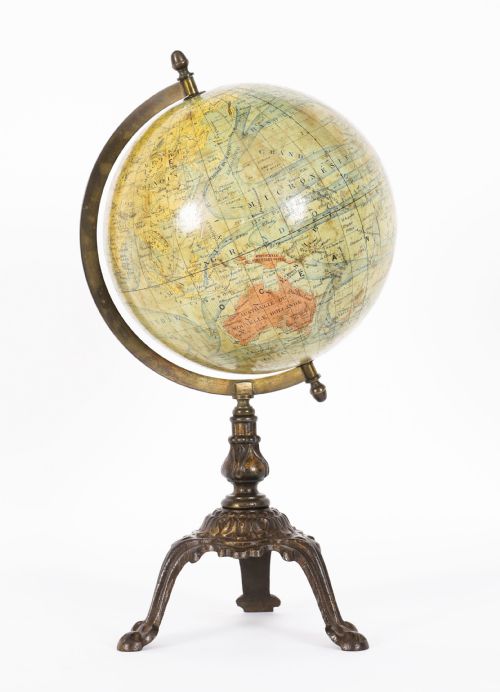
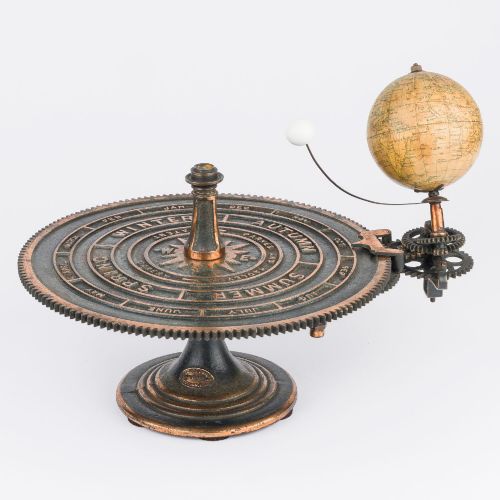
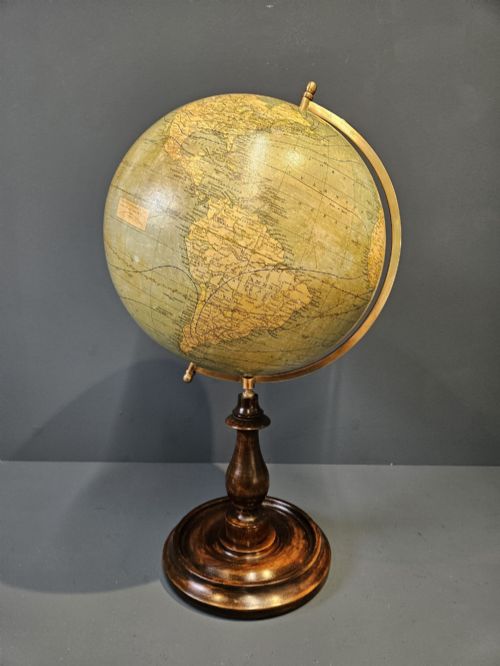
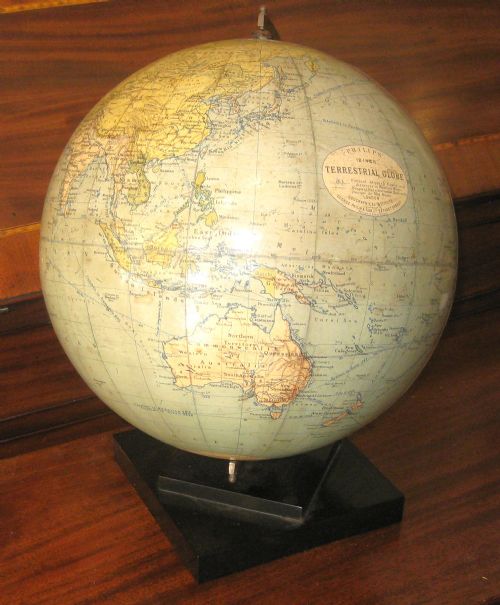
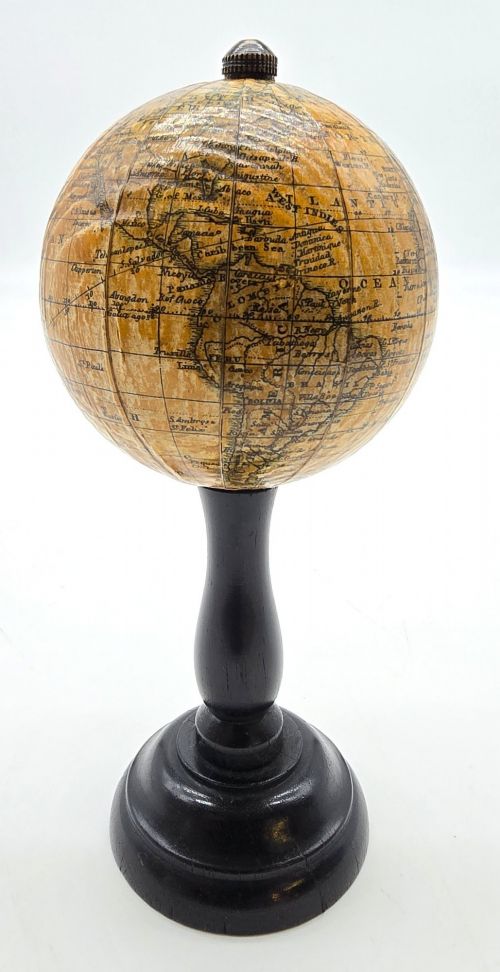


Desktop Terrestrial Globe
A desktop terrestrial globe brings the mapped world to your study table, combining geographical knowledge with period craftsmanship.
Desktop Terrestrial Globe
A desktop terrestrial globe is a scientific instrument designed for table or desk placement, representing the earth through printed cartography mounted on a sphere. These objects emerge from various eras including the Victorian and Edwardian periods, alongside interwar productions.
The specimens seen here take the form of desk globes, miniature globes, and table globes accompanied by specific maker attributions. Such pieces range from compact German miniature globes to larger twelve-inch examples resting on walnut or ebonised wood stands.
Materials and construction
Construction relies upon papier-mâché or plaster spheres covered with segmented paper gores that display the printed map details. These globes are finished with varnishes to protect the paper surface over decades of use.
Mountings utilise turned wood such as walnut or ebony, alongside brass hardware and cast iron or metal meridian rings. Stands range from simple circular bases to detailed feet supporting the tilted axis of the sphere.
Listings feature paper, brass, ebonised wood, cast iron, metal, plaster, wood, and walnut across Victorian, Edwardian, and interwar periods.
Assessing quality in a desktop terrestrial globe
Quality rests upon the clarity and detail of the printed cartography, where finer copperplate printing reveals intricate political boundaries and shipping routes. The precision of the gores aligning seamlessly across the plaster or papier-mâché sphere also marks superior production.
The choice of materials for the stand elevates the piece, distinguishing simple wooden bases from substantial walnut feet or weighted brass mountings. Maker reputation further separates standard geographical tools from distinguished scientific instruments.
Lebegue & Cie·Parkes & Hadley·Bacon's·Phillips·Geographia·J. Forest·Malby's·M.Vivien
The Desktop Terrestrial Globe Glossary
- Gore
- A tapering, printed paper strip that is applied to the sphere to form the map of the earth. Several gores are shaped to cover the spherical surface without distortion.
- Orrery
- A mechanical model of the solar system that illustrates the relative positions and motions of the planets. These scientific instruments occasionally accompany globe collections.
- Terrestrial
- Pertaining to the planet Earth, used to distinguish globes showing the earth from celestial globes mapping the stars.
Desktop Terrestrial Globe: Frequently Asked Questions
What is a desktop terrestrial globe?
A desktop terrestrial globe is a scaled spherical map of the earth designed to sit upon a desk, table, or cabinet. These instruments provide geographical reference while serving as decorative objects.
They appear in various diameters and styles, reflecting the cartographic knowledge and decorative tastes of their respective periods of manufacture.
How are desktop globes dated?
Dating relies upon the political boundaries and place names printed on the map gores, which often correspond to specific historical treaties or colonial territories. Maker signatures and patent dates printed on the cartouche also offer precise chronological markers.
Material composition and the style of the wooden stand or brass meridian further help identify periods such as the Victorian era or the interwar years.
Where should I place my globe?
These pieces suit placement on library tables, writing desks, or bookshelves where they receive indirect lighting. Direct sunlight should be avoided to prevent fading of the printed paper gores.
Stable surfaces away from heat sources ensure the wood stands and plaster spheres remain preserved in good condition.
How do I clean a paper globe?
Dusting requires only a soft, dry microfibre cloth applied very gently across the surface. Moisture must be avoided entirely to prevent staining or lifting of the paper gores.
Professional restoration is recommended if the paper surface requires more than careful surface dusting.