


Victorian Wedgwood Pottery
Victorian Wedgwood pottery offers distinct 19th-century ceramic forms that collectors seek for their classic relief decoration and refined utility.
Victorian Wedgwood Pottery
Victorian Wedgwood pottery encompasses a range of functional and decorative ceramic objects produced throughout the nineteenth century. Buyers searching this phrase encounter tea sets, biscuit barrels, cheese domes, and decorative vases.
The material selection on this page centres on jasperware, stoneware, and earthenware, alongside specialised bodies like caneware and drabware. Forms often exhibit Neoclassical, Aesthetic Movement, or Persian styles.
Most pieces date from the Victorian period, specifically the 1870s, 1880s, and 1890s. These items range from small trinket boxes and miniature teapots to larger dessert services and game pie dishes.
How these pieces were made
Makers utilised stoneware and earthenware bodies, shaping them into functional vessels such as cheese dishes, biscuit barrels, and dessert plates. Artisans applied hand-painted details and intricate relief work to the ceramic surfaces.
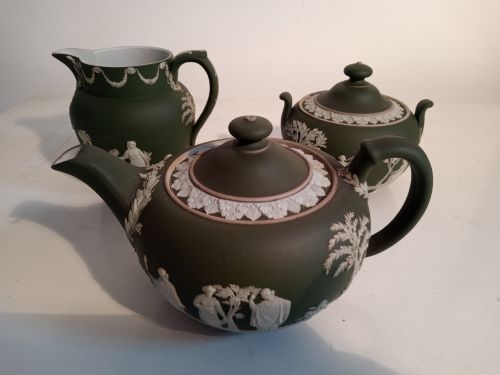
Jasperware items required precise moulding of applied classical figures against a contrasting background colour, known as dip. Certain pieces incorporated silver plate mounts or gold leaf to enhance the ceramic body.
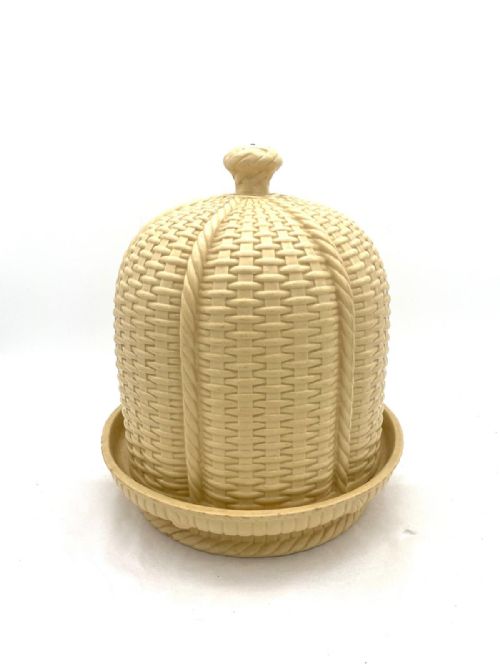
Basket weave drabware kept Victorian cheese properly sequestered from wandering eyes.
What varies in quality
Quality depends upon the crispness of the moulded relief work and the evenness of the coloured body. Pieces with sharply defined figures and clean separation between base and applied decoration demonstrate superior skill.
The presence of named designer work, such as Thomas Allen designs, or careful hand-painting elevates individual items. The integration of mounts like silver plate alongside the ceramic body also distinguishes finer examples.
Thomas Allen Design
The Victorian Wedgwood Pottery Glossary
- Jasperware
- A fine-grained, unglazed stoneware developed by Wedgwood, typically featuring white classical relief figures against a coloured ground. Blue and olive green are common variations seen in the nineteenth-century selections.
- Caneware
- A buff-coloured, fine earthenware resembling the shade of bamboo or pale biscuit. This body was frequently utilised for kitchen and dining wares like game pie dishes.
- Drabware
- A utilitarian earthenware body possessing a subdued, greyish-brown or olive tone. It often appeared in practical dining forms such as cheese domes with basket weave textures.
- Biscuit Barrel
- A covered ceramic container designed to hold dry biscuits at the Victorian dining table. These vessels commonly incorporated silver plate mountings and swing handles.
Victorian Wedgwood Pottery: Frequently Asked Questions
What is Victorian Wedgwood pottery?
Victorian Wedgwood pottery comprises nineteenth-century ceramic items including jasperware vases, biscuit barrels, and tea sets. These pieces reflect Neoclassical and Aesthetic Movement styles.
Production spans earthenware, stoneware, and specialised bodies like drabware and caneware, often featuring applied white relief decoration.
How do I date these pieces?
Dating relies on stylistic clues, period markers, and specific date letters or c. notations recorded in the listings. Victorian examples frequently date from the 1870s to the 1890s.
Nineteenth-century items often combine traditional Neoclassical motifs with later Victorian aesthetic influences, such as Persian style oriental designs.
How were cheese domes used?
Cheese domes served to cover and preserve cheese on the Victorian dining table. The ceramic dome trapped moisture while resting on a matching dish.
Designs like drabware cheese dishes utilised basket weave textures for decorative effect alongside practical function.
What is jasper dip?
Jasper dip refers to a technique where a white stoneware body received a wash of coloured slip on the exterior surface. This method produced the characteristic contrasting background for white classical reliefs.
Blue and olive green are typical colours found on circular patch boxes and miniature teapots produced during this era.
How should I care for jasperware?
Jasperware requires gentle cleaning to protect the unglazed stoneware surface and applied relief details. Dusting with a soft, dry brush preserves the porous ceramic body.
Avoid abrasive cleaners and excessive moisture, particularly on pieces featuring delicate silver plate mounts or gold leaf.