



Victorian Orientalist Side Table
A victorian orientalist side table brings geometric intricacy and rich inlay into a room, offering a functional surface shaped by nineteenth-century fascination with eastern design.
Victorian Orientalist Side Table
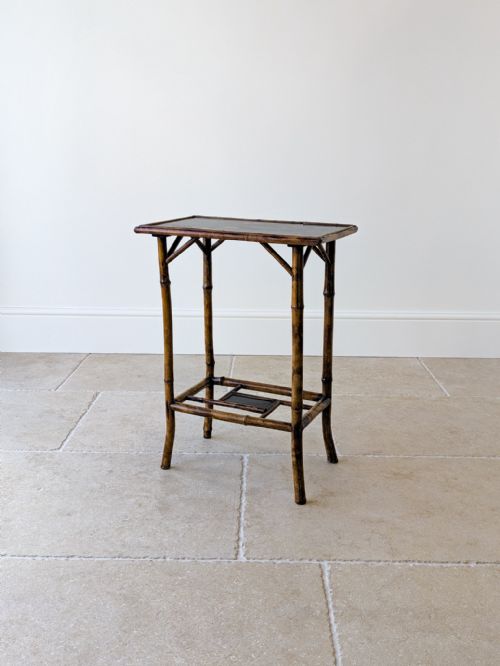
A victorian orientalist side table spans forms such as occasional tables, games tables, centre tables, and specific shapes like hexagonal or octagonal tables and camel tables. These pieces draw on Moorish Revival, Aesthetic Movement, Mamluk Revival, Venetian Baroque Revival, Ottoman Syrian, and Anglo-Indian styles, reflecting nineteenth-century design tastes.
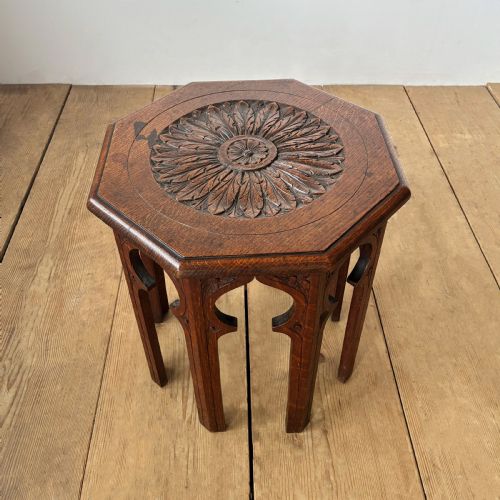
The versions most commonly met on this page include octagonal occasional tables, hexagonal tables, and inlaid Syrian or Moroccan pieces often associated with makers like Liberty & Co. The periods represented range across the nineteenth century, including specific dates from 1850 to 1890, alongside early twentieth-century examples from 1930.
Materials and construction
The construction relies on woods such as walnut, ebonised wood, hardwood, and oak, forming the structural carcass of the furniture. Artisans shaped these timbers into hand-carved surfaces and complex geometric frames.
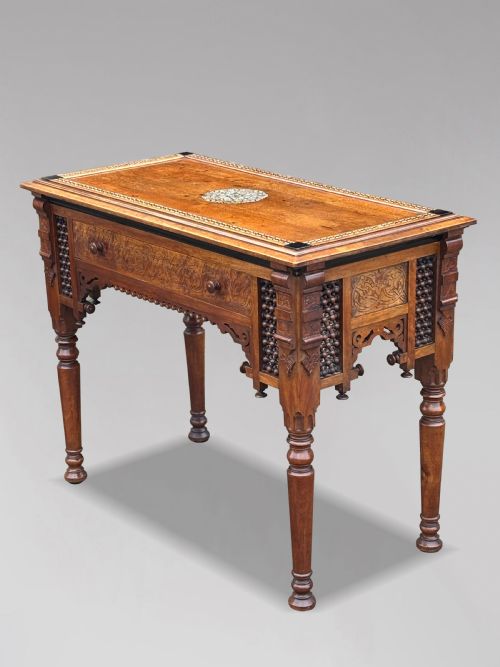
Decoration is achieved through elaborate inlay work utilising mother-of-pearl, bone, brass, white-metal, and copper. This meticulous surface enrichment defines the visual identity of these tables.
Listings feature woods including walnut, oak, and ebonised wood, combined with inlay materials such as mother-of-pearl, bone, and brass.
Assessing quality and execution
Quality rests in the precision of the joinery and the density of the geometric carving across the wooden frames. Tighter execution shows deliberate alignment in panels and stable construction across complex multi-sided forms.
The standard of inlay work further separates examples, seen in how securely mother-of-pearl, bone, and metal wire sit within the wood or brass substrate. Finer pieces demonstrate consistent pattern rhythm without gaps or crude repairs in the mosaic elements.
Liberty & Co
The Victorian Orientalist Side Table Glossary
- Moorish Revival
- A nineteenth-century architectural and decorative style drawing inspiration from North African and Spanish Islamic design. It heavily influences the geometric patterns and arched motifs found on these tables.
- Cairoware
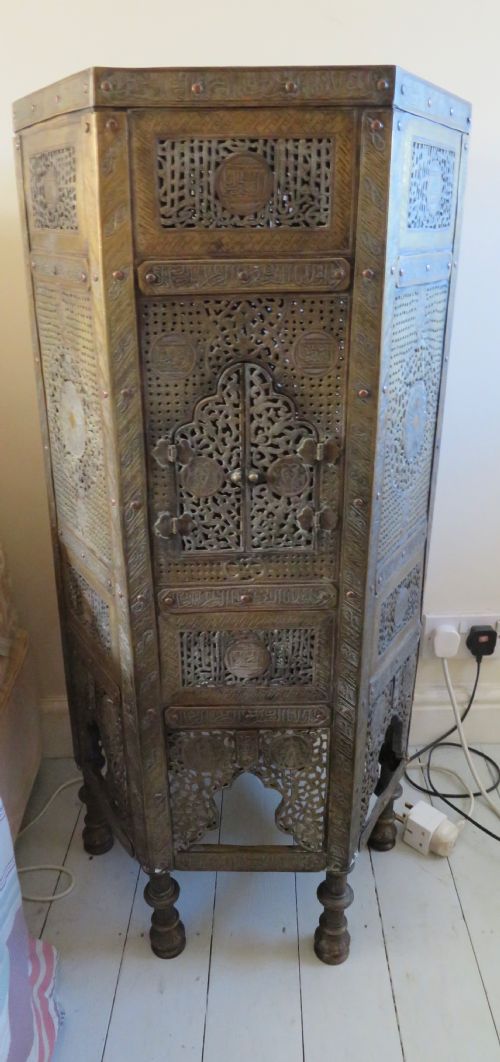
- Metalwork produced in Cairo and exported during the late nineteenth and early twentieth centuries, typically constructed from brass inlaid with silver, copper, and white-metal. Such pieces translate traditional Middle Eastern vessel techniques into table forms.
- Aesthetic Movement
- A late nineteenth-century British design movement that emphasised visual beauty over narrative or moral function. It frequently incorporated Anglo-Japanese and Islamic motifs into domestic furniture.
- Mamluk Revival
- A style reviving the rich decorative arts of the Mamluk Sultanate, characterised by intricate engraved brasswork and geometric strapwork. On tables, this appears in heavy metal tops and geometric bases.
- Octagonal
- Having eight sides and eight angles, forming a distinct geometric footprint common in occasional tables of this group. This shape allowed complex inlay patterns to repeat across symmetrical faces.
Victorian Orientalist Side Table: Frequently Asked Questions
How were these tables used originally?
These tables served as occasional, centre, or games tables within Victorian drawing rooms and studies. Their exotic decoration made them conversation pieces rather than heavy utility furniture.
Many functioned as display surfaces for ornaments, smoking paraphernalia, or chess sets, matching the Victorian taste for eclectic interior staging.
How do I care for inlaid wooden surfaces?
Inlaid surfaces require consistent indoor humidity and gentle dusting with a dry, soft cloth to protect the delicate bone and mother-of-pearl elements. Avoid liquid polishes that can seep into microscopic gaps around the inlay.
Keeping the furniture away from direct heat sources prevents the timber from shrinking and loosening the metal or organic mosaic pieces.
How can I distinguish different nineteenth century styles?
Differentiation depends on the specific motifs and material combinations present on the piece. Moorish and Syrian examples often rely on dense wood carving and bone or mother-of-pearl inlay, whereas Mamluk Revival pieces showcase heavy brass tops with inlaid white-metal and copper.
Aesthetic Movement interpretations blend these eastern motifs with cleaner structural lines favoured by contemporary British designers.