
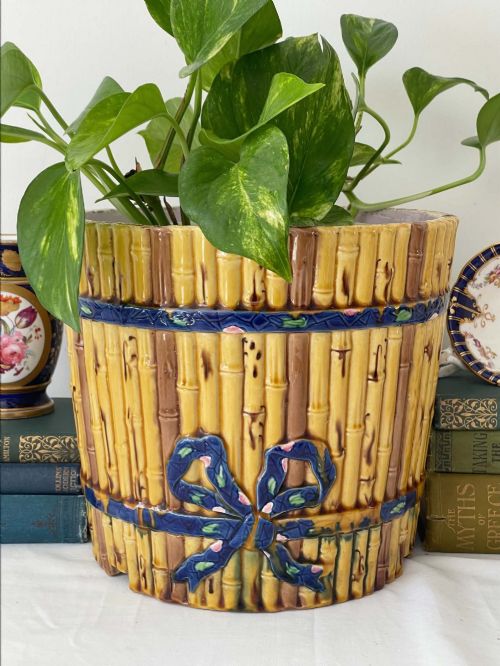


Victorian Majolica Planter
A victorian majolica planter brings vibrant colour and relief-moulded botanical ornament to a room, offering a rich centrepiece for interior planting.
Victorian Majolica Planter
When you search for a victorian majolica planter, you are looking at glazed earthenware vessels designed to hold large indoor plants or ferns. The pieces appearing here span the Victorian era, the Edwardian period, and the early twentieth century, taking the form of bulbous jardinieres, footed bowls, and tall pedestals.
Many examples embrace Victorian naturalism and rustic aesthetics, taking shape as bamboo, rockwork, ferns, and swans. Alongside these organic forms, later pieces reflect the flowing lines of the Art Nouveau movement and the early Secessionist style.
The objects originate from notable English potteries alongside Scottish makers and continental European workshops. You will frequently encounter solo jardinieres as well as paired combinations featuring matching stands or pedestals.
Materials and production methods
These vessels are formed from earthenware or pottery, shaped either by hand or moulded in relief to capture intricate natural textures like tree bark, feathers, and foliage. The earthenware body provides a porous structure well suited to absorbing the thick coatings applied to the surface.
Potters applied vibrant lead glazes and lustre glazes directly over white or tinted grounds, allowing the liquid colours to pool naturally across the moulded details. This technique produces the characteristic rich, glossy finish and deep colour saturation associated with the genre.
Victorian Majolica Planter Retail Price Guide 2026
Typical asking prices for victorian majolica planter among the pieces listed under this phrase on Sellingantiques today, from the lower quarter to the upper quarter. They describe what is for sale here now, not the wider market.
Listings feature earthenware bodies decorated with lead and lustre glazes, spanning the Victorian era, the Edwardian period, and the early twentieth century.
Assessing quality and craftsmanship
The standard of a piece rests largely on the crispness of the moulded relief and the control of the glaze application. Finer examples retain sharp botanical details and subtle colour shading that does not obscure the underlying earthenware texture.
Completeness also dictates standing, particularly for pieces designed as a jardiniere and stand combination. Surviving pairs or complete multi-piece pedestals represent a higher tier of production than isolated bowls.
Minton·Clement Massier·Julius Dressler·Royal Worcester·George Jones·Burmantofts
The Victorian Majolica Planter Glossary
- Majolica
- A type of pottery glazed with opaque tin or transparent lead glazes over coloured slips, known for brilliant hues. It gained immense popularity during the nineteenth century for decorative wares.
- Jardiniere
- A large ornamental pot or receptacle used for holding flowers or growing plants indoors. They often sit directly on tabletops or on matching ceramic pedestals.
- Earthenware
- Porous pottery fired at a relatively low temperature, forming the base body for the majority of these glazed vessels. It requires a vitreous glaze coating to become completely watertight.
- Naturalism
- An artistic style focusing on accurate depictions of plants, animals, and geological formations. In these ceramics, it manifests as realistic bamboo stalks, rockwork, and animal figures.
- Lustre glaze
- A metallic glaze technique that produces an iridescent sheen on the ceramic surface. This finish shifts in colour when viewed under different angles of light.
Victorian Majolica Planter: Frequently Asked Questions
How were majolica planters used?
These vessels served as ornamental containers for large indoor palms, ferns, and flowering plants in nineteenth-century drawing rooms and conservatories. They were placed on tables or displayed proudly on matching ceramic pedestals.
Because earthenware is porous, growers typically placed potted plants inside the jardiniere to catch drainage water and protect the decorative glaze.
What is the difference between a jardiniere and a planter?
In historical terms, a jardiniere specifically denotes an ornamental pot designed for holding indoor plants, functioning primarily as a decorative cachepot rather than a direct planting vessel. The term planter is often used interchangeably today for any large container configured for greenery.
Both forms appear frequently in nineteenth-century ceramic production, sometimes accompanied by matching columnar stands.
How do I date a majolica jardiniere?
Dating relies on stylistic clues, pottery registry marks, and specific artist signatures stamped into the earthenware base. Early Victorian pieces often feature naturalistic plant and animal forms, while turn-of-the-century examples lean towards Art Nouveau or Secessionist designs.
Examining the glazing technique and the nature of the pottery body also helps narrow down the period of manufacture.
Are majolica planters waterproof?
While the heavy lead glaze seals the interior surface, antique earthenware can develop microscopic crazing over time. It is wise to use a modern plastic liner inside the vessel rather than planting directly into the antique ceramic.
This precaution prevents moisture from seeping into the historic earthenware body and preserves the integrity of the piece.