


Victorian Earthenware Cachepot
These Victorian earthenware cachepot pieces are decorative indoor plant pots that bring rich nineteenth-century colour and texture to a room.
Victorian Earthenware Cachepot
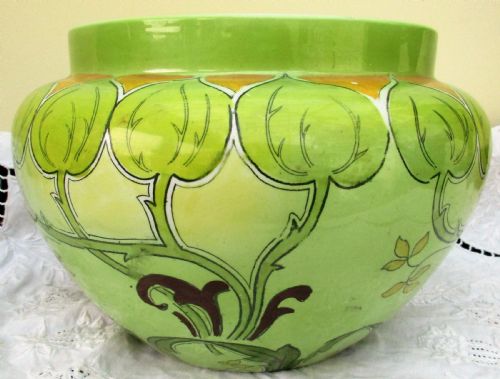
When you search for a Victorian earthenware cachepot, you are looking at nineteenth-century jardiniere planters designed to hold potted plants indoors. The examples seen here span from the 1870s through to 1900, capturing the shift from early Victorian naturalism to later Art Nouveau designs.
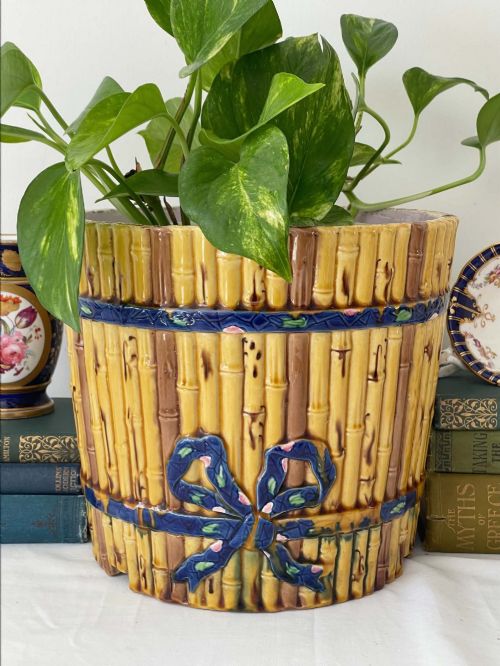
You will encounter various forms on this page, including majolica fern rockwork, bamboo motifs, and classical blue jasperware. These pieces originate from renowned English potteries and encompass both glazed earthenware and stoneware productions.
The primary function remains housing potted greenery while protecting interior surfaces from water. Makers achieved this through heavy potting and internal waterproofing glazes suited to domestic plant displays.
Materials and Manufacture
Potters shaped these cachepots using local clay bodies, primarily earthenware and stoneware, before applying richly coloured glazes. Majolica techniques predominate, using metallic oxide glazes over moulded relief decoration to create vibrant greens, browns, and blues.
Moulding and slip-casting allowed workshops to produce complex surface details such as bamboo stalks, rockwork, and swan forms. Artisans then hand-finished the greenware and fired the pieces in kilns to fuse the vitreous glaze surfaces.
Listings feature items spanning the nineteenth century, with specific dates recorded from 1866, 1870, 1873, 1876, 1880, 1890, and 1900.
Judging Quality
Quality in these planters rests upon the crispness of the moulded relief and the depth of the glaze application. Finer examples display sharp botanical or architectural details without blurring in the recessed areas.
The richness and consistency of the coloured glaze separation indicate superior kiln control and skilled hand-painting. Marked pieces from notable potteries also command attention through documented design provenance and artistic collaboration.
Minton·W.A. Adderley·Doulton Burslem·Doulton Lambeth·Royal Doulton·Royal Worcester·William Adams And Sons·Linthorpe Pottery
The Victorian Earthenware Cachepot Glossary
- Cachepot
- A decorative indoor flowerpot designed to hide an ordinary, unadorned plant pot inside. It typically lacks a drainage hole in the base.
- Majolica
- A type of earthenware coated with an opaque tin-lead glaze or colourful lead glazes over moulded relief decoration. It became extremely popular during the Victorian period for botanical and animal subjects.
- Jasperware
- A type of unglazed stoneware developed by Josiah Wedgwood and continued by later potteries, featuring white raised cameo reliefs against a coloured background such as blue.
- Jardiniere
- A large ornamental pot or stand for holding plants or flowers, often used as a freestanding floor or table centrepiece during the nineteenth century.
- Stoneware
- A dense, hard pottery fired at high temperatures until the clay body vitrifies and becomes waterproof without needing a surface glaze.
Victorian Earthenware Cachepot: Frequently Asked Questions
What is a cachepot?
A cachepot is an ornamental container designed to hold a potted plant and catch excess water from drainage.
Unlike traditional garden pots, these decorative vessels usually lack a hole in the bottom to protect indoor surfaces.
How do I date these?
Dating relies on maker marks, registration diamonds, stylistic shifts from naturalism to Art Nouveau, and specific glaze types.
Nineteenth-century pieces often carry impressed factory ciphers or artist monograms on the underside.
Can I plant directly inside?
Direct planting is generally discouraged because moisture can seep through porous earthenware or trap salts against the interior glaze.
Using a smaller plastic nursery pot inside keeps the historic ceramic dry and safe from mineral staining.
Where were they displayed?
Victorian households placed these planters on tables, mantelpieces, plant stands, or directly on the floor for large jardiniere forms.
They brought botanical life indoors during an era obsessed with ferns, palms, and interior greenery.