


Victorian Earthenware Poodles
Victorian earthenware poodles bring character and ceramic charm to a room, offering the appeal of nineteenth-century animal figures.
Victorian Earthenware Poodles
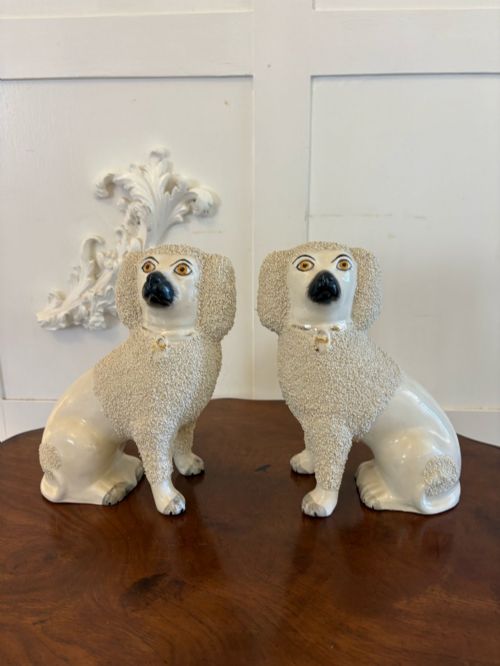
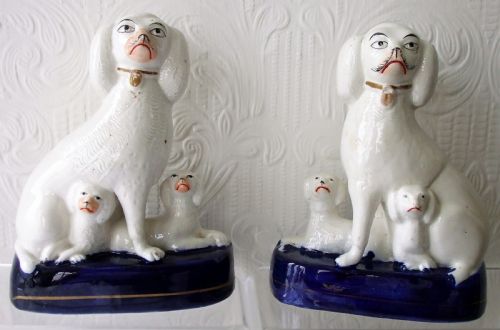
Victorian earthenware poodles are decorative figurines that appear in various forms, from pairs with pups to individual figure groups and miniature models. These ceramic pieces date across the nineteenth century, including examples from around eighteen sixty and nineteen hundred.
Buyers commonly encounter pairs of poodles, often modelled with textured coats and seated postures. Certain pieces incorporate functional elements like quill holders or clock groups alongside the standard decorative format.
Materials and technique
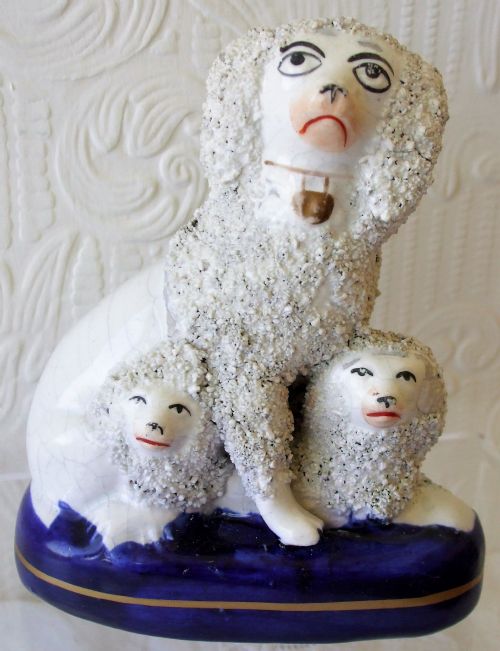
Potters shaped these figures from earthenware clay before applying lead glaze and colourful enamel details. Many examples feature applied clay work to simulate curly coats, alongside touches of gold leaf or gilt.
The combination of moulded earthenware bodies and hand-painted surface decoration defined the production of these nineteenth-century ceramic figures.
The listings show nineteenth-century earthenware figures utilising lead glaze, enamel, and gold leaf in both standard and miniature sizes.
Assessing quality
The overall proportion and the complexity of the grouping, such as the inclusion of pups or baskets, separate standard production pieces from finer outputs.
James Dudson
The Victorian Earthenware Poodles Glossary
- Earthenware
- Porous pottery fired at lower temperatures, commonly used for nineteenth-century figures. It forms the core body beneath the glaze.
- Lead glaze
- A shiny coating applied to pottery before firing to provide a smooth, waterproof surface. It gives these figures their characteristic gloss.
- Enamel
- Coloured glass painted onto fired ceramic surfaces and fused by a subsequent heating. It provides the decorative tones on the poodles.
- Gold leaf
- Very thin sheets of metal applied to highlights on the pottery. It is often found accenting collars and details.
- Quill holder
- A desk accessory featuring a hollow section or basket designed to hold writing feathers. Some figural groups incorporate this practical function.
Victorian Earthenware Poodles: Frequently Asked Questions
What are Victorian earthenware poodles?
These pieces are nineteenth-century ceramic figures depicting poodles, often created in matched pairs for mantelpiece display.
Potters produced them in various sizes, ranging from miniature models to larger sculptural groups complete with puppies.
How were these dog figures used?
Victorian households placed these ceramic animals on mantelpieces, side tables, and shelves as purely decorative ornaments.
Certain variations served dual purposes, such as holding writing quills or forming part of a clock garniture set.
How do you identify nineteenth-century examples?
Identification relies on examining the clay body, the characteristic lead glaze, and the specific hand-painted enamel details typical of the period.
The style of the modelling and the presence of nineteenth-century decorative conventions help confirm the era.
How do you care for glazed earthenware?
Display these ceramic figures away from direct sunlight and areas of high moisture to protect the surface enamels and glazes.
Dusting gently with a dry, soft cloth keeps the glaze clean without risking abrasion to the painted details.