
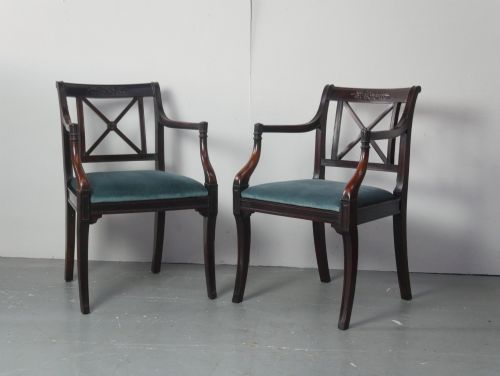
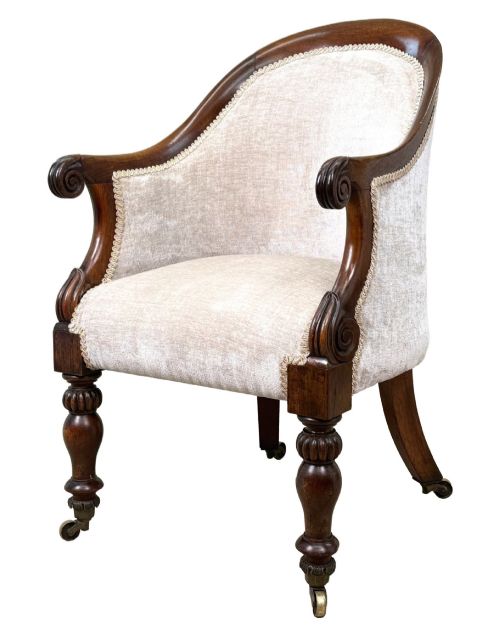
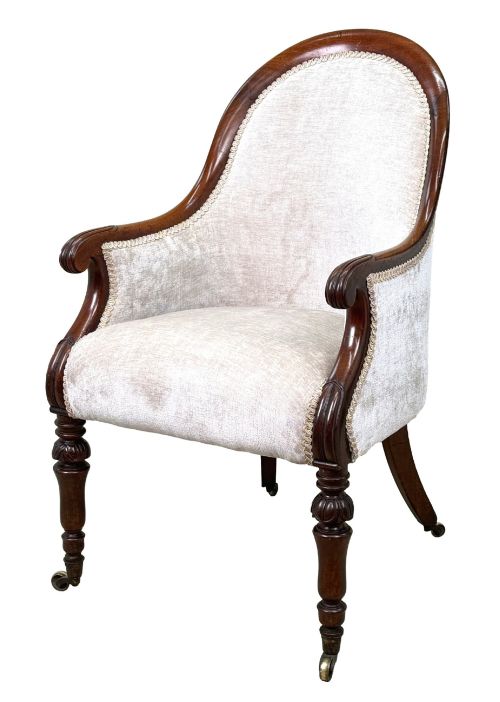
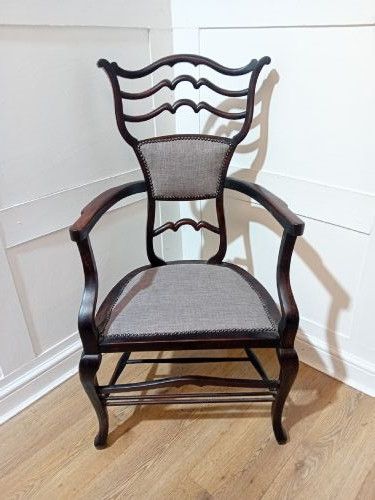

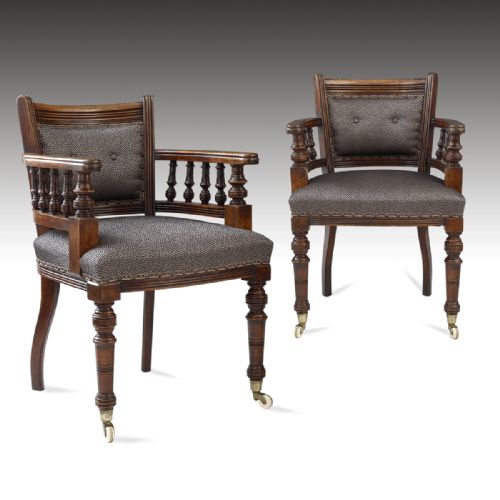
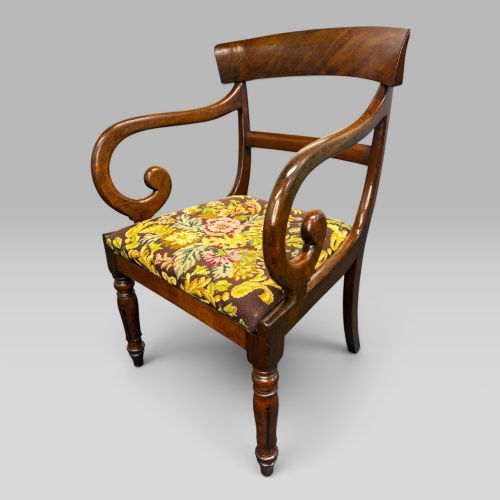
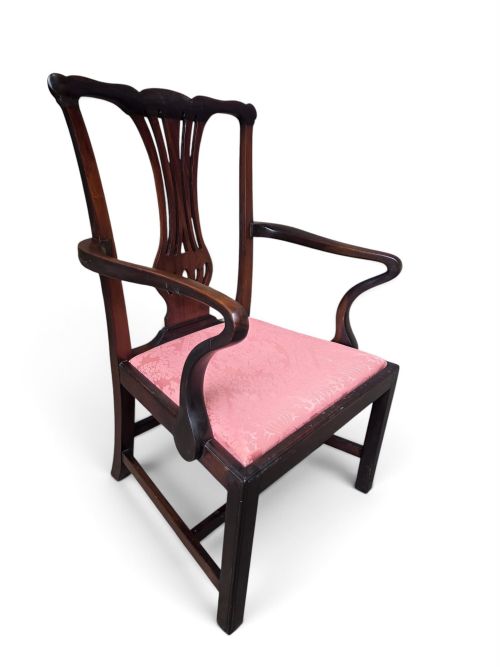
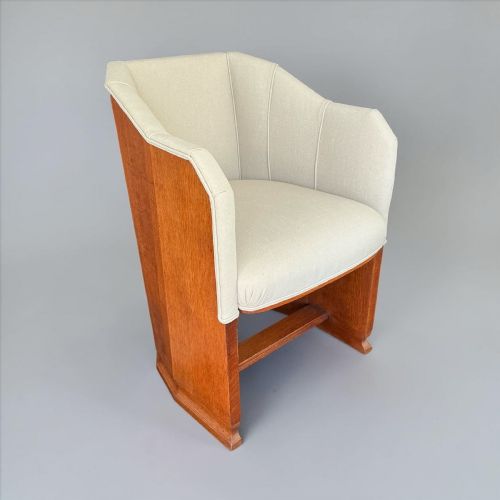
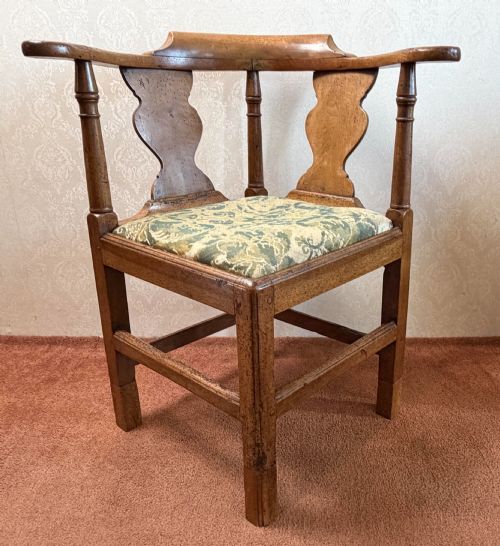
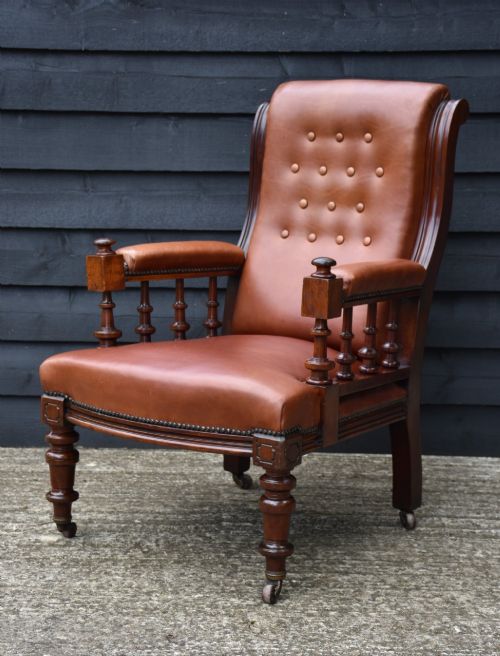
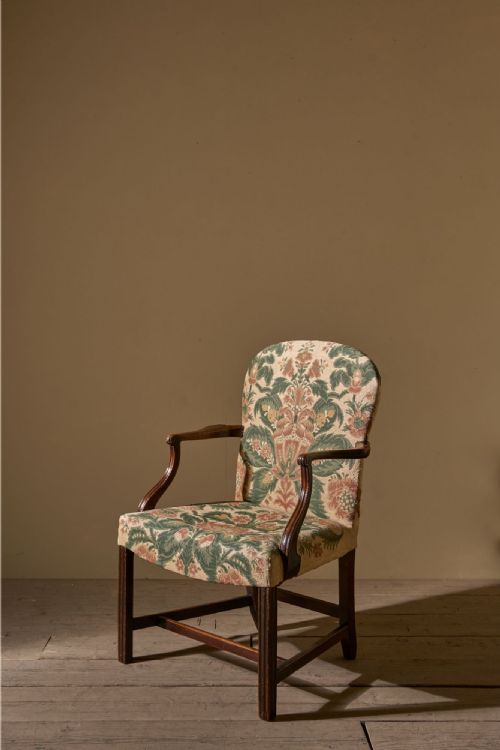
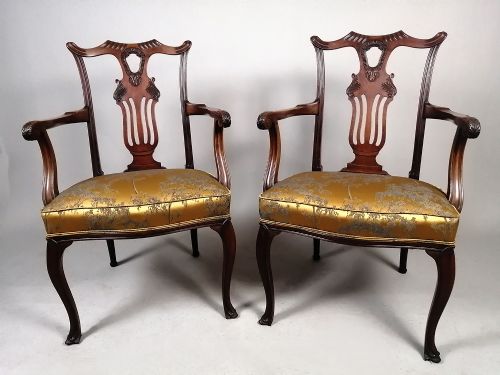
Upholstered Desk Armchair
An upholstered desk armchair brings substance to a study, offering the support needed for long hours at a writing table.
Upholstered Desk Armchair
When you search for an upholstered desk armchair, you enter a domain where utilitarian seating meets cabinet-maker refinement across multiple eras. These pieces bridge the gap between heavy library chairs and lighter writing seats, designed specifically for comfort at a desk.
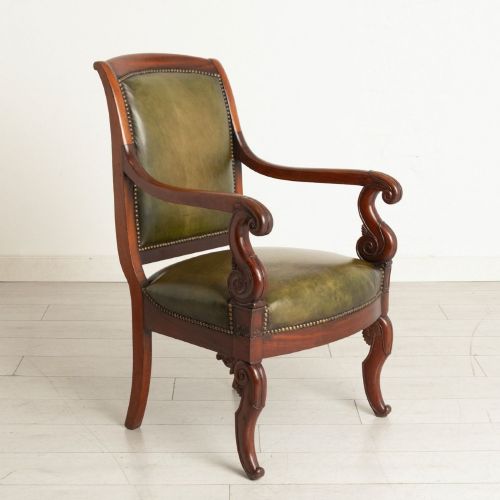
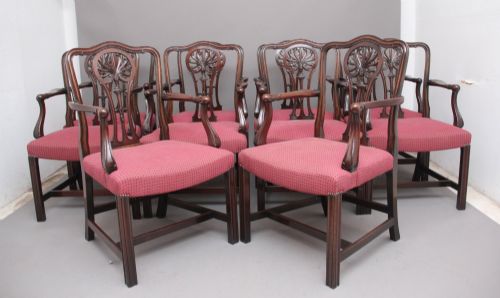
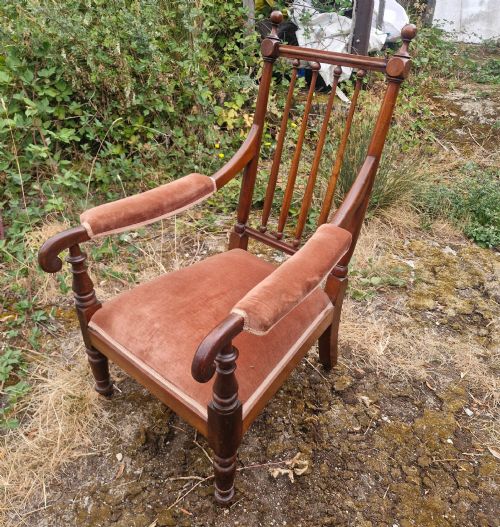
The versions you are most likely to meet on this page span from the Georgian and Regency periods through to Edwardian interpretations. Mahogany and walnut frames dominate, frequently paired with leather or textile upholstery.
Forms range from compact tub library armchairs to grand Gainsborough chairs and swivel variants. Whether finished with deep buttoning or simple tapestry fabric, each piece serves the dual purpose of workspace utility and formal seating.
How they were made
Makers constructed these chairs primarily using dense hardwoods such as mahogany, oak, and walnut, providing a rigid structural skeleton capable of enduring daily movement and weight. Joinery relied on traditional pinned mortise and tenon joints to secure the frame before any padding was applied.
Upholstery techniques involved layering natural stuffings like horsehair over webbing or canvas, secured directly to the wooden rails with tacks. Top coverings of leather or woven textile were then nailed or piped into place, often finished with decorative brass tacks.
Specialised movement mechanisms appeared on later variants, utilising brass spindles, swivel screws, or tilting actions fitted beneath the wooden seat base. Carved details, reeded legs, and marquetry inlays were executed by hand directly onto the structural wood before final assembly.
Materials recorded across current pieces include brass accents, leather upholstery, and woven textiles.
What varies in quality
The distinction between ordinary and exceptional examples lies in the integrity of the timber selection and the crispness of the hand-carved details. Superior pieces display finely figured mahogany or walnut grain that follows the structural curves without compromise.
Proportion and stance dictate the visual success of the chair, with better examples maintaining balanced arm heights and supportive rake to the backrest. The execution of internal joinery and the resilience of the original frame dictate longevity far more than surface embellishment.
Upholstery finish, whether through precise leather tooling or neatly tensioned textile work, reflects the standard of the workshop responsible. Maker attribution, visible through stamps or distinctive structural signatures, elevates the standing of an individual piece within its period.
Alfred Allen of Birmingham·C. Hindley and Sons·Gillows
The Upholstered Desk Armchair Glossary
- Gainsborough chair
- A wide, open-armed armchair with a padded seat and back, originating in the mid-18th century. This form is typically associated with library and writing desk use.
- Tub armchair
- A comfortable seat featuring a continuous curved back and arms that form a single enclosed shell. These often appear in leather or fabric upholstery for study spaces.
- Reeded
- A decorative moulding consisting of parallel convex strips resembling inverted fluting. This technique frequently appears on the legs of Regency and Georgian desk chairs.
- Bergère
- An enclosed armchair with stuffed upholstery and exposed wooden framing, often incorporating cane panels to the sides or back. It provides a lighter appearance while retaining comfort.
- Marquetry
- The art of applying decorative veneer pieces in geometric or floral patterns onto a structural wood base. Edwardian and Georgian writing chairs sometimes utilise this on the splat or crest rail.
Upholstered Desk Armchair: Frequently Asked Questions
How do I date a desk armchair?
Dating relies on identifying the prevailing timber, carving styles, and structural joinery characteristic of periods like the Georgian era or Victorian times. Secondary woods and tool marks hidden beneath the seat often provide definitive clues.
Changes in upholstery methods, from early horsehair stuffing to later metal springs, also help narrow down the decade of manufacture. Comparing the turning of the legs against known design books offers further chronological certainty.
Were these chairs used only for writing?
While engineered for use at a desk or bureau, their comfort made them equally suitable for reading in libraries or relaxing in drawing rooms. The inclusion of reading stands or swivel mechanisms on specific models shows they served multi-purpose study roles.
Wealthy households deployed them wherever sedentary tasks required sustained back support and upholstered ease. Their generous proportions distinguished them from standard dining or side seating.
What is the difference between a Gainsborough and a library chair?
A Gainsborough chair specifically denotes a mid-18th-century open armchair with upholstered arms, a square padded back, and short moulded legs. The term library chair covers a broader category of heavier, often leather-bound seating designed for institutional or domestic study rooms.
Library variants frequently incorporate reading desks, swivel functions, or enclosing tub backs for additional draft exclusion. Both types utilise dense hardwood frames but serve slightly different architectural functions within a room.
How should I care for antique leather upholstery?
Historic leather requires gentle cleaning using specialised saddle soaps or damp cloths to remove dust without stripping natural moisture. Periodic application of conservation-grade leather balms prevents cracking and maintains flexibility in the hide.
Keeping the chair away from direct sunlight and strong heat sources protects both the leather and the underlying wooden frame from warping. Regular, careful dusting ensures abrasive particles do not settle into the grain or crevices.