
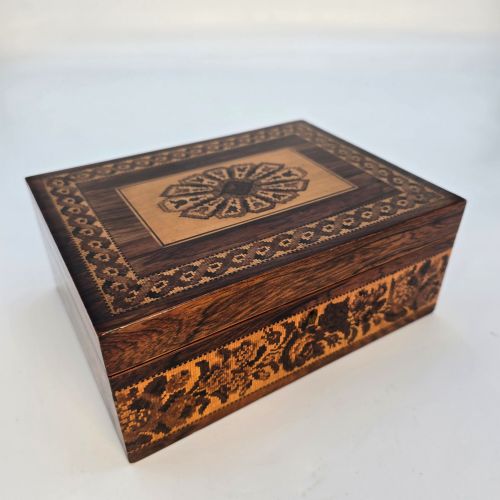


Tunbridge Ware Mosaic
Tunbridge ware mosaic pieces are intricate wooden boxes, plaques and desk accessories built from thousands of tiny tinted tesserae, prized for their elaborate pictorial and geometric inlay.
Tunbridge Ware Mosaic
Tunbridge ware mosaic comprises functional and decorative items such as tea caddies, jewellery boxes, book-slides, stationery boxes, baskets and wall plaques. These pieces date predominantly from the nineteenth century, including the Regency and Victorian periods.
You are most likely to encounter rosewood or walnut boxes and book-slides decorated with complex geometric or pictorial wood inlay panels. The forms range from small trinket boxes and travelling inkwells to fitted sewing boxes and work tables.
How they were made
Craftsmen utilised woods of various natural colours, including boxwood, holly, sycamore, rosewood and walnut, to achieve contrasting tones without the use of artificial stains. Many hundreds or thousands of minute wood rods were glued together in precise geometric patterns, then sliced across to produce identical mosaic tile sheets.
These mosaic tile sheets and micro-mosaic panels depicting castles or butterflies were subsequently applied to the exterior surfaces of carcases made from timbers such as rosewood and walnut, often complemented by brass fittings.
Puzzle boxes challenged nineteenth-century owners to discover concealed sliding mechanisms before they could access the compartments within.
What varies in quality
The standard of a piece depends heavily on the fineness of the mosaic tesserae and the complexity of the pictorial or geometric design. Pieces featuring detailed micro-mosaic architecture, such as Hever Castle or Eridge Castle, or intricate butterfly motifs, represent a higher tier of workmanship than simpler geometric banding.
Overall preservation of the wooden surface, the crispness of the mosaic pattern, and the inclusion of original fitted interiors such as compartments or writing slopes further distinguish superior examples.
Edmund Nye·Henry Hollamby
The Tunbridge Ware Mosaic Glossary
- Mosaic
- A pattern or image made of small regular pieces of coloured wood. In these items, the technique relies on bundled rods sliced thinly to create repeating pictorial or geometric tile sheets.
- Micro-mosaic
- A highly detailed miniature picture constructed from microscopic wooden tesserae. These panels frequently depict historic buildings or local landmarks such as Hever Castle.
- Tesserae
- The individual small blocks or tiles of coloured wood used to build up the mosaic patterns. Craftsmen arranged them tightly together before slicing the glued bundles.
- Marquetry
- Decorative woodwork in which pieces of veneer are applied to a base structure to form designs. This technique frames the geometric mosaic panels on box lids and panels.
Tunbridge Ware Mosaic: Frequently Asked Questions
How do I clean a Tunbridge ware box?
Dust the exterior gently with a dry, soft cloth to prevent moisture damage to the delicate mosaic tiles and wood veneers.
Avoid liquid cleaners, polishes, or excessive rubbing, which can loosen the microscopic tesserae or degrade the nineteenth-century finish.
What were tea caddies used for?
Tea caddies stored expensive loose tea leaves safely under lock and key in nineteenth-century drawing rooms.
Their fitted interior compartments kept different tea varieties separate and protected from humidity.
How can I tell a Victorian piece from a Regency one?
Regency items often display lighter carcases and specific neoclassical design motifs reflecting the early nineteenth-century aesthetic.
Victorian pieces from the 1850s onward frequently incorporate darker rosewood or walnut foundations alongside increasingly complex pictorial micro-mosaics.
Where were these items made?
These decorative objects were produced in Tunbridge Wells, Kent, during the nineteenth century, building upon earlier local woodworking traditions.
Specialist workshops developed intricate mosaic techniques that utilised the natural colours of British and exotic woods.