



Traditional Dark Wood Desk
A traditional dark wood desk anchors a room with steady gravitas, offering rich mahogany and oak surfaces built for writing and paperwork.
Traditional Dark Wood Desk
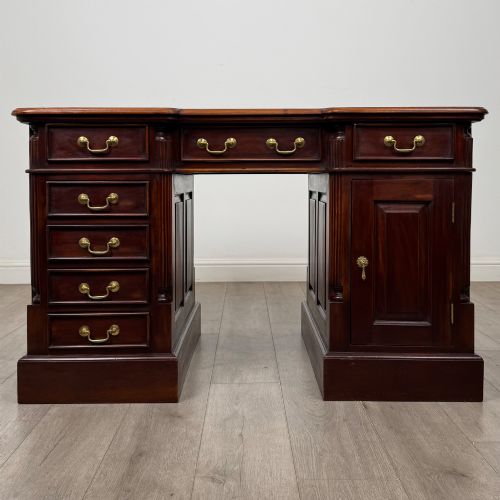
A traditional dark wood desk represents a heavy timber workspace designed for daily use, appearing in forms such as kneehole desks, pedestal desks, and bureaus. These pieces emerge predominantly from periods spanning the Georgian era through the Victorian period and into the Edwardian years.
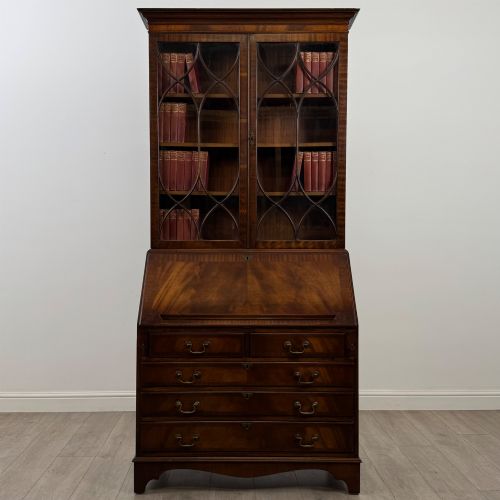
The versions most likely to meet a buyer on this page are mahogany kneehole and pedestal desks featuring fitted writing surfaces, alongside oak bureau variations. Makers constructed these furniture items to serve domestic studies and offices, utilising robust hardwoods.
Makers shaped these utilitarian writing stations with structural integrity, often incorporating subsidiary compartments or drawers for storage. The surviving examples reflect decades of functional service within traditional interiors.
What varies in quality
The grade of timber selection and the depth of carving define the upper tiers of these desks, where finer grain patterns in the mahogany or oak distinguish superior examples. Subtleties in proportion and the retention of original brass handles separate workshop-standard pieces from finer commissions.
Construction fidelity within the drawer linings and the neatness of dovetail joints mark the difference between standard utility items and high-end cabinet work. The preservation of the original leather writing insert and finish also elevates the standing of a desk.
The listings show desks and writing furniture constructed from mahogany, oak, and elm across the Georgian, Victorian, and Edwardian periods.
Trollope & sons·Gillows·Alfred Allen of Birmingham
The Traditional Dark Wood Desk Glossary
- Kneehole desk
- A freestanding desk featuring a central recess for the legs, flanked by pedestals of small drawers.
- Pedestal desk
- A heavy writing table supported by two vertical columns of drawers on either side.
- Bureau
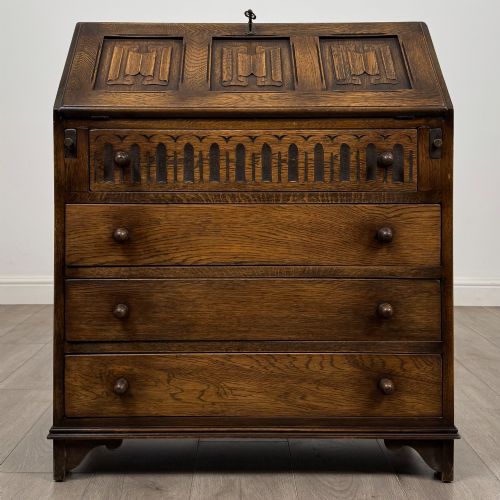
- A desk featuring a sloping fall-front lid that opens to reveal a fitted interior of small drawers and pigeonholes.
- Mahogany
- A durable, reddish-brown tropical hardwood favoured by cabinetmakers for its fine grain and stability.
- Escutcheon
- A protective brass plate surrounding a keyhole, designed to prevent wear on the surrounding wood.
Traditional Dark Wood Desk: Frequently Asked Questions
What is a traditional dark wood desk?
A traditional dark wood desk is a heavy timber writing table or bureau, typically fashioned from mahogany or oak during the Georgian, Victorian, or Edwardian eras. These pieces provide a dedicated workspace featuring built-in drawers and compartments.
They serve as functional furniture and focal points in studies or libraries, designed to withstand daily clerical tasks.
How do I care for a leather desk top?
Leather desk inserts require gentle cleaning with a slightly damp cloth, avoiding harsh chemical solvents that strip the original dye and finish. Periodic application of specialist leather balms helps prevent the surface from drying and cracking.
Keeping the leather away from direct sunlight preserves its colour and suppleness over decades of use.
How do I identify a Victorian pedestal desk?
Victorian pedestal desks generally comprise two stacks of drawers supporting a wide top, frequently finished with an inset leather writing surface and original brass pulls. They display the heavier proportions and darker finishes characteristic of nineteenth-century cabinetmaking.
Examining the drawer construction reveals hand-cut dovetails typical of the period before mass-produced joinery became standard.
Where should I place a partner's desk?
Partner's desks are designed to sit freestanding in the centre of a room rather than against a wall, as they feature drawers and cupboards on both sides. This layout allows two people to work opposite one another.
Positioning the desk with adequate clearance around all sides highlights its symmetrical form and finished rear panels.