

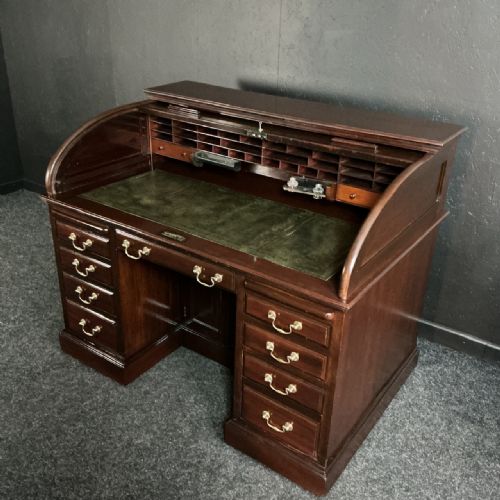


Vintage Rolltop Writing Desk
A vintage rolltop writing desk brings practical workspace and shuttered privacy into a room, combining architectural timberwork with internal pigeonholes.
Vintage Rolltop Writing Desk
A vintage rolltop writing desk is a form of workspace designed to conceal paperwork beneath a slatted timber tambour shutter or a rigid cylinder lid. These pieces appear primarily in Edwardian and Victorian forms, alongside occasional Georgian and 19th-century continental interpretations.
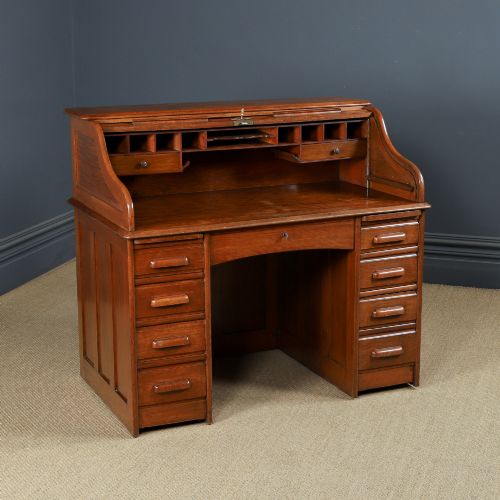
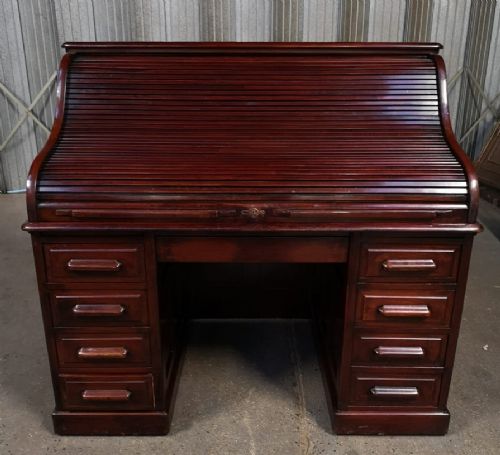
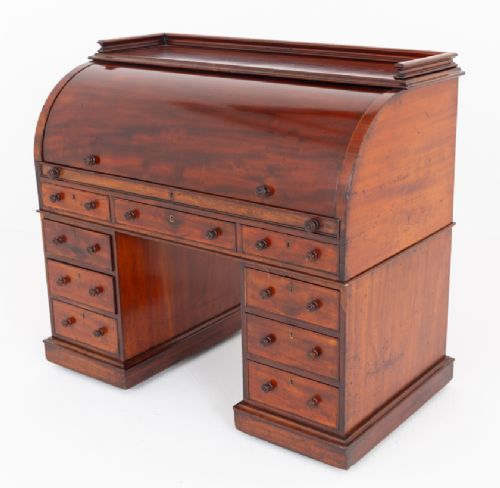
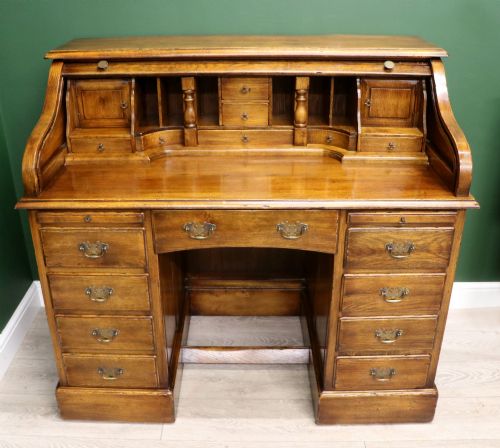
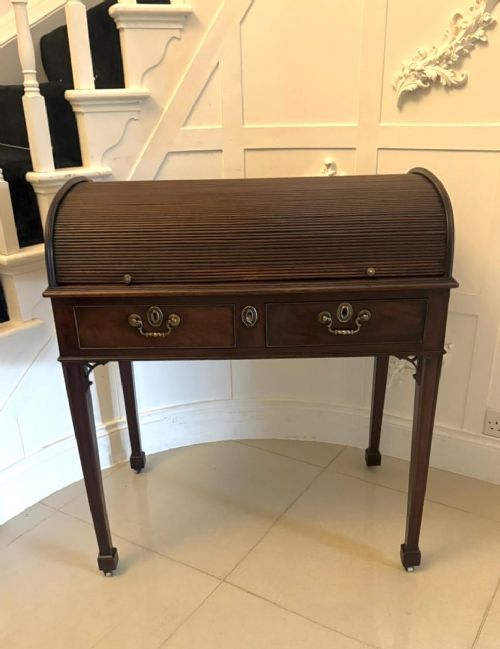
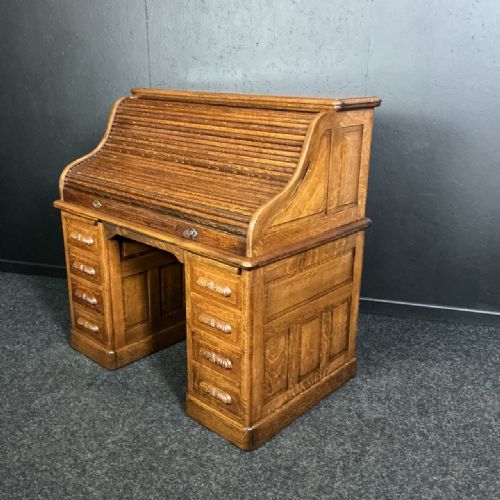
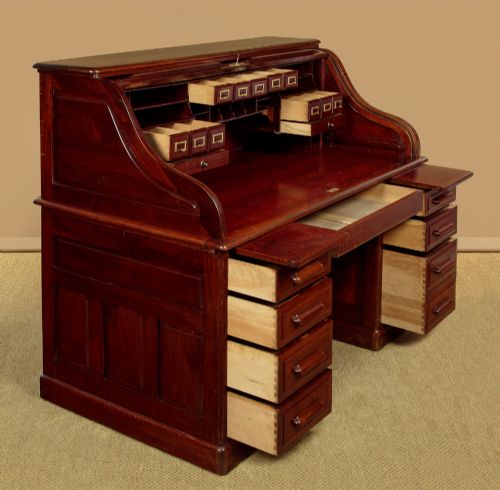
The most common examples on this page are substantial oak and mahogany pedestal desks featuring slatted rolltops that draw down to secure the writing surface. Alongside these office formats, buyers encounter lighter cylinder desks and taller bureau bookcase combinations equipped with interior shelving and pigeonholes.
Construction and materials
Makers built these desks using solid timbers and veneers of oak and mahogany, often enhanced with walnut, satinwood, and brass hardware. Leather panels frequently insert into the pull-out writing slides to provide a durable surface for daily correspondence.
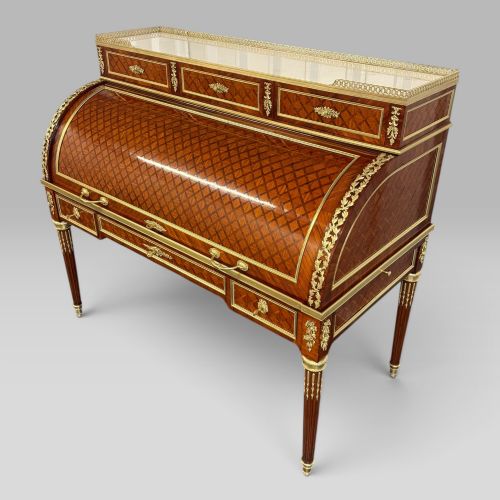
The defining mechanical feature is the tambour or cylinder action, constructed from narrow vertical strips of wood glued to a flexible canvas backing that runs smoothly within curved side grooves. Decorative surface work relies on marquetry inlays, parquetry geometric patterns, and ormolu mounts on revival pieces.
Listings demonstrate a strong preference for oak and mahogany, supplemented by walnut, satinwood, and brass mounts across Victorian and Edwardian periods.
Distinctions in grade and execution
Quality rests heavily on the integrity of the timber selection and the precision of the tambour mechanism. A superior desk operates with a smooth, silent glide along the track, whereas lesser examples suffer from binding slats or warped framing due to humidity changes.
Cabinetwork detail distinguishes standard commercial items from finer pieces. Finely finished interiors with secret compartments, pigeonhole banks, and crisp marquetry inlay demonstrate the hand of a more accomplished workshop.
Maples of London and Paris
The Vintage Rolltop Writing Desk Glossary
- Tambour
- A flexible shutter made from narrow strips of wood glued to canvas, allowing a desk top to curve around a track and lock away the workspace. This ingenious mechanism replaced rigid lids in the 19th century.
- Cylinder desk
- A piece featuring a quarter-circle solid wooden lid that rotates backward into the body of the desk rather than rolling on flexible slats. These often house a pull-out writing slide.
- Pedestal desk
- A heavy table form supported by two banks of small drawers flanking a central kneehole. These frequently incorporate the rolltop enclosure above the main writing surface.
- Marquetry
- Decorative veneer work forming pictorial or geometric designs using various coloured woods. It appears frequently on Sheraton Revival pieces.
- Ormolu
- Gilt-bronze mounts applied to furniture edges and corners, seen predominantly on French-influenced revival desks.
Vintage Rolltop Writing Desk: Frequently Asked Questions
How does a tambour mechanism work?
The tambour consists of narrow strips of wood glued side by side onto a canvas or linen backing. This allows the wooden mat to bend smoothly along curved tracks cut into the sides of the desk.
When pushed upward or pulled down, the slats follow the groove to open or secure the workspace without requiring clearance above the furniture.
What is the difference between a cylinder desk and a rolltop?
A cylinder desk uses a solid, curved piece of wood that rotates on a pivot or slides along a curved track into the body of the desk. A rolltop uses individual slats attached to flexible fabric.
Cylinder desks generally originate from earlier Georgian and 19th-century French revival periods, while slat-backed rolltops became the standard for heavy office use by the Edwardian era.
Are these desks suitable for modern home offices?
Many of these pieces function well for contemporary work, offering ample surface area and extensive internal compartments for modern stationery. The pull-out writing slides provide extra depth when needed.
Buyers should measure kneehole clearances and overall dimensions carefully, as many Edwardian and Victorian pedestal formats were built for smaller historical chairs.
How do I identify a Sheraton Revival piece?
Sheraton Revival furniture draws inspiration from late 18th-century classical designs, featuring delicate proportions and lighter woods like satinwood and mahogany. Look for characteristic details such as contrasting stringing and floral marquetry inlays.
These pieces typically date from the late Victorian or Edwardian periods rather than the original Georgian era.