
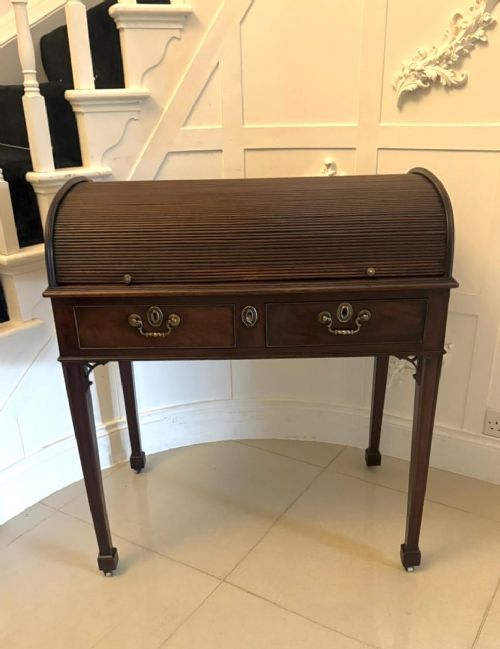
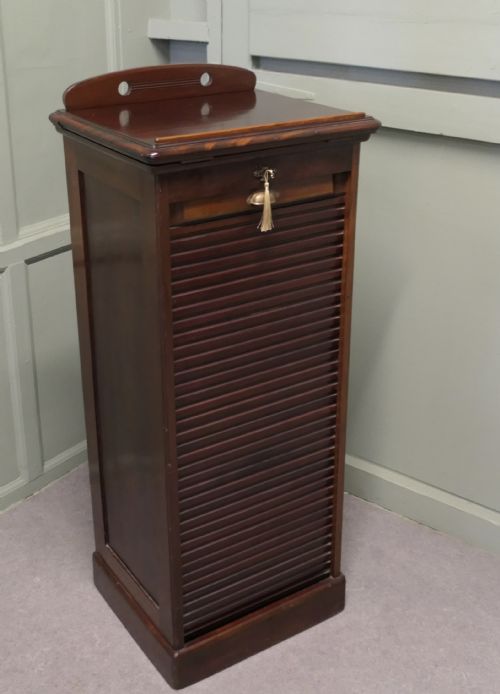


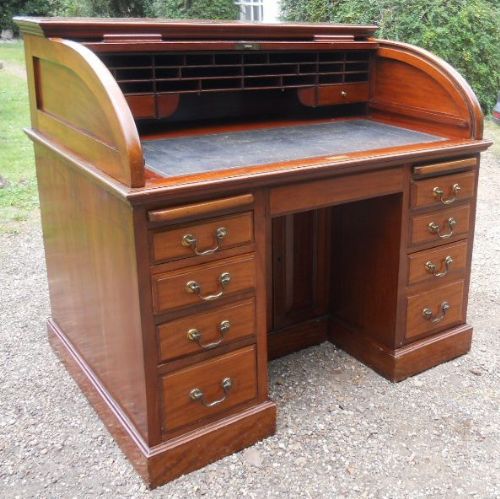
Dark Wood Tambour Desk
A dark wood tambour desk is a practical writing station with a slatted sliding top that conceals compartments, offering both workspace organisation and timeless character.
Dark Wood Tambour Desk
When you search for a dark wood tambour desk, you find items built to manage correspondence and paperwork through sliding slatted covers. These pieces appear across several periods, including the Georgian era, the Victorian era, and the Edwardian period.
The versions you are most likely to meet on this page are constructed from mahogany or oak, often taking the form of large pedestal desks, smaller writing desks, or compact office cabinets. Some examples include pull-out writing slides or internal storage boxes designed for specific clerical tasks.
Origins span the nineteenth and early twentieth centuries, reflecting changing workplace needs from grand reception spaces to home offices. The defining characteristic across these forms remains the flexible slatted tambour top that rolls back to reveal pigeonholes and small drawers.
How they were made
Makers utilised solid timbers and veneers such as mahogany, oak, and partridgewood, selecting dense woods capable of withstanding daily clerical use. These primary woods formed the structural carcase, the desktop surfaces, and the individual slats of the rolling covers.
Secondary details frequently incorporate brass hardware for handles and escutcheons, alongside inset leather writing surfaces. The tambour mechanism itself required precise woodworking, joining small horizontal slats of wood onto a flexible fabric or leather backing so the top could curve smoothly along hidden tracks.
Listings feature pieces spanning the Georgian, Victorian, and Edwardian periods, constructed in mahogany, oak, and partridgewood.
What varies in quality
The distinction between standard utility furniture and finer pieces lies in the selection of timber figures and the precision of the joinery. Superior examples display carefully matched mahogany or partridgewood grains across the exterior panels and drawer fronts.
The smoothness of the sliding tambour action indicates the standard of original construction, as well as how well the piece has survived decades of use. Well-made desks operate the slatted track without sticking, while lesser versions suffer from warping or stiffness in the mechanism.
The Dark Wood Tambour Desk Glossary
- Tambour
- A flexible shutter made of narrow wooden slats glued to canvas or leather, allowing the top to slide open along a curved track.
- Pedestal desk
- A heavy freestanding writing table supported by two vertical banks of drawers or filing compartments.
- Partridgewood
- A dense decorative timber with a mottled grain pattern, utilised on select high-status furniture pieces.
- Pull-out writing slide
- A secondary shelf that extends from beneath the main desktop to provide extra surface area for correspondence.
Dark Wood Tambour Desk: Frequently Asked Questions
What is a tambour desk?
A tambour desk is a form of writing furniture featuring a slatted sliding cover that rolls back to conceal the pigeonholes and small drawers of the upper section. This mechanism protects the contents while offering a compact footprint.
Such desks were developed to manage correspondence and paperwork efficiently in both home and commercial office settings during the nineteenth and early twentieth centuries.
How do I date a tambour desk?
Dating relies on identifying the prevailing stylistic traits, timber choices, and construction methods associated with periods like the Georgian era, the Victorian era, or the Edwardian period. Georgian and Sheraton examples often display finer mahogany veneers and delicate proportions.
Later Victorian and Edwardian iterations tend to be larger pedestal forms built in oak or heavier mahogany, reflecting the growing demand for commercial office furniture.
How were tambour desks used?
These desks served as secure workstations for writing letters, sorting correspondence, and filing important documents. The sliding tambour shutter allowed users to lock away their papers at the end of the working day without clearing the desktop.
They were placed in libraries, reception rooms, and private studies where managing paperwork required numerous small compartments close at hand.
How do I care for a dark wood surface?
Maintaining dark wood involves dusting regularly with a soft cloth and occasionally applying appropriate beeswax to nourish the timber finish. Keeping the furniture away from direct heat sources prevents the wood and the tambour tracks from warping.
Leather writing inserts benefit from gentle cleaning and minimal moisture to preserve their texture over years of daily use.