


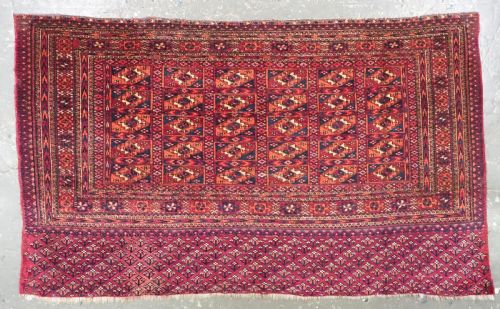
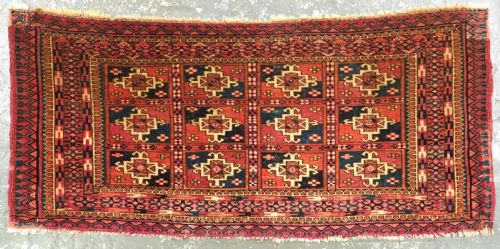


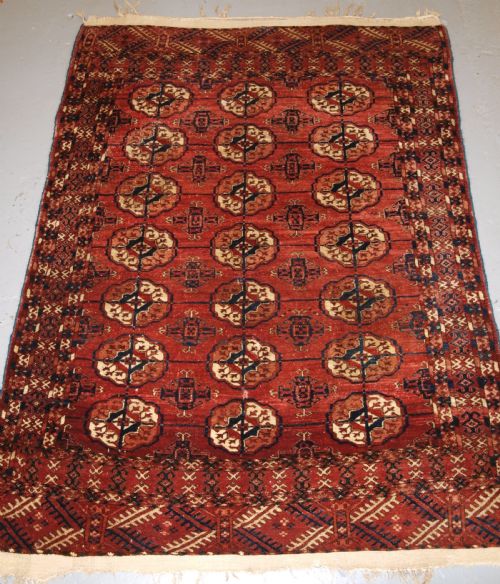
Tekke Turkmen Small Rug
When you seek a tekke turkmen small rug, you enter a world of finely knotted tribal textiles created by Central Asian nomads.
Tekke Turkmen Small Rug
A tekke turkmen small rug encompasses various tribal textile forms, including utility bags, torbas, mafrashes, and small floor coverings woven by nomadic weavers.
The pieces on this page originate primarily from the late nineteenth century and the early twentieth century, spanning decades of traditional tribal production.
Many examples are identified specifically as dowry or wedding pieces, reflecting their original cultural purpose within the tribe.
How They Were Made
Weavers utilised natural dyes to achieve deep crimson, red, and brown tones, often working with very soft wool that yields a velvety handle.
Construction relies on fine knotting techniques, resulting in dense structures that define the precise geometric layouts of the textiles.
Some nineteenth-century weavers included rows of small animals padding quietly across the field beneath the geometric guls.
What Varies in Quality
Knot density and handling define the upper tiers of production, where extremely fine weaves and soft, pliable wool demonstrate high technical skill.
Depth and clarity of natural dye colours separate ordinary examples from those possessing rich, luminous red and brown shades.
The Tekke Turkmen Small Rug Glossary
- Gul
- The primary octagonal medallion motif repeated across tribal carpets and torbas. It serves as the defining structural and visual element of the design.
- Torba
- A small horizontal storage bag traditionally used inside nomadic tents. These pieces feature dense pile work and specific tribal guls.
- Chuval
- A large tent bag used for household storage by nomadic families. They display orderly rows of major guls across the face.
- Mafrash
- A rectangular storage container or face utilised for bedding and possessions. They often incorporate panel or tree designs.
- Dip khali
- A term describing rugs with a deep crimson or red ground colour. These examples display saturated natural dye work.
Tekke Turkmen Small Rug: Frequently Asked Questions
What is a tekke turkmen small rug?
These pieces are hand-knotted tribal textiles made by Turkmen nomads in Central Asia. They include small floor rugs, dowry pieces, and utility bags.
Historically woven for domestic use and ceremonial purposes, they are recognised by their orderly geometric layouts and distinct red colour palettes.
How were these rugs used?
Nomadic families utilised these textiles primarily inside tents for floor coverings, bedding storage, and household organisation. Many smaller formats and torbas served practical storage functions.
Dowry and wedding rugs held significant cultural value during matrimonial ceremonies, representing the weaving skill of the bride's family.
How do I date a rug?
Dating relies on assessing the wool quality, natural dye saturation, and structural fineness of the weave. Nineteenth-century examples often exhibit softer wool and complex natural dye variations.
Comparing structural details and repeating gul motifs against documented tribal pieces helps narrow down the period of production.
How should I live with one?
These small textiles suit placement in low-traffic areas, on walls, or as small accent pieces on wooden floors. Gentle placement preserves the pile and structural integrity.
Regular light rotation and protection from direct sunlight help maintain the natural dyes and soft wool over time.