



Tekke Bokhara Rug
A tekke bokhara rug brings deep red tones and disciplined tribal patterns into a room, originating from Central Asian weavers.
Tekke Bokhara Rug
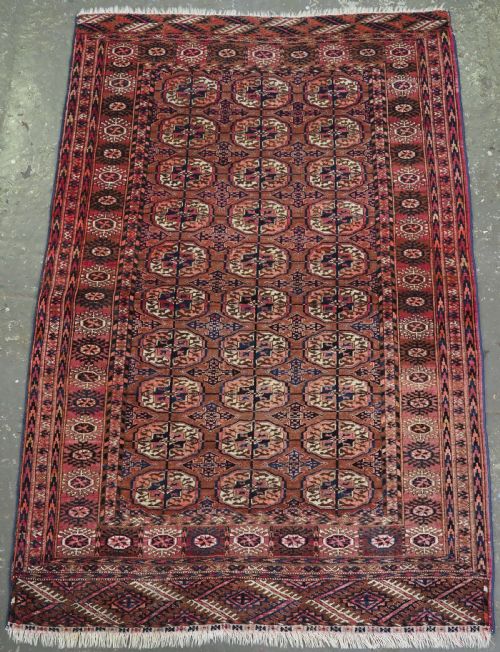
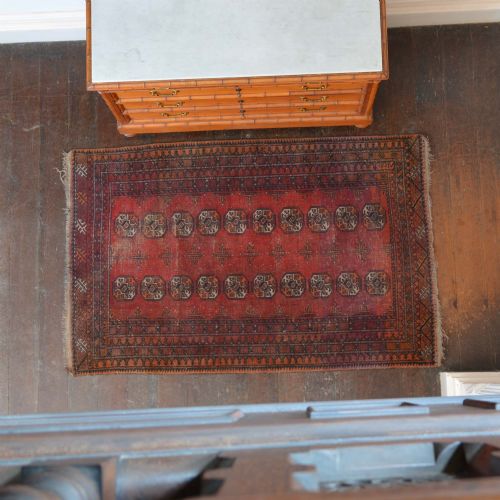
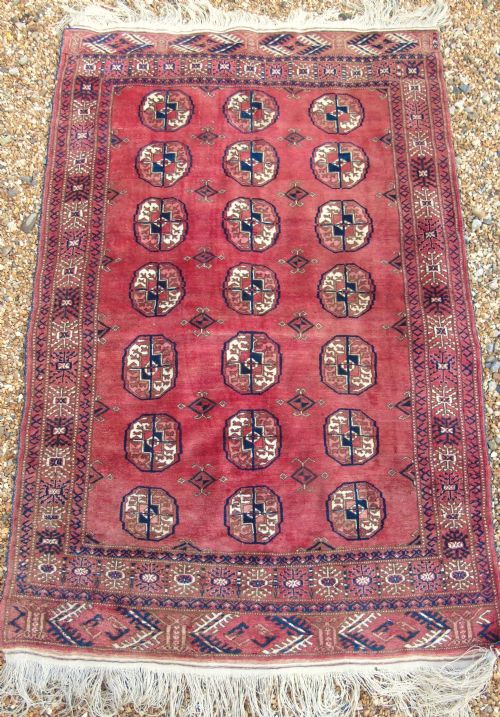
The tekke bokhara rug sits firmly within the Central Asian tribal tradition, most commonly appearing as main carpets, smaller dowry pieces or wedding rugs dating from the nineteenth and early twentieth centuries. These woven works display structured layouts dominated by repeating octagonal motifs known as guls, often produced by nomadic or village makers across the region.
Buyers encounter examples ranging from compact square formats and torba fragments to full-scale carpets woven with dense wool piles. The aesthetic centres on a rich palette of burgundy, red and gold, occasionally relieved by silk highlights or unusual borders that mark out specific tribal subgroups.
Materials and construction methods
Weavers built these textiles primarily from wool, utilising cotton for foundations and incorporating silk highlights in certain finer dowry pieces. The yarn was handspun and dyed using traditional methods to achieve the characteristic soft colour variations and deep cochineal accents seen across the pile.
Construction relies on precise hand knotting executed with a very fine weave, which allowed makers to render intricate geometric guls and complex border systems with distinct clarity. The resulting structure provides a durable, heavy-duty fabric designed to withstand generations of daily use.
The listings span from the mid-nineteenth century through to the 1930s, featuring wool, cotton and silk materials in tribal formats.
Distinctions in quality and execution
Quality reveals itself primarily in the density of the knotting and the precision of the geometric drawing across the field. Finer examples display exceptionally tight weaves and crisp outlines within the guls, whereas standard commercial pieces show a more relaxed handling of the motifs.
The choice and handling of dyestuffs further separate exceptional examples from ordinary production, with superior pieces exhibiting subtle tonal variations and glowing highlights. Condition and pile retention also dictate standing, though well-preserved surfaces with original finishes command the strongest attention.
The Tekke Bokhara Rug Glossary
- Gul
- The primary octagonal medallion motif repeated across Central Asian carpets. It serves as the defining structural and tribal identifier for these nomadic textiles.
- Torba
- A small storage bag face produced by Turkmen tribes. These pieces typically feature compressed horizontal rows of guls.
- Dip khali
- A term used to describe specific formats of Central Asian rugs. It relates to traditional village and nomadic weaving classifications.
- Cochineal
- A natural dye source yielding rich crimson and pinkish-red tones. It frequently appears as a highlight colour in nineteenth-century dowry pieces.
- Dowry rug
- A smaller textile woven specifically for a bride's trousseau. These examples often incorporate finer knotting and silk elements.
Tekke Bokhara Rug: Frequently Asked Questions
How do I style a tekke bokhara rug?
The deep red and burgundy tones work naturally alongside traditional wooden furniture and classic interior schemes. Their strong geometric patterns also anchor minimalist modern spaces when used as focal floor coverings.
Smaller formats suit hallways or study spaces as runners or hearth rugs, while larger main carpets define primary seating areas in living rooms.
What is a gul design?
A gul is the repeating octagonal medallion that forms the backbone of Turkmen carpet design. Each tribal group utilised distinct variations of these motifs to signal identity and heritage.
In tekke weaving, these guls appear in orderly rows across the field, often paired with minor secondary guls to create a balanced composition.
How are these rugs dated?
Dating relies on assessing the wool quality, dye characteristics, structural fineness and overall wear patterns against known historical benchmarks from the nineteenth and early twentieth centuries. Earlier pieces from the mid-nineteenth century generally display softer wool and more complex natural dye variations.
Later examples from the twentieth century often shift toward heavier utility and standardised commercial production for export markets.